Lessons from Vietnam: Culture, Craft and Footwear's Place in Sustainable and Regenerative Fashion Research
Episode 7 Overview:
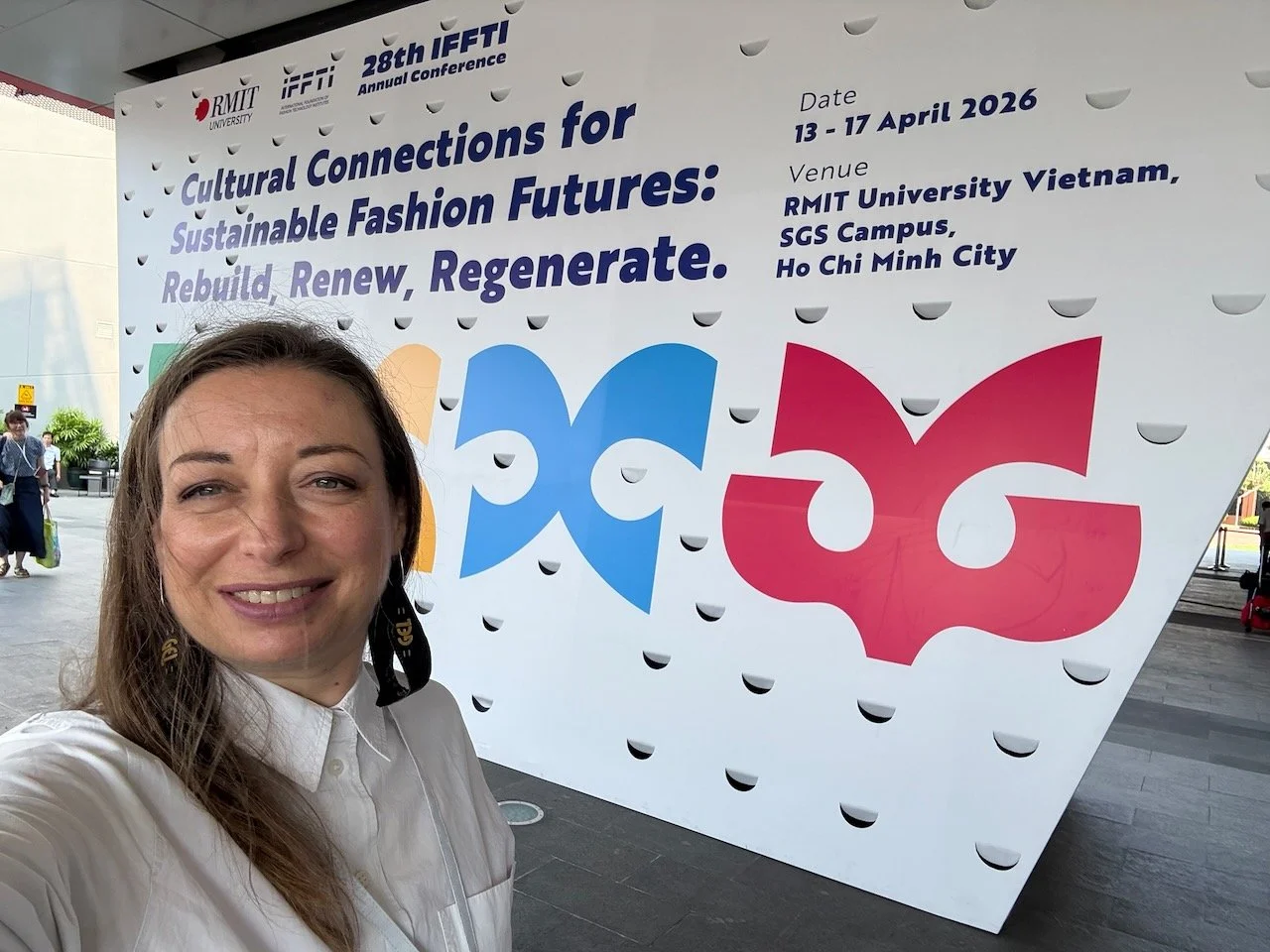
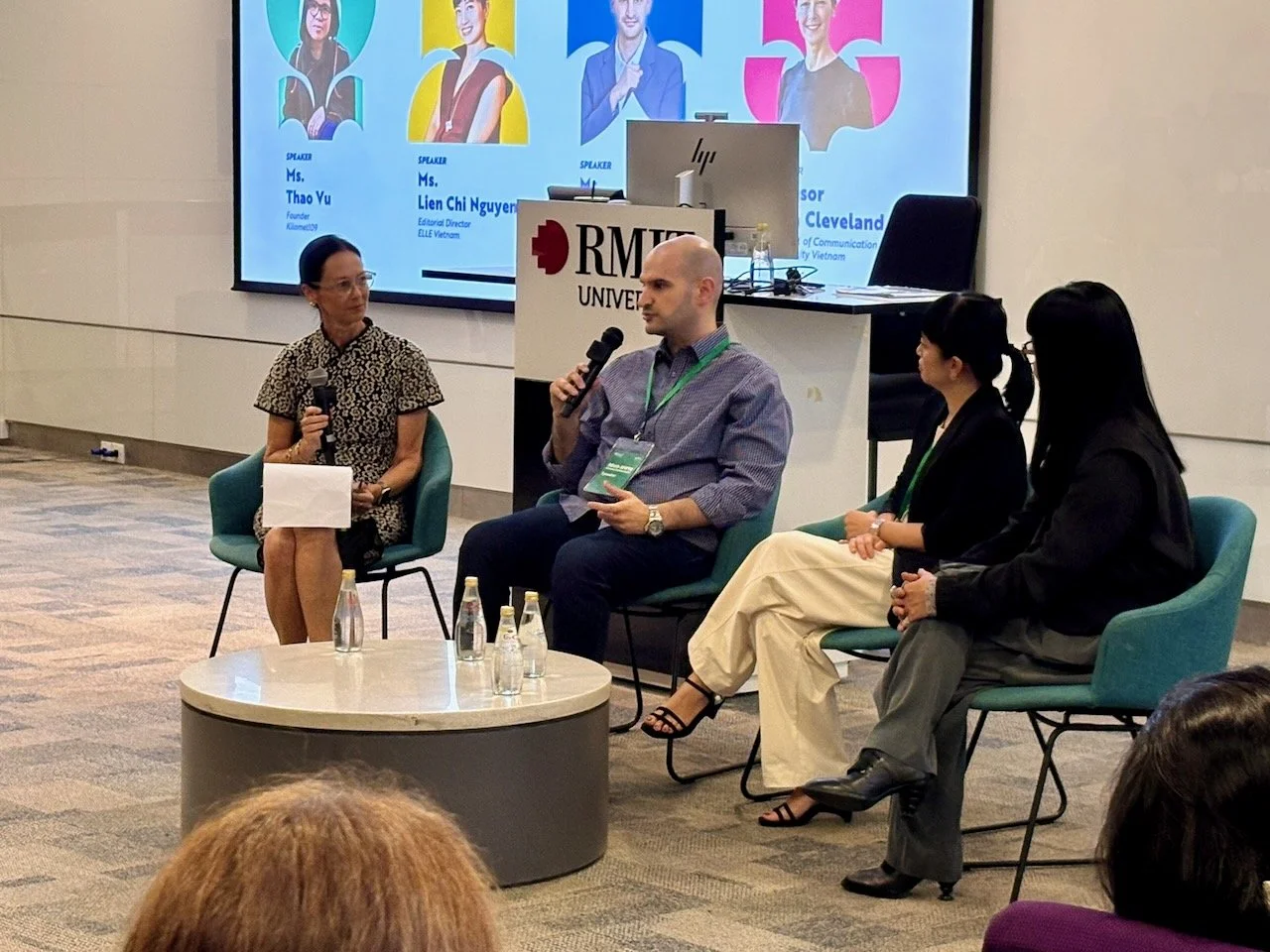
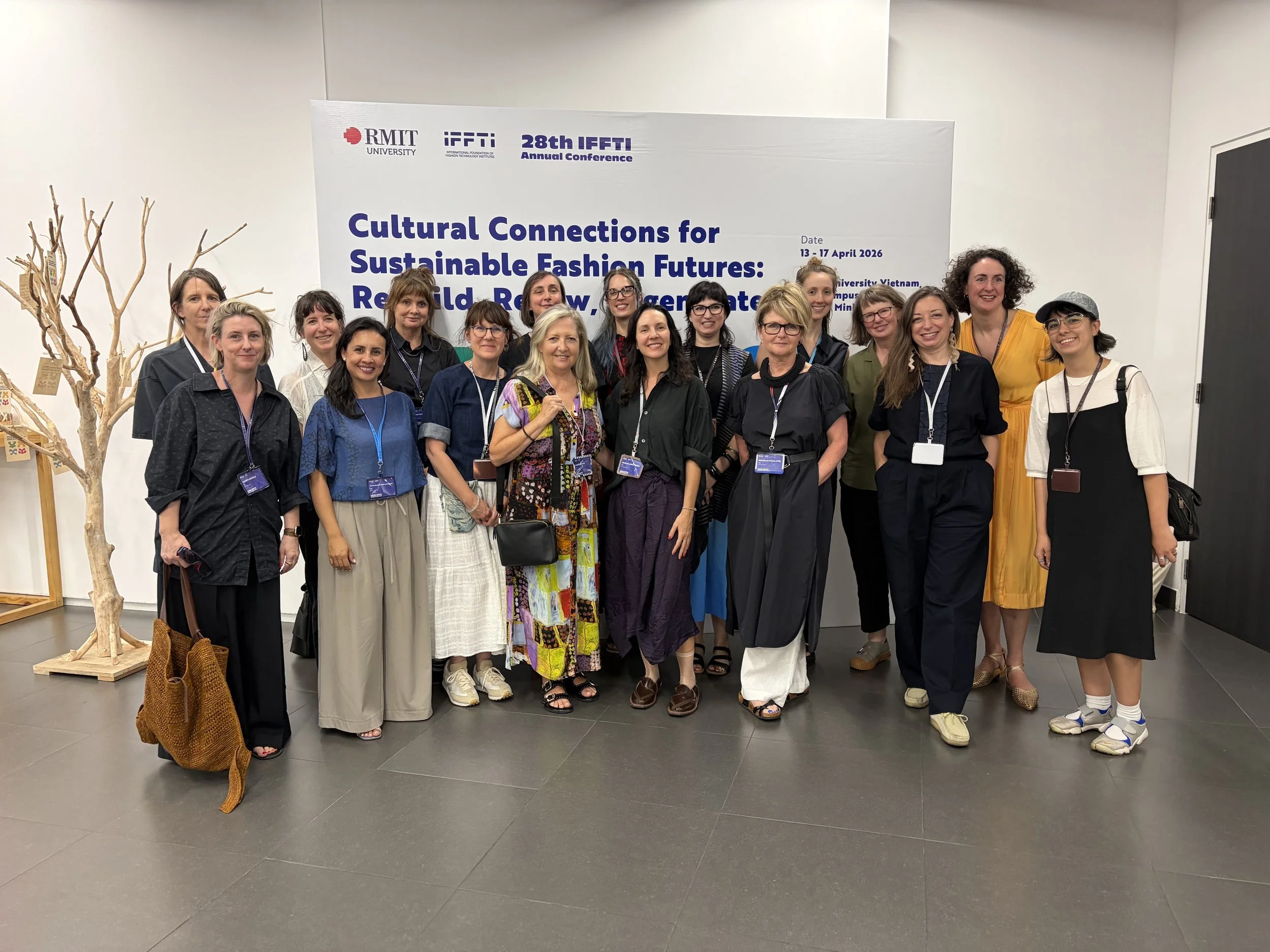
In this episode, Dr Alexandra Sherlock debriefs Dr Emily Brayshaw on her recent attendance at the 28th Annual IFFTI (International Foundation of Fashion Technology Institutes) Conference, hosted by RMIT University's Vietnam Campus in Ho Chi Minh City. The conference theme, ‘Cultural Connections for Sustainable Fashion Futures: Rebuild, Renew and Regenerate’, drew Alex to Vietnam with a clear purpose: to put footwear on the radar of fashion sustainability researchers, and to ask what the field's most progressive thinking means for an industry that has long been left out of the conversation. Alex shares insights from key conference papers, translates their themes for a footwear audience, reflects on a visit to Vietnamese footwear factory, and makes the case for culture as the essential foundation of any genuinely sustainable fashion future.
Credits:
Presenters: Dr Alexandra Sherlock and Dr Emily Brayshaw
Edited and produced by: Dr Alexandra Sherlock
Photographs and images: Credits in captions
Chapters:
[00:00] Show Intro
[00:47] Acknowledgements and Corrections
[05:22] Vietnam and IFFTI: Cultural Connections for Sustainable Fashion Futures - Rebuild, Renew and Regenerate
[08:23] Footwear: The Blind Spot in Fashion Research
[14:41] School Uniforms and Permaculture
[20:31] School Uniforms, Government Funding and Repair Economies
[25:55] Inside a Vietnamese Shoe Factory
[31:12] Digital Product Passports, Blockchain and Storytelling
[36:43] Taming, Rewilding and the Capitalist Co-option Problem
[40:30] Boro, Kintsugi and the Repair as Ritual
[51:13] Waste Not Want Not
[56:01] The Evolving Role of Higher Education
[59:13] Culture as the Fourth Pillar of Sustainability
Links:
Organisations & Institutions
IFFTI (International Foundation of Fashion Technology Institutes): https://site.iffti.org
RMIT University Vietnam: https://www.rmit.edu.vn
RMIT School of Fashion and Textiles: https://www.rmit.edu.au/about/schools-colleges/fashion-and-textiles
RMIT Sustainable Technologies and Systems Enabling Impact Platform:https://www.rmit.edu.au/research/our-research/enabling-impact-platforms/sustainable-technologies-systems
Footwear Research Network: https://footwearresearchnetwork.org
Fashion Institute of Technology (FIT), New York:https://www.fitnyc.edu
ReTuna - Sweden's secondhand shopping mall:https://en.wikipedia.org/wiki/ReTuna
People and papers mentioned in the episode
Laticha Brown, Assistant Professor at Fashion Institute of Technology. ‘Re-threading the Roots, Reconnecting and Relocating Fashion Through Black Cultural Practices.’ https://www.linkedin.com/in/laticha-brown-8594b66/
Giovanna Casimiro, Professor at the Institut Francais de La Mode. ‘Binary Fabrics and Digital Product Passport: Rethinking Connected Clothes Through Connected Fabrics’ (Link to IFFTI presentation debrief)
Dr Kyunghee Pyun, Associate Professor of Art History, FIT New York:https://www.fitnyc.edu/creative-nexus/faculty/directory/pyun-kyunghee.php
Mary-Ann Ball, Senior Lecturer in Fashion Sustainability and Marketing, Nottingham Trent Universityhttps://www.linkedin.com/in/mary-ann-ball-15111559/
Nirbhay Rana - Associate Professor IILM University Gurugram. ‘Reclaiming the Curriculum: Regenerative Fashion Education Through Indigenous Knowledge and Community Praxis’ https://www.linkedin.com/in/rananirbhay/
Ijeoma Onwumere, Manchester Metropolitan University ‘Blockchain in Luxury Fashion: An Empirical Study of Adoption Drivers, Consumer Trust, and Perceived Benefits.’ https://www.linkedin.com/in/drijy/
Ezinma Mbeledogu, Senior Lecturer, University of the Creative Arts. ‘From Obioma to Oxford Street, The Sustainability of Nigeria's Slow Fashion Culture in Diaspora.’ https://www.linkedin.com/in/ezinma-mbeledogu-frsa-181b0146/
Other Publications & Research
Alex's article: Learning from the Social Lives of Shoes: A Cultural Approach to Sustainability — Footwear Research Network:https://footwearresearchnetwork.org/articles/learning-from-the-social-lives-of-shoes-a-cultural-approach-to-sustainability
Alex's article: Learning from the Social Lives of Shoes — International Journal of Sustainable Fashion & Textiles (Intellect):https://intellectdiscover.com/content/journals/10.1386/sft_00049_1
Tansy Hoskins, Foot Work: What Your Shoes Are Doing to the World:https://www.weidenfeldandnicolson.co.uk/titles/tansy-e-hoskins/foot-work/9781474609876/
Jennifer Craik (academic, author of Uniforms Exposed):https://www.bloomsburycollections.com/book/uniforms-exposed-from-conformity-to-transgression/
PLATE Conference (Product Lifetimes and the Environment):https://www.iiiee.lu.se/calendar/product-lifetimes-and-environment-plate-2027-conference
Mary-Ann Ball's article on ReTuna in The Conversation:https://theconversation.com/how-swedens-secondhand-only-shopping-mall-is-changing-retail-260459
Wendy Ward, PhD researcher (sustainable fashion, craft and clothing longevity), Sheffield Hallam University: https://thatwendyward.substack.com/
Emmy Lombard, Master's researcher on velskoen and product attachment, University of Pretoria — article on FRN:https://footwearresearchnetwork.org/articles/scuffed-but-standing-the-velskoen-the-shoe-that-stood-the-test-of-time
Brands & Practices Mentioned
High Tea with Mrs Woo (Sydney-based slow fashion label, Kintsugi for Clothing):https://highteawithmrswoo.com.au– Kintsugi inspired repair kits:https://highteawithmrswoo.com.au/collections/mend-and-care
An interesting article discussing the ethical nuances around using traditional Japanese techniques: https://upcyclestitches.com/cultural-appropriation-in-sashiko/
Transcript:
1. [00:00] Show Intro
Emily (00:10) What if shoes could speak? What might their stories, and the stories of those who make and wear them, tell us about the ways we live, our values and our impact on the world?
Alex (00:22) Welcome to the Social Lives of Shoes, a podcast brought to you by theFootwear Research Network that brings to life one of the most underestimated and humble aspects of consumer culture.
Emily Brayshaw (00:32) Whether you design, produce, make, market, sell, or just wear shoes. These conversations will transform how you think about them and reveal new possibilities for a more sustainable future.
2. [00:47] Acknowledgements and Corrections
Alex (00:47) This episode was recorded and produced in Australia on the unceded lands of the Wongal people of the Eora nation and the Wurundjeri people of the Eastern Kulin nation. We pay our respects to their ancestors, elders and custodians.
Alex (01:03) Hi, this is Alex. Before we get going with this episode, I'd like to briefly make a few small corrections and acknowledgements, which you can also find in the show notes on the Footwear Research Network. Firstly, I either did not mention or may have mispronounced the authors’ names of several conference papers discussed in this episode.
The first of these is Kyunghee Pyun, author of ‘Regenerating School Uniforms Towards Ethical Civic Fashion’ who is Associate Professor of art history at the Fashion Institute of Technology New York, and whose researchinvestigates Asian American visual culture and the reception of Asian art in Europe and North America.
The second is PhD candidate in aesthetics and fashion theory Cyana Anaïs Hadjali, from the Panthéon-Sorbonne University of Paris, whose paper ‘Material Memories and Internal Ecologies Reconnecting Fashion to Cultural Continuity through Boro in High Fashion’ takes a philosophical approach to exploring the material, ethical, and temporal dimensions of clothing creation through European and Japanese fashion and craft practices.
The third is Ezinma Mbeledogu, fashion anthropologist and senior lecturer at the University of the Creative Arts, whose paper from ‘Obioma to Oxford Street, The Sustainability of Nigeria's Slow Fashion Culture in Diaspora’ reframed the sustainable practices of Nigerian tailors and seamstresses in the UK as a form of cultural affirmation.
The paper on blockchain that I mentioned in the episode was by Dr. Ijeoma Onwumere at Manchester Metropolitan University and was titled ‘Blockchain in Luxury Fashion, an Empirical Study of Adoption Drivers, Consumer Trust and Benefits.’
And the paper on digital product passports was by Dr. Giovanna Casimiro, a professor from the Institute Francais de la Mode, who leads digital transformation for creative industries through immersive marketing, gaming, Web3 and AI. Her paper was titled ‘Binary Fabrics and Digital Product Passport: Rethinking Connected Clothes Through Connected Fabrics.’ Giovanna later produced a fun overview of her paper and the audience's responses to it on LinkedIn, which I will provide a link to in the notes.
If you want to follow up with any of the academics featured in this episode, and there are many more than those mentioned here, you will find links to their details in the show notes on the Footwear Research Network website.
I do reference at one point the West Indies, which in a podcast about culture in a post-colonial and decolonising context would of course be more appropriate to call the Caribbean.
And another correction is that in response to Kyunghee’s paper on school uniform, I mentioned the Victorian state government's funding of school uniforms in Australia, which was actually $400, not $500, and was delivered to parents’ delight as a school savings bonus in 2024 and 2025 only in response to the cost-of-living pressures. The payment assisted with a range of costs beyond uniforms alone, including textbooks, camps, excursions, or other extracurricular activities. That said, as a parent of school-aged children in Victoria, my observation was that many parents were using the money to pay for brand-new synthetic school uniforms instead of using the school's existing donation and reuse service, thereby undermining existing sustainable uniform initiatives. It would be very interesting to find statistics on where and how this bonus money was spent.
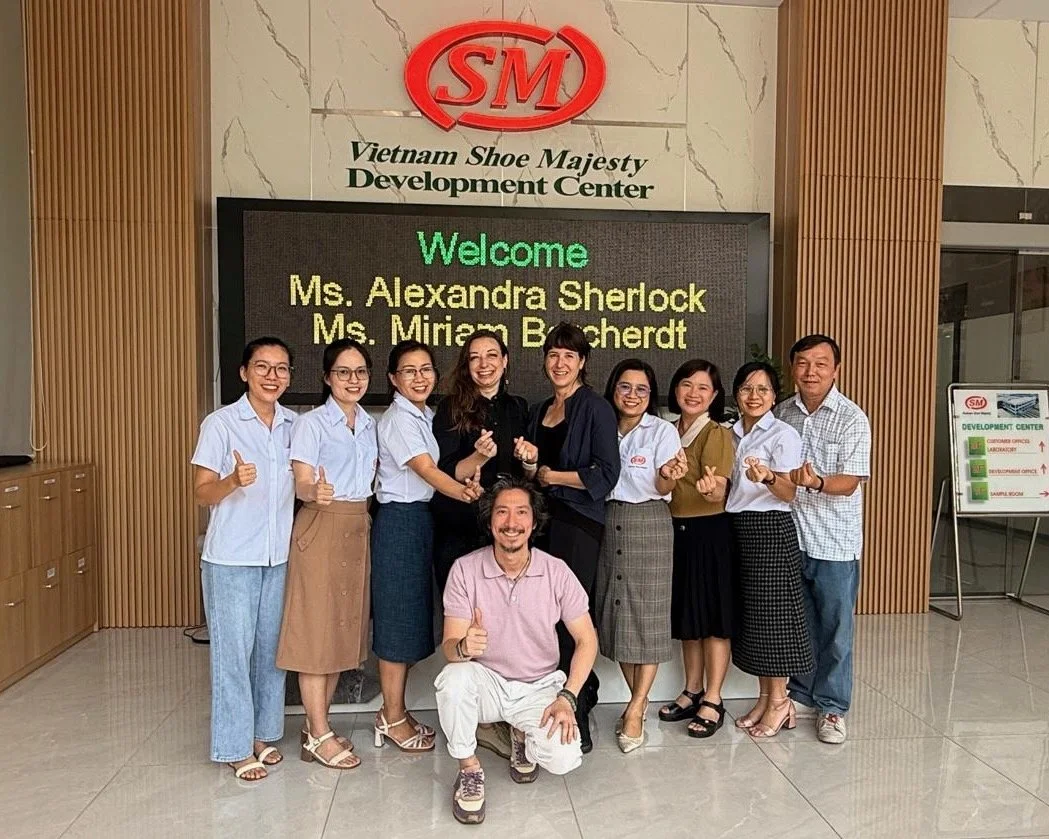
The factory I visited while in Vietnam was Vietnam Shoe Majesty in the Vung Tau province in the south of the country. And I'd like to extend my enormous thanks to Stephen and Abby, along with the whole management team and factory employees for accommodating our visit and giving us such a thorough and educational tour of the facilities and production processes.
Finally, my visit to Vietnam and attendance at the 28th annual IFFTI conference, which forms the focus of this episode, wouldn't have been possible without the financial assistance of RMIT University's School of Fashion and Textiles and RMIT's Sustainable Technologies and Systems Enabling Impact Platform.
On a technical note, you'll also notice as the episode closes, my audio suddenly becomes a lot clearer. And this was because my EarPods ran out of battery and it turns out my Laptop mic is better for recording, which I will remember for next time.
So without further ado, on with episode number seven.
3. [05:22] Vietnam and IFFTI: Cultural Connections for Sustainable Fashion Futures - Rebuild, Renew and Regenerate
Emily (05:22) Welcome back listeners to the Social Lives of Shoes, I’m Dr. Emily Brayshaw and today Alex is going to tell us about her recent trip. Alex has been at the 28th IFFTI annual conference run by RMIT in Vietnam, where she had the opportunity to not only look at the power of cultural diversity in shaping fashion, but also got to visit a footwear factory. So we're going to hear all about that today. The insights for industry, for designers, for educators. I'm very excited. Alex, take it away.
Alex (06:02) Aw thanks, Emily. Yes, IFFTI conference happens every year. I have only been, I think maybe this might be my third time that I've been, and it happens in different places around the world every time, which is lovely because you get to engage in different cultures and all of the stories that those places hold. And it stands for the International Foundation of Fashion Technology Institutes and there are member organisations and RMIT is one of them, which is the university that I work for, which is the Royal Melbourne Institute of Technology. So yeah, in 2000, RMIT established a Vietnam campus, which was aligning with Australia’s economic strategy to collaborate with ASEAN nations, so the South East Asian nations, of which Vietnam is one of them. Now, I was particularly interested in going to this one as Vietnam, as many listeners will know, is, I think, it is the third largest producer of footwear in the world. And with all of the geopolitical tensions and unrest at the moment, Vietnam is actually becoming one of the preferred producers of footwear for a lot of brands.
So as we know, in this podcast, we're very interested in thinking about how the humanities and social sciences might inform a more sustainable and regenerative footwear system and industry moving forward. So the title of the conference this time was ‘Cultural Connections for Sustainable Fashion Futures: Rebuild, Renew and Regenerate.’ So it wasn't just a conference about sustainability and fashion, it was a conference about culture to, support a more holistically sustainable fashion system moving forward.
Emily (07:50) So that's a really great point because there's actually a lot of work being done on culture in fashion globally, particularly around obviously cultural misappropriation, but also to learn this human value of cultural diversity, and ways to create fantastic designs without, erasing culture, but also learning from First Nations populations around their historically sustainable practices. So was there any of that sort of focus at the conference?
4. [08:23] Footwear: The Blind Spot in Fashion Research
Alex (08:23) Well, there was all of that, and I was absolutely, it was actually quite frustrating because there were lots of parallel sessions and I was spoiled for choice. And so, what I would like to do, Emily, is I would like to interview the conveners of the conference about the conference aims as sort of an introductory episode to a trilogy on culture in relation to footwear. There are experts around the world that are very interested in cultural practices, Indigenous Knowledge Systems and how that might relate to footwear. And I think actually an interview with the conveners of the conference might be a nice way to give some context and background to then some more specific research that's being done in this area.
But I didn't want to kind of wait, because that will probably be later in the year, I would say, by the time we've organised that. But I thought it was worth in the meantime us maybe, I mean, I was going to debrief you anyway on the conference and I thought we may as well just actually record the debrief to share it with a broader community to say these are the conversations that are going on, these are really progressive conversations and they're really helpful. So I can definitely give you a little bit of an insight, I won't explain all the papers I went to, but I can give you some sort of broad overarching themes and what those themes might mean.
One thing that I have noticed that's quite frustrating in the field of fashion research is that footwear is so often not thought about. I don’t think it’s consciously excluded. What I've noticed is that a lot of fashion sustainability researchers, I say, well, did you include shoes? You're doing these sort of audits of things that are going into landfill, you know, did you include shoes in it? And the answer is always, oh, no shoes is another category that's so complex in itself that actually that's a separate project. But then what happens is no one is actually necessarily doing those separate projects. So it sort of goes into the too-hard basket and therefore sort of falls through the cracks. And we know from, you know, this incoming legislation around the ESPR, so Eco Design for Sustainable Product Regulation and Extended Producer Responsibility. I think Tansy Hoskins' work on, she's written this brilliant book, Footwear: What Your Shoes Are Doing to the World. Footwear and footwear research and production and manufacture is around 10 years behind the rest of the fashion industry in terms of becoming more sustainable and circular. And yet, because it is so complex, the research around that is lagging. And so what I've sort of made it my mission to do, is to try and get funding to go to some of these fashion conferences, to really and put footwear in the radar and really ask the questions in these papers, what does this mean for footwear? And get people, get these incredible researchers trying to engage with the field and thinking about how their research translates to footwear to get more people on board really. And that's also the purpose of the footwear research network is to try and get, more sort feet on the ground, as it were, to sort of investigate and expand this area.
Emily (11:34) I think that's a really good point as well, because, you know, there are so many different components and fields and types of footwear. It's so difficult just to throw them all in the one basket. You know, you've got initiatives with all different kinds of leather happening on the one hand, vegan leathers, plant leathers, these sorts of materials. But then you've also got like wool, shoes made of wool, and work being done in that space. You've got all the works going on with plastics in the sneaker space. And so, you know, again, I think the way to start doing it is, like you mentioned, just start chipping away, right? It's like the fashion industry. We can't one person or one researcher or even one organisation solve the whole mess that's come up. We do need to start having these conversations, though, about, you know, how we can really create these systems and how we can maybe also include discussions and resources around that into teaching fashion in tertiary institutions and high schools so that students are also kind of aware of this and can bring a lot of this fantastic knowledge into the workplace when they graduate.
Alex (12.57) Absolutely, and I think it's not just high schools and universities, I also think it's like primary schools and to start to get people engaging with these things all the way back there. Bit I think, yeah, I think these, these forums are happening. And in academia, you already have these conferences. But as I say, no one's really talking about footwear. That’s starting to change. I went to, the same enabling impact platform funded me to go to the PLATE conference last year, which was the product lifetimes in the environment conference, which you've got these, you know, world-leading academics on sustainability and fashion. Well, all products, so PLATE's really nice because it's not just about fashion. So you're looking at crossovers between different disciplines. So it might be electronics or product design or furniture, and then you've got fashion there as well. But yeah, I did have a few conversations with a few people there and although footwear wasn't, I put footwear on the agenda because I became a chair of panel and I said, can we put footwear in the title? And because of that, Emmi Lombard, who wrote a wonderful article about her master's research on Velskoen, which are like sort of desert boots, but in South Africa, where they originated from. But I was really encouraged in conversations with some of these sustainability researchers who are starting to include footwear in their research and starting to have PhD scholarships that are looking at repair and reuse of footwear. So I'm super excited about continuing those conversations and inviting some of those researchers onto the podcast and to write articles. about what they're finding so that this research can be activated as quickly as possible because it's urgent, you know. So, it's exciting to think about what's going on.
5. [14.41] School Uniforms, Sustainability and Shoes
Alex (14.41) One of the things that I wanted to say as well is just on the point that you mentioned before about introducing some of these ideas early on, there was this paper on school uniforms…
Emily (14.45) Ahhhh!
Alex (14.57) and, oh my goodness, I mean my mind was blown in most of these papers I will say but I want to start with this just because you've already sort of mentioned it.
Here we go, ‘Regenerating School Uniforms: Towards Ethical Civic Fashion.’ The academic was Kyunghee Pyun from the Fashion Institute of Technology. So one of her research groups was in South Korea and she seemed to be quite frustrated in the sort of, everyone looks the same. And it kind of strips out any kind of identity or opportunity to express one's identity through school uniform, which I guess kind of, there's lots of reasons for that.
Emily (15:41) I mean, I've done some work on uniforms and Jennifer Craik, for example, is an amazing academic who's written extensively on uniforms. And she makes the point that, yes, even though there might be dress codes and uniforms, people will always still find a little way to make it their own. You know, whether it's having the skirt just a little bit too short or whether it's, you know, whether its having a shade of nail polish that's maybe just not quite right, or, there'll be something there. And I think footwear is a way that people definitely make school uniforms their own.
Alex (16:18) Well, it’s interesting you say that, Emily, because as she was going through these pictures of these Korean students in very traditional black sort of long gowns that they would go to school in, that was traditional to wear, you could see these sneakers poking out the bottom.
Emily (16:33) I love it.
Alex (16:34) And I pointed it out and I said, isn't it interesting because, you know, I wonder if you considered footwear because I can see in all of those pictures, you know, the sneakers pointing out and that is the way of kind of having that agency in terms of identity.
We could… we need to have a whole episode on uniform and identity and identification. I'm desperate to do a research project about it in terms of the kids that do and don't wear school shoes. And even in my family… so when our children first started going to school, my husband was absolutely committed to the idea that our children need to wear school shoes because they need to know when they put their shoes on, it's a day for learning. And getting into that mindset, I'd never thought about it like that because I'd always been in favour of them expressing their identity.
I sort of made the comment that, there's also something quite lovely and levelling about us all wearing the Clarks school shoes, which around the world, everyone, no matter what nation you come from, that is a connector. Everyone understands Clarks as traditionally, sort of the supplier of this quite archetypal sort of school shoe and that's actually something that is lovely to… and I noticed as I was saying that there was someone from North America over the other side of the room really nodding emphatically and I thought how lovely that we probably wore the same shoes even though we're in completely different parts of the world so I think that's also one of the positive things of globalisation in that you have these wonderful like connectors.
Alex (18.03) So, putting all the identity stuff aside, which in itself is absolutely fascinating and isn't necessarily entirely separable from the sustainability and the regeneration, but what she sort of pointed out is that actually the design of school uniform and the materials with which a school uniform is made is a wonderful way to actually get students to engage with place-based learning and regenerative systems in fashion. So she talked about permaculture and the slow food movement and how, actually paying attention to what is produced locally within the local climate and with the local ecologies, being conscious about that. So you know, what fabrics, what materials are you producing within your region of the world and how can that be incorporated into the school uniform?
So there was another member of the audience, which was an academic from New Zealand, who said, well in New Zealand and in Australia, wool is a huge part of our culture, our agriculture, our identity… merino wool.
But obviously it's quite expensive. So in our school at the moment, and I've got a five-year-old and an eight-year-old, we had quite a good system of people bringing back their school uniforms, because kids grow out of it before the uniform is destroyed generally. So it's got plenty of use left in it. They would bring back their school uniforms most of which is polyester because it's cheap, terrible sweaty horrible stuff, fossil fuel based materials but good that it's continuing to be used and not sort of landfilled and whatever. So they'd bring them back and you'd be able to just like swap out items and so on. But then recently the government introduced five, I think it's about five hundred dollars a year per family to buy new uniforms.
That's new polyester uniforms, new synthetic uniforms. The kids got these hats, which are just so plastic and so sweaty. So it's terrible materials. And I said to my children, I'm really frustrated about this hat because your previous hat was cotton. I could repair it. I could embroider it. This one, I can't do anything with it. And it's also not very comfortable for you to wear.
6. [20:31] School Uniforms, Government Funding and Repair Economies
Alex (20:31) And I just thought what a shame that rather than the government putting money into initiatives to make good quality uniforms that people want to repair, they're actually encouraging replacement. Like could that $500 go towards repairing? Could we do something like they do in France where you get repair credits, which is actually helping to build a whole repair economy and lots of new businesses are actually starting up now because the government is supporting this new model, which is repair over replacement. Or systems to make sure that school uniforms are designed with enough seam allowance to be able to adjust the size as the child grows.
So you know, you could have a whole industry of repairers and alterations that could… yes, you pay a lot of money for your school uniforms initially, but that money is going to your own GDP and then you're also investing in the infrastructure to be able to alter those and design those in a way that they can be altered to fit the child as they grow and then also teaching the child potentially their own you know systems for repair and you could teach them how to sew. You know don't have home economics classes where you're teaching a child to make a cushion, you know, teach them to repair their own school uniform made from the materials from, you know, their own culture.
So I just thought, gosh, school uniforms, it's not just about what they're made and how they're made and trying to make that as cheap as possible. It's actually thinking about how school uniforms can educate and engage children through what they're just wearing in their local economies, place-based learning. Let's go and look at the place where the wool for your woollen jumper is grown and learn about what that means. And so this whole idea of permaculture and the slow movement coming into school uniforms, I just thought was absolutely genius.
And someone said, you know, well, what needs to happen? And it's like, well, it's the government. The government needs to step in with sort of legislation around this and not actually do things that contradict the sustainable practices that people are doing themselves, you know, and undermine the sustainable practices that people are doing themselves.
So I think school uniforms, I think, are a really underestimated avenue for not just dressing our children, but actually educating them about the broader implications of fashion and clothing, manufacture, materials, permaculture, culture. But also just on the school shoes thing, there are no regenerative or circular strategies for them. Now, if we could work out a way for school shoes to be recycled. I know some, I know some sort of businesses are sort of looking at reuse so they can be passed on to someone else. But I don't know about your child. But mine wrecked them.
Emily (23:40) No, no, no, Well, kids wreck them and remember I was talking about this with Elizabeth Semmelhack and the second-hand shoe markets. And of course, the big issue is how we wear our shoes, we leave the traces of our body, our imprint. And if you're wearing shoes that have belonged to someone else, it can actually really mess with your foot development, with your spine, with your balance. So, you know, maybe second-hand shoes aren't the answer there. They're there to have to be sort of something else that we can. You know.
Alex (24:17) Exactly. Well, exactly. So in which case then what's the end-of-life strategy for school shoes? And I think any brands that that manufacture shoes for school or that generally tend to be used for school. Um, it would be wonderful to see them investing in ideas around recycling, or mono materials, or industrial compostability. Again, using the shoes and how they're made and the materials that they're made from to create awareness amongst children and parents at quite a young age about you know material flows and circularity, and again using the school shoes as an opportunity to educate not just clothe our children.
But I just think, my god, we're trying to educate our children in a way that prepares them to tackle the challenges of their future, many of which we have set up for them. We are destroying the world that they are inheriting, and we are clothing them in materials that are contributing to that destruction.
And so it's just, I just find the whole thing just ridiculously ironic. And I think there's a wonderful creative project there, I think marketing could absolutely have a field day with it. And the values that you would be communicating through engaging with some of these, these topics, through school uniforms through, you know, I think could be really, really great. So, look, I've spent a long time on the school uniforms.
7. [25:55] Inside a Vietnamese Shoe Factory
Emily (25:55) Speaking of values, sorry, no, that's all right. We've just gone on a uniform rant, but it's interesting, speaking of values and sustainability and education. One of the things you did was you visited the shoe factory. And of course, part of teaching people is where their where their things come from. We do need to think about ethical supply chains, ethical working conditions for people in those factories, because that also then has a flow-on effect socially and globally, shaping what's available to us, what we can wear, how we are as consumers, which of course all gets tied into school uniforms as well. So, if we're thinking of that, what did you find? You said maybe it was quite a valuable experience, and looking at the factory and the conditions, they were quite good.
Alex (26:48) They were really good. Generally the rule of thumb is that the cheaper the shoes, the more likelihood is that there's going to be exploitation and some really kind of quite dangerous and culturally destructive practices that are going on.
I was able to gain access to a factory in Vietnam, which as I understand generally has quite good rules around production. It is becoming a little bit more expensive to produce there, but as a result with some wonderful, you know, quality product coming out of Vietnam. Now, the factory that I went to produce for three brands that I was aware of, um that produce iconic shoes. So if you remember our episode on iconic shoes, we were talking about the idea of universal design and the fact that those iconic styles can withstand the fluctuations in fashions and people tend to keep them longer and as a result, they're sort of willing to pay a bit more for them. A lot of those iconic shoes are really good quality materials. They're well made, they can be repairable. Some of them.
When you have a culturally meaningful object that people are willing to pay a bit more for. I saw the impact of that in terms of working conditions. So this was a factory that was very well set up. There was a lot of ventilation. There was even air conditioning in some of the rooms. It was very clean. You know when you can tell that people are sort of pretty happy and content and there's jovial behaviour and a lot of sort joking around. And actually Vietnamese people I would say generally, It's the first time I've been to Vietnam, absolutely beautiful people, just a good sense of humour, bit mischievous, incredible food. So when we went there with my colleague Miriam Borcherdt who's really interested in ideas around remanufacturing. So what we can do with pre-consumer manufacturing waste and also how we might remake things that might be dead stock or whatever. So we're quite interested in whether that could be done with footwear, which is quite complex because it's built for durability. But we just wanted to get into a factory and sort of look at what some of the problems are and think about, can we find creative solutions for these problems?
But yeah, I mean, look, the conditions, the product that they're producing, like it was all incredibly impressive. The factory was absolutely ginormous. But I was also actually quite surprised that we were treated like absolute royalty when we got there. And it turned out that very few people sort of really visit the factories on a regular basis. And I thought about actually the value that could come from designers, for example, actually fully understanding the manufacturing process and the constraints and the waste streams.
Miriam and I have both taught material-driven design, which is where you start with the materials and you design with those in mind. So what happens if you start with a bag of off-cuts and you actually kind of think about how you can design in a way that actually can sort of accommodate for some of that waste or. And yeah, so I think all of that was a real eye-opener. It's very easy to say how to produce sustainable and repairable and regenerative shoes on small scale and particularly through artisanal practice, but how do you do it at scale with large production numbers? And I absolutely think the opportunities are there.
But one key opportunity is that as I was sitting with the assistant to the product development manager, there, and we were talking about our children and she has two children at the same age as mine roughly, and she was pregnant during COVID, and I was pregnant during COVID, and she was talking about what they did during COVID. And I just thought what a terrible thing it is that consumers and actually just people working in the industry don't ever get this opportunity to connect with the people that make our shoes and hear their stories and develop that sense of empathy and that huge respect.
8. [31:12] Digital Product Passports, Blockchain and Storytelling
Alex (31:12) And it was interesting that the day before I'd been to two papers, one on the value of blockchain. So blockchain is related to the importance of traceability. But it's just sort of code. So it's not actual stories about these things. It's not the stories of the factory or the people that made it, which would engage the consumer. I don't think data particularly engages the consumer. But then the next paper was on digital product passports and the importance of bringing in digital product passports to be able to trace, we would say, the biography of the shoe or the life cycle of the materials from production, potentially all the way to divestment and disposal. I do think product passports are going to be really great for engaging the consumer better in the life cycle of the materials and connecting them not only to the brand, but also to where they were manufactured.
Because I think as we hope to show through this podcast the better you understand the lives of your shoes where they came from, who made them, the more you value them, the more you look after them, the more you're willing to pay for them. And so I actually think the legislation that's bringing in digital product passports, blockchain, all of those things is, if we look past it as being an annoying and expensive requirement, we can actually see the creative opportunity it presents for creating more of a connection between the different stages of the value chain and more of an appreciation of the value of things.
So how might we use digital product passports to connect the consumer with the person that made them? And goodness knows we need more connections, don't we, in the world? We need more empathy. I think a lot of people think when they buy a shoe that's been mass manufactured in a factory, it's a lower class of person that produces it or it's a machine that you press the button and it all comes out.
Emily (33:15) Or worse still, people just don't care. People simply don't even think about it. They just simply don't even care. You know, putting a human face on it, think is incredibly important. You know, I think it's one of the ways that we're going to get ourselves out of this mess.
Alex (33:35) Absolutely. So I'm walking around this factory in a pair of shoes that that factory made. And I'm like, oh my God, these shoes have been on that conveyor belt and been touched by those people. And it was this full circle moment, and it was really quite profound. And equally, they were looking at me and going, there's one of our pairs of shoes that's ended up on Alex.
So I think digital product passports, all that legislation, I think there's a huge creative opportunity for storytelling there that I think brands could have a lot of fun with.
Yeah, so that was the sort of the main takeaway, I think, from the factory visit. And I think there'll be more to come on that. But I think I would just absolutely urge listeners, anyone who's involved in the footwear industry, visit the factories, meet the people, see how things are produced, understand what the challenges are in terms of manufacturing waste and design with that in mind. There's a creative opportunity in constraint, I think. So if you understand the factory's constraints, you'd be surprised how much I think creativity and innovation that can inspire,
I will just add that I do think that reshoring is important. And I think it's very important to regenerate skills within communities and cultures that we've lost. But I don't think we should go as far as to think that onshoring is the answer to all of our problems. And actually, I think if we think that onshoring is the answer to all of our problems, we're ignoring some concerning things about why we think offshore production is a lower class of production.
I think really we need to think carefully about why we think a pair of shoes that is produced in Northampton by someone who's British is more valuable than a pair of shoes that is produced using exactly the same materials and processes by someone from another culture. So I think there's something a bit not quite right there. Yeah, so I think the sort of fetishising and romanticising of onshore local production can be a little bit dangerous sometimes.
Ultimately, everyone deserves to be paid well, whether they're offshore or onshore. And we need to understand how to educate the consumer and motivate the consumer to want to buy from a good quality brand that uses a good non-exploitative manufacturer offshore over the Sheins and the Temus, which I can categorically say, there's no way you can get cheap product like that without some kind of exploitation being involved. So yeah, I think it's identification at the end of the day, isn't it, with the people that make our products is the most important way to motivate people.
And actually, think maybe it's a little bit more about how can we reconnect or connect, not even reconnect, just connect with the people in different cultures and use it as an opportunity to learn about other cultures and just connect and build empathy generally.
9. [36:44] Taming, Rewilding and the Capitalist Co-option Problem
Alex (36:44) So, yeah, I mean, look, we’ve focused in quite a lot of detail on a couple of key themes that I thought… As I say, none of the papers themselves are about footwear. So I'm just drawing out, I guess, the key things from my perspective as a socio-cultural anthropologist that I think are sort of translatable into footwear space. And there was a wonderful paper at the beginning by actually our dean at RMIT University. Full disclosure, she is our Dean, Professor Alice Payne but the research that she does do I think is really valuable in this space. So she gave the initial presentation and panel discussion with a couple of delegates. around the taming and rewilding of the fashion system and she has published quite extensively on these different approaches. And maybe we can get her on the podcast to explain this a little bit because I think it is different perspectives in terms of sustainability. So she's sort of saying that we're moving from the Holocene to the Anthropocene. So the Anthropocene is essentially the era that we're living in where we can no longer reverse or undo the damage that we have done and the way that we have changed the world and ecologies. And so we have to work with what we have got and we need, it's not sustainability anymore. It needs to be, we need to be regenerating things.
Alex (38:10) so she's talking about, so you've got the Promethean view is that new technology is the solution. So Prometheus…
Emily (38:20) Is it though? Is it though? Yeah.
Alex (38:21) So well, no, this is the different views you see. I don't think we can say that either one or the other is correct or not, but it's interesting that, so Prometheus… was Prometheus the mythical story of the god that invented fire? Our technologies come and destroy us. Is that the thing? Is that the? I don't know we need to look into it. So Prometheus is the idea that yeah technology can save us but technology can also destroy us so whatever we invent which is interesting in the age of AI. And then the Soterian view is much more sort of cautious and humble and so with the with the sort of rewilding, so there's this idea we can either tame the world through new technologies, or we can sort of rewild it by going back to some of those artisanal practices and repair all of those. So that would be the sort of the rewilding practices. I don't think it's one or the other, but I think it is interesting to understand that there are these sort of different approaches. But the point that she made is that whatever strategies you use are in danger of being co-opted back into the capitalist logic. Which is why, even though we've all been working on all of these strategies around sustainability, actually emissions have got worse, waste has got worse. So it's almost like all of these creative solutions have been co-opted back into the capitalist system and are just making things even worse.
Emily (39:48) Mmm. Greenwashed. They've just been greenwashed. Yeah.
Alex (39:51) Yeah, so we've ended up with more of all of this. So I just think that was a really important thing to call out, to think about actually as we're coming up with all of these ideas, we need to mitigate against the danger of like co-option. Now in some of the papers, they were talking about actually some of these technologies, they cannot be scaled. They cannot be mass manufactured by their very nature. So there was this wonderful paper on Boro. Do you know the Japanese practice of Boro and Sashiko?
10. [40:30] Boro, Kintsugi and the Repair as Ritual
Emily (40:30) Yes. Yes, yes. Yes. For listeners who don't know, we will put a link at the end of our chat, but it's basically repair, the idea that you're mending, that the objects you repair are visual. You can see the repairs. It's an embroidery which is actually really easy to learn because it's just a running stitch going in and out. And it's quite meditative. I've taken to doing my husband's jeans with it and, yeah, every time you do it, it gets a little bit better. So it's definitely worth having a crack at if you're interested.
Alex (41:03) Yes. So...so there's, so I'm actually wearing my jeans today that I don't know if you can see that. I've got all the stitching and the repair.
Emily (41:07) Fantastic, yes I like those. Yeah.
Alex (41:11) So she was talking about people like Junya Watanabe and Yoji Yamamoto has become very famous for that sort of the Boro stitching. Because it's very fashionable at the moment. A lot of people are really liking the repaired stitching.
Emily (41:22) Yes. Yes.
Alex (41:26) And as we have seen in the past with like ripped jeans and stuff, you've got like a fast fashion brand maybe selling a pair of jeans that have been supposedly repaired with the Boro technique to get that aesthetic, so that's the co-option of these kind of cultural practices into fashion. But actually, in the act of doing it yourself, it's actually connecting you to the practices of repair that give you that connection with the materials with your clothes, give you that connection with culture. I have noticed that the jeans that I repair with the stitching and the time that I spend doing it means that I can never throw these jeans away because I've spent attention and time on them. And it sounds like you do it for your husband as well. So the practice of doing that is actually a... sort of reinforces your relationship. I've repaired one pair of my jeans with patches made from my, at the time, two-year-old's jeans that were beyond repair. And so actually, every time I repair my jeans, I add a bit of his jeans to mine. And so symbolically, the two, his clothes and my clothes are becoming one, which is just such a beautiful thing. And I can then therefore never give those away and those will become an heirloom. So it was really interesting that she was talking about high fashion designers making Boro, appealing for all of those reasons. But that actually to get something that has the uniqueness that you want, you have to do it yourself, which inadvertently just through following fashion reconnects you with your garments and reconnects you with those practices and helps you build those skills.
So I think this was an example of how you can engage with cultural practices and through transparency and communicating those cultural practices… So then it's like, okay, well, how can brands support their customers to use Boro as a way of developing more of an attachment with and learn about another culture at the same time.
Emily (43:35) But I think also, I mean, we think about footwear, too, that's kind of quite interesting as well, because obviously not everybody's got leather tools. But, you know, maybe if we own shoes made of fabric, we can think about how we want to patch and repair our canvas or our fabric shoes. Or even the different type… So something that happens with handicrafts as well and that practice of embroidering, knitting, crochet is that it's a very, very meditative practice and it's very calming and very soothing on the nervous system. It's caring for yourself as much as your clothes. And I think even extending that to practices around conditioning leather, for example, like the meditation of like the brush strokes to clean or the rubbing strokes to recondition the leather and just having that sense of satisfaction as well, that comes from restoring and repairing. It's never going to look exactly the same, but it will look good. You know, it'll look neat. It'll look taken care of. It'll. And I think that's something maybe that we can think about through footwear as well is this personal repair culture. Not just sending your shoes in to get resoled at the local cobbler, which is a great thing to do as well, but even just cleaning and looking after our shoes before they even trash out too badly.
Alex (45:11) So again, it's that kind of, it's not getting people to do this because they should. It's not getting to do this because we're making people ashamed of the fact that they're replacing and not repairing.
Emily (45:21) No, no, no, not at all.
Alex (45:23) It's actually really shining a light on the sort of mentally and psychologically restorative…
Emily (45:28) Absolutely, yeah.
Alex (45:30) practice of doing these things and restoring some of those rituals that we've lost because of the abundance that we keep talking about. This abundance of products and this idea of replacement rather than repair, or any of those things, unfortunately has come with a loss of these rituals that actually are really restorative for us, by restoring our things we're restoring ourselves in the process, and It's almost like I look forward to when these jeans are going to rip again because I'm excited about sitting there in front of the television, getting my thread out and stitching. Again, you know, I'd point to the, there's a lot of good researchers who are working in a space like Wendy Ward again @thatWendyWard, you know, does all of these kinds of practices. And I think Japanese culture as well is a wonderful place to look and, and again, learn from. So again, the theme of the conference was culture for regeneration and actually you look at the kind of values and ideologies and worldviews of these different cultures and how you can learn from them. So in Japan, you've got the Kintsugi, which is the, you know, like the repairing things and actually the repair being the beautiful part, like the actually celebrating the repair, you know, where those cracks in the porcelain are painted with gold lacquer. And actually the repair shows the journey, and the trials and tribulations of the thing. And it’s that journey that makes it valuable. And also wabi-sabi, so beauty in imperfection. So I think in terms of footwear, it's… and then going to the factory as well, there's this idea that everything has to be uniform. All the shoes have to look exactly right and exactly the same. And actually, if that shoe isn't exactly the same as its pair, then it needs to be sold in a bargain, basement or not even make it to market, be incinerated or destroyed. It reminds me of, you know, in the supermarket, I don't know if this has happened in the UK, but the ugly fruit.
Emily (47:35) The ugly fruit. You have your ugly fruit and veg. Yes, yes.
Alex (47:39) Yes, yes, so actually this idea that don't we feel sorry for the things that don't quite... And actually it's that imperfection that gives them their authenticity and their value. So actually again, instead of informing the consumer about actually, no, this is what makes it unique. And I was really surprised to learn recently, who was it? I was listening to someone in kind of the sneaker sphere who was saying that actually the sort of, was it like the holy grail for the sneaker collector is the mistake. And you kind of hope again that that practice hasn't been co-opted and that they're just not doing that on purpose. I'm sure that's not the case, but it could be, couldn't it? But it is actually that the ones that are a bit wrong, or there's a mistake, or there's a slight inconsistency, because let's face it, natural materials, leathers, they are inconsistent because they're living materials. And actually it's the fact that they're not perfect and they're not uniform that actually gives it its value. So the consumer understanding that and therefore kind of more of these products that are inconsistent are sellable, but also that we can actually celebrate the wear and tear and work with it and repair it.
And I do, and I came out of that Boro, paper. And I have got a pair of leather sneakers that have got a split in them. And I do really want to do some stitching. And I'm kind of thinking about what thread I'm going to use. Might I use a gold embroidery thread? Cause they're gold sneakers and, and making that repair visible and celebrating the repair, which starts conversations. People see it and they go, how wonderful. And you tell them about it.
Emily (49:14) It does. It does. Yes.
Alex (49:19) Just interrupting here with a post-record observation. Following the recording, an advertisement popped up for a slow sustainable Sydney-based label that I buy from, called High Tea with Mrs Woo who are selling Kintsugi mending travellers kits and materials including gold, silk, and cotton thread and vintage gold thread, to repair the clothing that you buy from them.
This seems to have been set up with a corresponding Instagram account and a YouTube account to share tutorials. And importantly, on all communications, it acknowledges that the practice is borrowed and adapted from the Japanese art of repairing broken pottery with gold alloy, which they've developed for clothing practice as a way to cherish and extend the life of our favourite garments. A great example an alternative business model that encourages consumer loyalty whilst also acknowledging and educating consumers about the cultures from which these practices are derived.
Now back to the conversation.
Emily (50:26) And something there too, you know, for people who are interested in getting started in that, is you might see, you know, a really nice jumper or garment at the Vinnie's, the thrift store, the op shop,
Alex (50:42) charity shop. Hmm.
Emily (50:43) and it might have a little rip or a tear and, you know, but it's cheap. So buy it. If you mess it up, it doesn't matter. You're giving it a go, right? You're making stuff uniquely yours. You might see a pair of shoes that are in maybe not great condition, but if you got them resoled and reconditioned the leather, there's something fantastic there. So, you know, and it's also a great way to upskill yourself. You know, don't be frightened. Give it a shot. What have you got to lose?
11. [51:13] Waste Not Want Not
Emily (51:13) I've been thinking a lot about this idea of waste not want not. And I don't know if I've mentioned this in the podcast before. And of course, obviously, it used to mean, you know, don't waste that, hold on to it where, you know, you're thrifty, you'll have something later. But of course, today we have too much stuff. So for us today, it's more waste not - If we don't waste these things, then we won't want for clean air, a clean environment, clean water, happy people, you know. Waste not want not, but the meanings changed, yeah.
Alex (51:51) I love that. I love that. Yeah, I love that change, does that meaning. That's a wonderful shift. It really makes you think, doesn't it? Yeah.
Emily (51:58) With that in mind, should we wrap it up? We've been having a good chat. This is, Are there any?
Alex (52:01) We have, we have, look, I think, I think I've got, I think I've communicated sort of most of the key things. The other thing that I would just say very briefly looking at a lot of the papers, the main theme was all of the stuff that we're supposedly discovering at the moment around repair and efficiency of materials and material reuse, and… of course we're, we're not discovering it, because all of these cultures have been doing this for time immemorial. So there were lots of papers by people who through their own heritage had come to learn about these incredible repair and recycling practices in their own cultures or diasporas that had kind of continued through the generations. So generational knowledge exchange of efficient use of materials. So there were some wonderful ones. There was ‘Re-threading the Roots, Reconnecting and Relocating Fashion Through Black Cultural Practices.’ So just look at kind of like black, whether it be African-American or West Indian or whatever diasporas living away from home through like migration or whatever, but those wonderful cultural practices relating to those sort of coming through families and that was Laticha Brown. And ‘From Obioma to Oxford Street, the sustainability of Nigeria's slow fashion culture and diaspora’ so that was talking about diasporic Nigerian tailors and seamstresses in London in the sort 70s and 80s and continuing today and the community connections that came through tailoring and repairing by particular people and actually the social capital that they generated and how they were sort of off in the glue in the community because they're dealing with everyone.
And what are some other work ones that I saw? I mean, I will basically post all of these papers will be available, freely available for anyone to read when they are published. So I will follow up and post a link to those. And there's a huge amount of inspiration in there.
Just quickly. Oh, there was a presentation on Retuna. Do you know about Retuna? So Retuna is the first second-hand fashion mall in Sweden and it is this whole sort of ecosystem, second-hand brands, businesses, systems, models, a whole community regenerating around it in Sweden and it was Mary-Ann Ball from Nottingham Trent University who actually won the award for early career researcher, through her research and that was talking about it and I desperately want to go there because it sounds absolutely brilliant. An incredible idea, the system that enables that to happen is something that all… And actually I didn't realise but government officials from all over the world are actually going there and having tours to understand how to integrate that into their own nations.
Lots of stuff on Vietnamese indigenous practices and crafts, and how, I don't know if you've ever been to Vietnam, Emily,
Emily (55:25) It was a long time ago, a long, time ago.
Alex (55:25) but as you walk around all of the shops, it is just absolutely astonishing how incredibly creative and resourceful Vietnamese people are. The skill and the craft, it makes absolute sense that they are producing so much of the world's textiles and footwear. There's a huge amount of skill. So it was lovely to learn more about those. I did buy quite a lot of things while I was there that had been made locally. And I'm going to let you go in a second.
12. [51:01] The Evolving Role of Higher Education
Alex (56:01) Yeah so another just really important theme that came through is the role of higher education and a lot of us I think are reflecting on what is the role of higher education in the age of AI and all the rest of it. And there was a wonderful paper by Lisa Piller who is a PhD student at RMIT University but also works over in Western Australia: ‘Social inclusion in fashion education global stories in textile stewardship’, who was very much talking about the importance of vocational education but also the importance of teaching in context.
And then that was reinforced by Nirbhay Rana, who was another academic, ‘Reclaiming the curriculum, regenerative fashion education through indigenous knowledge and community practices.’ So what he was doing is he's taking classes out to Indigenous communities, and basically facilitating knowledge exchange. So rather than students going into universities and you've got that whole sage, sage on stage, you know, where students go and they expect me, for example, or you as the lecturer to have all the answers about something, and I'm paying for you to impart all of that knowledge. No, nobody has all the answers. And even if we did, it would be from a particular perspective. So what I took from his presentation is actually as educators in the world that we live in now, actually educators being sort of facilitators of knowledge exchange, so taking students into communities and helping them understand how to respectfully collaborate, how to learn from other people, how to have difficult conversations, how to face your own insecurities or the legacies of colonialism and all of those things to be able to respectfully engage with other cultures in ethical and authentic ways. And so I just thought, gosh, yes, the role of the educator is changing. And it is much more about that teaching people to learn and critically engage and giving them the skills for lifelong learning, rather than giving them a set of information that you know, that rote learning, you know, you need to know this I'm not going to tell you why I'm not going to tell you how, you just need to remember it, you know, in a classroom.
Emily (58:17) Teach the person to fish…
Alex (58:23) That's exactly right. I mean, we see those adages everywhere, don't we? And I think higher education would do very well to think about, you know, that. So, yeah, I loved that idea. And also that makes higher education much more equitable as well, because you're not just appealing to the people that can afford to come to university and also the intimidating notion of going to university and living in a city that you don't... necessarily belong. So much of people's identities are embedded in the communities in the country, for example, with which identity is attached. So to remove them from that, you know, it is that whole kind of colonial ethos, isn't it? So look, really, really rich. And as I say, I think we'll do a little sort of mini series, just I've given a broad overview of some of the themes.
13. [59:13] Culture as the Fourth Pillar of Sustainability
Alex (59:13) The important thing to finish on is just thinking about the fact that... traditionally sustainability has been theorised as kind of the, you've got the three pillars, you've got the economic, you've got the social and you've got the ecological, so the environment. Increasingly culture has been understood as a fourth pillar, but I would argue and I have argued in the article that I did ‘learning from the social lives of shoes, a cultural approach to sustainability’, is that culture is the foundation and the bedrock upon which all other sustainability strategies need to be built. If we don't understand culture, if we don't understand how people engage with and relate to one another in the places in which they live, anything we do will be irrelevant and it just won't be adopted. Which I think is sort at the core of our podcast and what we're sort of investigating. So if people haven't fallen asleep already, hopefully some of those things are useful. We'll provide some resources in the show notes to follow up if need be. And thank you for your patience, Emily.
Emily (1:00:17) My pleasure. What a great opportunity to hear all about the conference and just really sort of start thinking about some of those key takeaways and how I can incorporate them in my own teaching and design and making practices. Fantastic.
Alex (1:00:34) Absolutely and just as a acknowledgement as we sign off again, I would just really like to thank RMIT University, specifically the School of Fashion and Textiles who gave me a bit of professional development funding which covered some of the costs and also the enabling impact platform sustainable technologies and systems which provided a bit of money to do that as well and I hope disseminating some of this to the broader community will show that investment. was worthwhile.
Emily (1:01:02) I'm sure it was. Thanks everyone!
Alex (1:01:06) Bye, see you next time, Emily.
Alex (1:01:09) We hope you've enjoyed this episode of the Social Lives of Shoes the Footwear Research Network. Please go to our website for the show notes, including a full transcript, links and images. You can us on LinkedIn and Instagram. That's footwearresearchnetwork.org.