Beyond Bridgerton: The Real History and Value of Regency Footwear with Dr Hilary Davidson
Episode 6 Overview:
In the third and final episode of our trilogy on footwear histories and archives, Dr Emily Brayshaw speaks with Dr Hilary Davidson, dress, textile and fashion historian and curator at the Fashion Institute of Technology in New York, about what we can learn from the consumption and manufacture of footwear in the Regency period, from proxy shopping networks and colonial supply chains to repair culture and the enduring value of archive-based research.
Credits:
Interviewee: Dr Hilary Davidson
Interviewer: Dr Emily Brayshaw
Presenters: Dr Alexandra Sherlock and Dr Emily Brayshaw
Edited and produced by: Dr Alexandra Sherlock
Photographs and images: Credits in captions
Links:
Dr Hilary Davidson – FIT Academia.edu profile
Hilary Davidson's Jane Austen Expertise on Full Display – FIT Newsroom
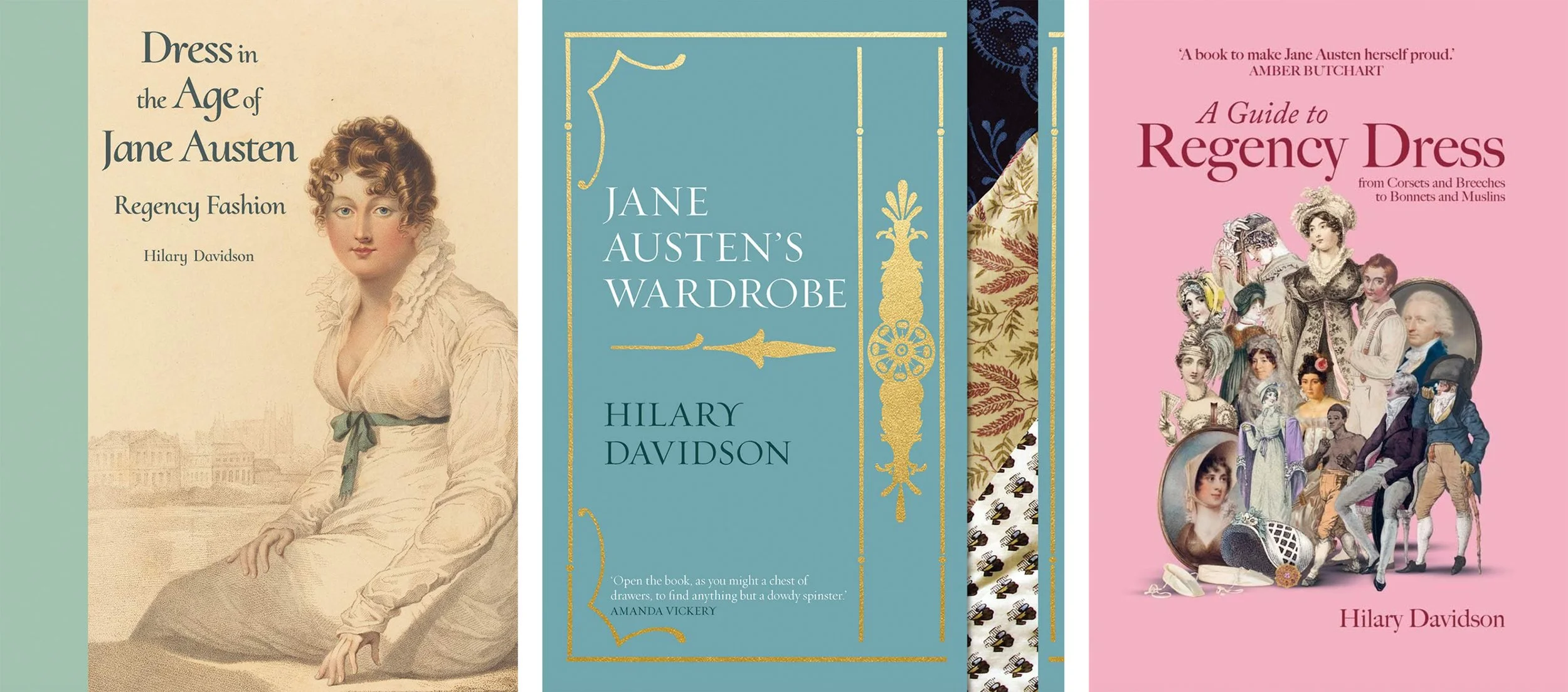
Hilary Davidson's Books
A Guide to Regency Dress: From Corsets and Breeches to Bonnets and Muslins – Yale University Press
Jane Austen's Wardrobe – Yale University Press
Dress in the Age of Jane Austen: Regency Fashion – Yale University Press
Other Books Mentioned
The Letters of Jane Austen, selected by Edward, Lord Brabourne – Project Gutenberg
Worn: Footwear, Attachment and the Affects of Wear, Ellen Sampson – Bloomsbury Visual Arts
Institutions
Fashion Institute of Technology (FIT), New York
Alfred Gillett Trust / The Shoemakers Museum, Street, Somerset
IFFTI – International Foundation of Fashion Technology Institutes
References
Austen, J. (n.d.). The letters of Jane Austen: Selected from the compilation of her great nephew Edward, Lord Bradbourne [E. Brabourne, Ed.]. Project Gutenberg. https://www.gutenberg.org/files/42078/42078-h/42078-h.htm (Original work published 1884)
Davidson, H. (2019). Dress in the age of Jane Austen: Regency fashion. Yale University Press.
Davidson, H. (2023). Jane Austen's wardrobe. Yale University Press.
Davidson, H. (2024). A guide to Regency dress: From corsets and breeches to bonnets and muslins. Yale University Press.
Riello, G. (2006). A foot in the past: Consumers, producers and footwear in the long eighteenth century (Pasold Studies in Textile History, Vol. 15). Oxford University Press.
Riello, G., & McNeil, P. (Eds.). (2006). Shoes: A history from sandals to sneakers. Berg/Bloomsbury Academic.
Sampson, E. (2020). Worn: Footwear, attachment and the affects of wear. Bloomsbury Visual Arts.
Chapters:
[00:00] - Show Intro
[00:59] - Episode 6 Overview and Context
[13:56] - Introducing Hilary Davidson
[17:08] - The Importance of Jane Austen
[20:34] - Shoes in the Regency Period: An Overview
[23:33] - Boots, Leisure, and Military Chic
[26:37] - When Women's Shoes Lost Their Heels
[29:30] - Regency retail: Letters and Proxy Shopping
[32:42] - Convicts, Colonies, and the rise of the Global Shoe Trade
[40:11] - Theft, Repair, and the Value of a Good Boot
[43:00] - Historical Insights for Sustainability
[46:07] - Australian Climate, Identity, and Style
[51:06] - Current Projects and Future Directions
[53:36] - Sign-off
Episode Notes:
Foundation of Goulburn - The first recorded settler in Goulburn established the farm of 'Strathallan' in 1825 (on the site of the present Police Academy) and a town was originally surveyed in 1828, although moved to the present site of the city in 1833 when the surveyor Robert Hoddle laid it out. The township of Goulburn in New South Wales, Australia, was founded in 1833. It was proclaimed as Australia's first inland city through letters patent by Queen Victoria in 1863. The Baxter Boot factory has been making boots in Goulburn since 1850.

Transcript:
[00:00] - 1. Show Intro
Emily Brayshaw (00:10) What if shoes could speak? What might their stories, and the stories of those who make and wear them, tell us about the ways we live, our values and our impact on the world?
Alexandra Sherlock (00:22) Welcome to the Social Lives of Shoes, a podcast brought to you by the Footwear Research Network that brings to life one of the most underestimated and humble aspects of consumer culture.
Emily Brayshaw (00:32) Whether you design, produce, make, market, sell, or just wear shoes. These conversations will transform how you think about them and reveal new possibilities for a more sustainable future.
Emily (00:46) This episode was recorded and produced in Australia on the unceded lands of the Wongal people of the Eora Nation. We pay our respects to their ancestors, elders and custodians.
[00:59] - 2. Episode Overview and Context
Emily (00:59) Hi, everyone. Welcome back to the social lives of shoes. This is our third and final episode in our trilogy on footwear histories, including a deep dive into museums and archives. We've spoken with Tim Crumplin from the Shoemakers Museum, Elizabeth Semmelhack from the Bata Shoe Museum. In case anyone's missed our previous two episodes, and today we are speaking with Hilary Davidson. So before we deep dive into our fantastic podcast and chat with Hillary on the Regency period and footwear, over to you, Alex
Alexandra Sherlock (01:34) Hi Emily. Yes, so, this podcast is quite new so we're kind of working it out as we go. So, before each episode we're just going to point out some key things which seems to be working, I think, and a nice opportunity for us to chat and maybe do a little bit of analysis from our academic perspectives on what the interviews are revealing. But also, we realised that it is good to have a regular podcast, but it can't be so regular that it becomes a problem in terms of other responsibilities and duties.
Emily (02:09) We've got to eat, Alex, we've got to make money to feed our kids.
Alexandra Sherlock (02:13) That is true, that is true.
So yeah, I think these trilogies along a particular theme are quite a nice little way to do sort of back to back episodes, have a bit of a break while we regroup and then do another short trilogy.
But yeah, this episode, Emily, I was listening as you and Hillary were speaking it's so fascinating I really didn't know anything about the Regency period other than it seems to be on trend at the moment obviously you've got various movies…
Emily (02:45) We are living under the large looming spectre of Bridgerton, which, you know, takes the very best of Jane Austen and… adds a little soupcon of something completely contemporary to re-imagine the era. But something that Hillary really warns us about is… it's a reimagining of the Regency period. It's not actually Regency accurate. So, you know, doing a deep dive into the period can help us kind of adjust some of our assumptions and also sort of get thinking about, like, really what is actually there that we can learn from as well. You know, if there's no shame in going and enjoying a big cheesy glossy TV series, we just need to keep in mind that, you know, it's not historical. It's fan fiction and it's fabulous in its own way for that.
Alexandra Sherlock (03:43) Yeah, that's right. So Hillary is like the authority on the reality. Because it is actually from this incredible kind of historical research from records. So, it's wonderful to have people like her and there's really not many of them around, so I feel really lucky to be talking about this specifically in relation to shoes. But yeah, I think because I don't really know anything about the Regency period, I just was fascinated by, and I wonder whether this is why it's so topical at the moment, how people responded to rapid changes, for example, in industrialisation, global trade, which was also connected to colonialism and empire. So we're seeing a lot of rapid changes at the moment, because of wars and tariffs and all of those other things. And so I think what it really pointed out to me was how important it is to look at these periods in the past where we have managed to tackle these huge challenges and think about actually how that might help us get through the challenges that we face at the moment. Yeah, what were the things that sort of stood out to you, Emily, as you were talking to Hilary the episode?
Emily (04:51) so definitely, this rapid rise of sort of globalisation and industrialisation. I think in today's context as well, the Regency era is just before the global revolution, which really sort of kicks off hard in the 1850s. And so if we think about that context and link it to today. I think we are in one of these periods where things are just starting to get faster and faster before, boom. So I think if we're thinking about technology what we're learning from archives is this reality of what actually happened versus our ideas about what happened. And that is going to be so important around critical thinking because the next boom that we're going to have is around AI, but AI is a tool, right? It can't actually think. So if we don't have this accurate information, this critical thinking to put into it, it's really not gonna amount to the way that we want it to be. We're not gonna be able to use it how we really wanna be able to use it, I think. So that's something that really comes from this episode too, I think.
Alexandra Sherlock (06:11) Yeah, and I think that's where I feel grateful Hillary was able to participate in this episode because I really think it shows the value of people like her, you know, and you, and well any sort of academics really and historians that actually go to the source material, that actually go to those primary sources who actually look at the facts look at what was happening and actually find that information in the first instance through which we might use tools like AI, to, kind of, consolidate or synthesize that information. But AI is only working with what it's got. And so we can't forget the absolutely essential purpose of people like this who are actually finding that information in the first instance. Such a great point. And sustainability as well, yeah, there were a few things that came out there, weren't there?
Emily (07:03) Definitely. And I think one of the things that is really key from the Regency period you know, all throughout history is this focus on the value of objects and repair culture. Because we're starting to see rise in interest around footwear, too, and repair culture among Gen Z. And so, we're starting to think about how people repaired, looked after their objects before we just had this abundance where we use something and then throw it away. And, you know, there are so much more conversations around that happening. I'm seeing a rise in social media on videos around repairing footwear, about people trying it for themselves, about people, you know, demonstrating skills that they have and teaching people how to do that. Anecdotally, too, a colleague of mine at uni put a call out on her socials about whether anybody had a shoe tree because her son is really getting interested in reconditioning leather and reconditioning his leather shoes. And so, we can sort of see some of these skills and learn from them as well when we do this object analysis in the archives, thinking about how people repaired their footwear.
Alexandra Sherlock (08:20) Yeah, absolutely. And I think Hillary made a really important point there about wishing that the people that are working on these new technologies would speak to people that have a really deep and good understanding of the past. And I think that really came through in Elizabeth's episode as well, particularly when she was making those predictions about the future, that those were informed predictions based on precedents and practices in the past. Something occurred to me as Hillary was talking about when… I don't know if this is because I watched too much science fiction… but she was talking about when this huge surge of people to Australia and convicts and having to suddenly make 4,000 pairs of boots for convicts having the supply chain to be able to do that. And it just sort of connected me with this kind of this idea… I mean, you've got all these strange conversations, haven't you, about, whether we're going to have to move to another planet I mean, I hope we don't colonise, other planets in the way that we have, colonised Earth… but I think it did raise this point about actually the need to be able to advance manufacturing in a way that can respond better to the realities of need, not over producing, not under producing. And that sort of connected me back to what Elizabeth was saying in the previous episode about the importance of 3D printing. And actually in the future, people will be surprised that shoes were mass manufactured to standard sizes and not just made bespoke for a particular foot. through being either grown overnight or 3D printed. So, I just love all these connections between the past and then thinking about the future and the relevance of that for like supply chains and all of those things as well.
Emily (10:20) I think so, too. And something that came out of, I think, all of the episodes, if we're linking them, so Tim's and Elizabeth's and Hillary's is this value in archives. And it's something that Hillary definitely touches on about they allow us to respect the personhood of people who have come before, people who have made objects. And so that's their incredible skill.
Emily (10:44) their incredible way with materials, their thoughtfulness, their problem solving abilities, rather than just sort of this view that, you know, they're all old fashioned, they're in the past, they're not very progressive. It's like people were… and with that, if we are more open to these ideas of respecting personhood, then we're also more likely to adopt and adapt and work with these ideas and methods. And there there's a great value I think for sustainability and making in looking at and respecting and adopting and adapting these ideas that have been around for centuries or indeed millennia.
Alexandra Sherlock (11:26) Yeah, that's right. Just very quickly as well, I loved your mention that shoes are a gateway drug again, which Elizabeth mentioned in the previous episode. And I would like to see how many times we can argue that shoes are in one way or another a gateway drug in all of the ensuing episodes.
Emily (11:43) They are, Jane Austen. There are so many. But that's the great thing about history, right? There are these little, I guess, gateway drugs, if you like, or rabbit holes, some people call it, that get us hooked. And once we kind of scratch the surface, get right into that, just these entire worlds open up. And there's so much like it's why I'm such a passionate historian, I think, because you can just you never stop learning.
Alexandra Sherlock (12:13) No, and it is intoxicating. So yes, well, our next episode, ⁓ I think, well, we're going to have a little bit of a break while we do some other things related to other jobs. One of those things is I think I'm attending, hopefully fuel permitting the IFFTI conference in Vietnam. We know Vietnam is I think, the third largest producer of footwear in the world. I'm excited to get over there.
Emily (12:39) What does IFFTI stand for?
Alexandra Sherlock (12:49) So IFFTI is International Foundation of Fashion Technology Institutes and it's being hosted this year by RMIT's Vietnam campus. And so yeah, I'm interested to go and look at all the papers and see which of them kind of relate to footwear and I'm hoping to be able to grab some kind of perspectives there. So that will be a one-off. And then we're going to have another nice little triptych specifically looking at the relationship between shoes and attachment. What attachment means for detachment at the end of a shoe’s life, and thinking about those things in relation to ideas around sustainability. And I'm excited to say that that little trio will open with Dr. Ellen Sampson, author of one Footwear Attachment and the Affects of Wear which is one of the really great books in this field.
So Emily, thank you so much again for such a wonderful interview and yeah listeners we hope you enjoy and please do let us know what you think.
[13:56] - 3. Introducing Hilary Davidson
Emily (13:53) Welcome, everyone, to our latest episode of the Social Lives of Shoes. Today, we are going to talk about shoes in the Regency period globally. And to do that, we are so lucky to have with us on the show Dr. Hilary Davidson, who is the associate professor chair of fashion and textile studies at the Fashion Institute of Technology in New York. So, Dr. Davidson, Hillary, hi…
Hilary (14.21) Hi.
Emily (14:22) …is a dress, textile and fashion historian and curator. Her work encompasses making and knowing, things and theory. And she really has an amazing understanding of how historic clothing objects come to be and how they function in culture. Why is she on our podcast? Well, apart from being a bit of an expert, Hillary trained as a bespoke shoemaker in Australia before completing her master's degree in the history of textiles and dress at Winchester School of Art, which is the University of Southampton. And she has also published extensively on the Regency period, but also on shoes. So specifically red shoes in a fantastic book edited by Peter McNeil and Giorgio Riello called Shoes: A History from Sandals to Sneakers which we will have a link to in the bio. So thank you so much for joining us today, Hillary.
Hilary (15:17) Thank you for having me
Emily (15:19) Do you have a favourite pair of shoes?
Hilary (15:21) Oh don't ask me that, Emily. That's cruel. Cruel! All right. So current favourite. We'll go with current favourite, is the pair of red suede flat pointed toe Manolo Blahniks with like a little frill on the toe that I bought myself as a present for completing my last book. So they're my kind of I think they're my kind of newest current most-most beloved shoes because they're new to me. I'll go with those.
Emily (15:52) Could you maybe then, tell us a bit about your recent book?
Hilary (15:56) The most recent book is my third book on Regency dress. Much to my surprise, I've written three. The first one was called Dress in the Age of Jane Austen and it is looking at the full kind of spectrum how dress and textiles work in the Regency for really kind of the middle class gentry ⁓ people of Austen's milieu, like a really broad study. And then my second book was a really deep-dive study looking just at what we can know Jane Austen herself wore based on her letters called Jane Austen's Wardrobe. But this third book is, it's kind of a dictionary or a guide or a glossary that I've put together from all of the information I've discovered from researching the previous two and it's called A Guide to Regency Dress from Corsets and Breaches to Bonnets and Muslins, and it is really that, it's a kind of an illustrated glossary dictionary that gives people who might know nothing about Regency dress a way in to kind of understand the basics as well as giving a lot of sort of terminology and definitions for the time that I hope will be useful for a wide range of people from kind of curators to costume designers, fiction writers, students, all sorts of things.
[17:08] – 4. The Importance of Jane Austen
Emily (17:08) So maybe we have listeners out there who might have seen Pride and Prejudice or it's on their radar, but they might not have read more broadly or widely from Jane Austen's oeuvre. Could you tell us a little bit about her and why she's such an amazing avenue for people who are interested in the Regency period?
Hilary (17:31) Well, I think that Jane Austen is, I feel like she's the pebble that I drop into the pool of history to kind of examine the wider world. And why she's so fantastic is because she kind of sits in the middle of the middle classes. And so there's a number of reasons why I approach the Regency through Jane Austen's life and works. One, she is so often the way that people come to the Regency period first, they've seen an adaptation, they've read the books, that's their kind of introduction to what this early 19th century life in Britain was. And she's so beloved. I mean, she's, she's one of the kind of the three greatest writers in England, you know, Shakespeare, Dickens and Austen. So she's kind of monumental in her achievement and in the modernity that she achieved in the books that that filters our perceptions of the Regency through her, but also, you know, she's not aristocratic, so she's not kind of not living the high life, but she touches on it. And because of her position as an as this kind of monumental author, her family has been incredibly well researched and they're really typical of kind of gentry or middle class consumers. So large family. Her father was a clergyman. And you can find examples of kind of averageness, average regency consumption throughout herself and her family. And so she's just this great kind of figure to say, hey let's start with what we can know through Jane Austen both fictionally and in letters and then expand from there. So she's just a really amazing representative figure both for how she actually lived her life and how we perceive Regency people living their life through her works.
Emily (19:13) She's a bit of a gateway drug. You could call her.
Hilary (19:14) That's it, completely, completely. She's at the start of everything. It's like all roads lead to and from Jane Austen in the Regency. So I've kind of distilled my Regency brain into an easy to look up guide.
Emily (19:29) which is a really fantastic source, you know, as someone who works in costume, teaches costume and fashion history as well, myself, something I think that comes from this is it's not always about 100 % historical accuracy in costuming or fashion. Some people want to do that, which is great. But then having this as a really valuable visual guide that can spark inspiration.
Hilary (19:56) I am, I think I'm a little worried at the moment that reinterpretations of Regency dress are shaping people's imaginations about the Regency kind of more and more and more that there's kind of like the costume Regency is becoming its own thing. And I think the actual, what was going on in fashion in the period, is so interesting in itself and in many ways, in many points, it's weirder than what is what people might imagine to kind of give people the way to go, hey, this is what they were doing and wearing. ⁓ I hope it prompts inspiration in a different way that isn't just kind of reiterating what people think Regency dress is.
[20:34] - 5. Shoes in the Regency Period: An Overview
Emily (20:34) Yes, we see that particularly around footwear, you know, and a lot of productions will have, you know, the actors wearing essentially contemporary footwear as well, you know, which is not accurate, obviously, to the Regency period. Could you maybe give us a bit of an overview about shoes then in the Regency period? Perhaps what they looked like, how they were worn, maybe even what they meant, like any significance, social significance.
Hilary (21:03) So like technically the Regency period is the period from 1811 to 1820 when the Prince of Wales was Prince Regent, but I tend to work on what I call a long Regency. So from the time when women's waistlines start going up from about 1795 to about 1825. And this is a really fantastic period of changes in shoes, because all throughout the 18th century, we've had shoes with heels of varying heights. And kind of in the early 1790s, these start to shrink and slim down and become essentially what we might call a kitten heel for women's shoes. So what we start to have is shoes that are, kind of like ballet flats, if you're trying to imagine it, but with a very pointed toe and a tiny kitten heel in the 1790s. And in the late 1790s to about 1800, shoes start to lose their heels for women. And this is really key. This is something that, and I don't mean they have no heel at all, but the kind of the heel goes flat on boots on evening slippers and shoes remain without a heel in women's fashion until sort of about the late 1830s, 1840s.
Emily (22:16) Yeah, right.
Hilary (22.17) So it's a really easy way to see if people are paying attention to what shoes do in the Regency because do they have heels? Nah. So yeah, these kind of flat slippers which actually are the origin of modern day ballet slippers, but I'm sure that's something you can cover in another podcast. So it's a really distinctive period for footwear in that sense, because we suddenly have no heels. There's little changes in fashion between sort of the more pointed toe of the 1800s, and then it becomes more rounded at the end in the 1810s. So for women, they're wearing flat shoes and the kind of the quality of the material is what determines the difference between, day and evening. So you could have like leather walking shoes and delicate satin evening slippers. But they also have boots kind of half boots which lace up the front often made out of fabric or leather as well. But equally for men we have another kind of really significant shift in footwear during this period which is that boots become acceptable as to be worn in the city and as part of fashionable dress. And this is huge because it's kind of the similar equivalent in the Regency period of when trainers or sneakers became kind of part of fashion and not just sportswear.
[23:33] – 6. Boots, Leisure, Military Chic and the loss of the Heel
Emily (23:33) Yeah, right. OK. is this kind of tied to like leisure and physical mobility?
Hilary (23:42) Sort of.
Emily (23:42) So I'm sort of seeing in the 1780s, Marie Antoinette wanting a more sort of casual, simple style of dress and a big move away from these robes de corps, you know, and is footwear kind of echoing that?
Hilary (24:00) So this is not coming from France. Certainly the boots for men is coming from the kind of Anglomania, which is sweeping Europe out of Britain. And it does kind of come from, in essence, a connection with leisure, but particularly the English country gentleman that... the English gentleman was seen to kind of, he's a man of the land, he's, you know, a landed gentry, but he rides, he hunts, he shoots, he's kind of striding about his estate in boots, which are riding dress, and kind of simpler, more comfortable, practical clothing. And this kind of English... ideal was there sort of as a contrast and a counterpoint, but not necessarily an opposition to the French court dress. But it really was popular even in France and across Europe as Anglimania and kind of set the standard for menswear. So you kind of have one influence coming in there. But then the other thing you have is war. And this becomes really key from the 1790s that as the conflicts start to grow, that are going to become the sort of larger Napoleon wars in the late 1790s. You have more and more men in uniform and wearing riding boots as part of army dress. And then you also similarly kind of emerging from this have the kind of the influence of military chic, as it were, and boots being worn more with pantaloons inside them that fit inside these slim fitting boots. Plus there's kind of a vogue for dressing, kind of almost dressing down. So it's complained about in letters from concerned mamas to their relatives that their sons are dressing like the grooms or like jockeys and this kind of whole horse culture really kind of makes boots popular to wear in the city when they used to just be sort of functional riding dress and there's still kind of complaints about like “oh everybody looks like dismounted jockeys and you shouldn't wear them in evening dress,” but, as the Napoleonic wars grow and you also have the naval import, become part of that, you know, men who are active and do things wear boots. And so they just become part of fashion. But I think what's really interesting to point out too is that boots cost at least twice as much as shoes. So there's still a marker of status and wealth investment. So it's not necessarily that everyone can wear them, but they're really popular.
[26:37] - 7. When Women's Shoes Lost Their Heels
And in terms of women's shoes losing the heel, this is a really interesting thing, and the discussions about the influence of neoclassicism in dress in the 1790s, where things become simpler. I'm still not quite sure that there's like a really clear reason why women's shoes lose their heels, as there is with these kind of the rise of boots that you can attribute to multiple sources. I've had discussions with Elizabeth Semmelhack about this and we're sort of wondering if there is an influence from Indian footwear because there's so much, all of this muslin and all of these influences coming in from India and there's kind of, when you look around, they've got the most similar footwear being produced at scale and being normal in a certain area, that it might have an influence on kind of, European dress. But I don't have as kind of those clear elements of it, but whatever the reason, women's shoes lose their heels and boots become a thing, basically. Which is, you know, two huge changes.
Emily (27:42) Yeah, it really is. Do you think maybe it might also be tied to… so I sort of know, in the 1790s, 1780s in France, we also start to see women copying men's wardrobes.
Hilary (27:59) I think the attribution of like the late 18th century as a particular period where women start copying men's wardrobe is, for me, it doesn't hold up. Like I've seen this in the 17th century. I've seen this in the 16th century. And it's always been there in riding dress, you know, riding habits have been always cut by tailors along masculine lines with habit shirts. So there's this kind of unbroken tradition of women taking in masculine elements from the male wardrobe that it might be comfortable when you ride.
Emily (28:33) True. You're right. Yeah. Come to think of it. Yeah.
Hilary (28:37) So, yeah, I'm not convinced that this is something that sort of particularly emerges as something new in the 1770s and 80s. So I've read it a lot, but it doesn't tally with what I'm seeing. So this might just be like rogue fashion historian opinion. But in the Regency period as well, women are definitely wearing men's style riding boots with their riding habits if they choose. But that's about the only time they're wearing knee-high boots, otherwise it's all ankle-high and sort of less robust boots.
Emily (29:10) Right. OK. OK. So, yeah, that's really interesting about women in riding boots.
Hilary (29:16) And there's a lot of great cross-dressing images from both France and Britain where women are dressing for like balls or masquerades. Or where you see kind of women in army uniforms and boys in dresses. yeah.
[29:30] - 8. Regency retail: Letters and Proxy Shopping
Emily (29:30) Does Jane Austen mention shoes specifically in her letters, for example?
Hilary (29:35) She absolutely does. So there's not a lot in her fiction, but in her letters, she mentions sort of the getting and wearing of shoes quite a lot for Austin. And I say that with a qualification that we have only maybe five percent of the letters that she's known to have written. But her best friend was her sister Cassandra, her older sister Cassandra. So they write a lot of letters to each other and they seem to have had very similar sized bodies because there's letters where Cassandra has tried on shoes in London for Jane, buying them on behalf of Jane. And so she knows that they'll fit and they kind of, they do this for each other. So we hear about, a couple of pairs, um, the pair that Cassandra buys is, they’re pink, but not particularly beautiful in Jane Austen's opinion. So I'm always fascinated by what makes a pair of, you know, what might've been a beautiful pair of shoes. We hear about some of her evening slippers, her list shoes, there’s a pair of green shoes as well. So yeah, we do see her kind of buying shoes. And what she seems to have been doing in those rare glimpses that we have, is buying... when she's buying in London or Cassandra's buying in London for her in this practice of proxy shopping, they go to warehouses because there's a big difference at this point between shoes that you get at the shoemaker which are made for you and shoes that are bought from the shoe warehouse which are ready-made which means they've been sort of made by out workers elsewhere. But you could try on shoes at the shoe warehouse and see if they fit rather than waiting to get them from you know Mr. Crumb the village shoemaker and then going “no that's too small here and too big there”. So this is kind of a, it's a fairly new development in retailing in the later 18th century. And Giorgio Riello has written fantastically about this in A Foot in the Past. But the fact that you can go and buy ready-made shoes is a shift in that consumer landscape. And even the fact that you can do that.
Another thing that the Napoleonic Wars does is it increases the need for military boots, for military footwear. So you have this huge increase in kind of outworking and people doing kind of ready-made shoes to supply the military and that kind of ready-made system starts to infiltrate civilian fashion systems throughout the 19th century from then on. So yeah even though she's just got like a couple of mentions the way Jane Austen talks about shoes in her letters ties into bigger retailing changes that are kind of… One of the reasons that I find the Regency such an interesting period because it's a period of so much change and transition in all sorts of ways and this is just you know just a tiny sliver of that kind of bigger picture.
[32:42] - 9. Convicts, Colonies, and the Rise of the Global Shoe Trade
Emily (32:42) Yeah, which is really interesting as well because what I sort of saw from looking around at your publications is that you've also worked on convict dress studies in Australia and we're talking about Australian convicts here in this context and so I was sort of thinking about, well, know, Mr Darcy and Elizabeth Bennett in Sydney [laughs]. And particularly this idea of like the shoe warehouse, as you like to call it. Sounds like a budget chain that you'd find in Sydney.
Hilary (33:11) It does, it sounds terrible, but it is what they mean, like at the time, a kind of a warehouse was more like a big shop, a house of wares, rather than a kind of small shop. So they think of it in terms of like, it's just like, it's a mass retailer. no, it's like, “Cassandra, I'm popping down the shoe warehouse for some evening shoes” [laughs].
Emily (33:38) [laughs] Yeah, but I'm thinking about that, so because there is this volume then of ready-made footwear. How do these sort of connect then to how maybe shoes were worn in the Regency period in Australia and whether there are like connections to, you know, broader conversations around colonialism, manufacture, trade and what was being worn here because… people were in Australia, you you might be in the colonies, but if you had a bit of money, you were still pretty interested in fashion, right?
Hilary (34:15) Yeah, it's, I mean, this is, I think this is a fascinating subject. So I'm just going to go on about this till I run out. So if we think about the kind of, what side would be on? The Eastern hemisphere in British colonial terms, we have, India has been somewhere where there's been colonial interchange for a couple of centuries at this point. And then Britain adds Australia. So, you know, I'm not even going to go into any of the politics of colonisation, invasion, you know, all of that kind of thing. So I'm just sort of going to talk about the geography. So what we have is a lot of people used to kind of going back and forward to India and living a British life in a colony. This happens in the West Indies as well. And so when people start going out to Australia, you've got a lot of intersections of this kind of colonial habits that have already existed. And a lot of the early governors of Australia were old India hands, as they were called. So they'd spent like 20 years, I can't remember which one it is, one of the governors, they'd spent 20 years in India. And so when people brought their families out. So, if we're talking about, first of all, the kind of, you know, the middle-class people, what they did was they kept shopping the same way, using this kind of proxy shopping of getting your family and friends to shop for you in Britain. And they use their connections to kind of write letters home going, “can you go to my shoemaker and I need like three pairs of black walking shoes? He's got my measure. And I also want, can you go to this, like this haberdasher? And I want certain kind of ribbons and I need new kinds of gloves.” And they would shop at a distance from Australia. And I mean, still with the six-month turnaround of time, it was fine for the fashions. And sometimes they'd write and go, “please send me something of the newest fashion, you know, whatever it is, I just need to like a white muslin gown like this.” So even though there was a bit of delay, they're still kind of purchasing at home. And this becomes a kind of point of social status and distinction. Who's got the best acquaintance network in Britain to get you the newest stuff first? And as Australian… as the colony of New South Wales grows in the early 1810s, you do start to get local fashions, which kind of surprised ladies coming off the boat straight from Britain. That's kind of, you start to get retailers, you start to get things sold. But what you also see in early things like the Sydney Gazette is the descriptions of shiploads that come in to Sydney and what they've got on board. And when you look at it, it's fascinating because there's all this kind of direct trade. There's tons of boats that come from India selling muslin directly and there's shoes and we know there's shoes because they've been found in shipwrecks of the boats coming in, but they're also on the lists. And so when you look at it, there's trading directly from Boston, from Dublin, from China, from India into the colony and kind of connecting with this global world of goods directly from the producers. So, it's actually sort of part of this colonial global consumption network that people are using in the same way. So the person who was shopping next to Jane Austen in this shoe warehouse might have been buying things to send to the other side of the world, but they're still sort of shopping in London. And then on the other hand, the poor convicts, well, the colony of New South Wales was obliged to clothe convicts
Emily (38:01) dear. This is not going to end well, is it?
Hilary (38:04) Well, it's, it's kind of not for the government because they have to give, you know, I'm going to mention the male convicts, because that's the ones I know. And this is sort of more into the 1800s and tens. So they have to give the male convicts a shirt, a pair of trousers, a jacket, and a pair of shoes every six months.
Emily (38:23) Oh wow.
Hilary (38:24) And so the logistics of mass supplying convicts in a colony with very few material resources was a complete nightmare for the colonial government. And so as people started making in Australia, they would try and tender locally for shoes or for shirts. But then they also had to kind of write back to Britain and say, “in two years time, we're going to need this many shoes, this many jackets, this many trousers.” And then they get the approval for that. So they write the letter gets there six months later, they get the approval six months back. They send the order in six months, and then if they're lucky, they get what they ordered six months after that. But they're trying to pull together suppliers from everywhere. And sometimes Britain would just say, “yeah, no, we don't have enough leather or we need the boots for some of our own things. You can't have your full boot allocation”. And twice a year, the colonial government had to scrape together enough clothing from all of these manufacturers and all of these sources in order to fulfill their obligation to the convicts. And, it gets really messy. I've kind of triangulated this through stores records, through outputting records, through newspaper advertisements, basically where the government's going, we would like to tender for 4,000 shirts, please. And it's the same with shoes. And it was actually really, really difficult because, yeah, they had to clothe a lot of people with this same kind of ready-made slop system but in the colony that just doesn't have the infrastructure, or it is only slowly growing. So it's absolutely fascinating how they have to try and get footwear. Anyway.
[40:11] - 10. Theft, Repair, and the Value of a Good Boot
Emily (40:11) Is there a is there a black market for shoes or shoe theft? Like what's happening?
Hilary (40:19) Oh yes. I'm sure there is, you know the value of a good pair of boots to soldiers or to convicts, it's huge because it's about your mobility, your ability to work, that's something that fits your foot, that doesn't rub, that's waterproof if you're lucky, because of course this is the days before vulcanized rubber, that's got a good stout tread on it, um and that you can also then afford to have repaired. Because I think this is another key point about footwear in this period, is there aren't any rubber soles. This is all leather soles and it wears through really quickly. And the repair of shoes, like they actually wear out faster. So you are constantly having to get them repaired. And they're more of a kind of a consumable commodity just because of the materials that are available. So a good pair of boots is something that you would sort of nurture and get repaired and keep fixing because it was a real investment. It was a kind of a material asset that could greatly affect your life. You know, kind of labour that you're doing.
Emily (41:28) Yeah, okay. Yeah, your mother wears convict boots!
Hilary (41:29) Exactly. Exactly.
Emily (41:34) Yeah. That's really fascinating, too. And you've given us this amazing overview of footwear in the Regency period, but also like a sense of what was happening. And we sort of see a lot of the earliest footwear manufacturers in Australia popping up inland, for example, sort of not long after cities are developed. So, for example, Goulburn, where I'm from, the town has Baxter boots
Hilary (41:58) Yes!
Emily (42:00) and there have been boot makers there since the 1850s, right, who are likely sort of and, that's when it was founded, but there's probably been a bootmaker there since I think Goulburn was founded around the 1830s? I'll have to check. Like it's the oldest inland city in Australia and there would have been shoemakers from the get go..
Hilary (42:20) Mm-hmm. Absolutely. Yeah.
Emily (42:21) So it's sort of, you know, it's almost a part of our manufacturing heritage, if you will, to have these, you know, early bespoke boot makers, but also manufacturers where they're kind of pumping them out a bit, I guess, as well, you know, to meet this demand. But what we're seeing today in Australia, is a lot of our manufacturing has been sent offshore, right?
Hilary (42:45) Yeah.
Emily (42:46) There are big offshoring in the 80s and 90s, particularly around footwear and things like that. And we've also got like a diminishing investment in the arts and humanities and the social sciences, right?
Hilary (42:57) Yeah.
[43:00] – 11.Historical Insights for Sustainability
Emily (43:00) what I think would be really fascinating, if you can talk about, is, the importance of like historians like you, like historians like I do, getting into archives, having a look, getting these findings, learning about these networks learning about materials, repair these ideas, not just sort of culturally for us to understand who we are and where we've come from, but I guess also like socially and economically, like what the future then holds for us based on what you're seeing in the archives.
Hilary (43:32) I mean, I think... I think the history of dress and textiles is the most incredible research for future sustainability development. And I wish that more people who are looking to the future would talk to the people who understand the past because what we, you know, what looking at the history of dress and textiles gives us is this incredible insight into what people did when we didn't have this disposable material, capitalist based abundance where things are designed to be used and then bought again. And they had to by necessity reuse, repair, remake, recycle because otherwise you didn't have shoes. So I would love to see kind of more conversations looking at what historians are finding in the archives and how that works. And it's also, you know, like I mentioned about Regency Dress before, what you find in the reality of history is often so much more fascinating than our ideas of what history was. And I'm sure, you know, we all have that experience of historians of coming across something that went, “oh! this has just turned everything I thought I knew about this on its head.” And I think it's also about… in a sense, it's also about respecting the personhood of people who came before us, because I think there's also a very there's a very modern attitude that somehow we're always more progressive, we're always evolving towards betterment and you know we're kind of “hey we're modern and you know we know what's what now and we don't do this” and that people in the past are kind of backwards and stupid, and I think it's really important to kind of respect the material ingenuity the thoughtfulness, and the sheer skills of people in the past as well. We could really be inspired by what it is possible for humans to do, I want to say with their hands, but you know, the quality of things that people can make. And it really increases your… working with archives and the objects of the past, really increases respect for the intelligence and creativity of people in the past. I'm a big believer that parameters and restrictions encourage creativity. So how can we see what people did when they didn't have very much and how did they make it last? And I think certainly that repair culture that was not just inherent but essential to footwear in the past is something that it would be really great to revive more now.
[46:07] – 12. Australian Climate, Identity, and Style
Emily (46:07) I think so. I think something too, sort of thinking about the Australian context and how we wear our clothes and shoes. Have you found that there are archival differences in like garments held in Australian museums versus garments held in English or American museums that are perhaps due to ideas around climate, like maybe our climate or how we wear or adapt our clothes?
Hilary (46:38) Not so much, not in this period. Because the thing is that anything that survives from this period from Australia is often very precious and was brought out from England. But I think it's also, I think it's important that.. you know, Australia's got such a range of climates too. And I think this is where the Indian link comes in, especially for the Regency, that this is so many of those kind of light cottons and the ways of dressing for a hot climate are already established in India. So I suspect that there's a lot of replication of that in Australia, but I don't really see… nothing that has stood out as particularly or distinctively Australian. What the British noticed was a kind of a... a too-muchness, which I think is quite Australian, that the girls were like, oh, they thought they were a bit vulgar, that they're wearing like bigger hats and like brighter colours. And I think that's quite, you know, that's quite Australian in terms of a taste thing, but not necessarily in terms of the bigger picture. That was just like a local style.
Emily (47:43) But I think that's really interesting, though, like when we're talking about culture and identity and we're seeing these seeds sown early. So, for example, you're saying, you know, a bit too much, too bright, too loud. And immediately I thought of the beautiful fashions of like Linda Jackson and Jenny Key, right, who are really leaning into these huge lines and colours and shapes or like the aesthetics of our costume design from Australian films in the 90s, like Baz Luhrmann and Catherine Martin's works or even films like Muriel's Wedding or The Castle,
Hilary (48:22) A kind of like bigger than, just slightly. I always think of it as like responding to landscape, you know,
Emily (48:29) Yes!
Hilary (48:28) it's, it's like we design to the size of the sky. We designed to the depths of rocks. We designed to, like, how far the horizon is because that's bigger in Australia than in many other places.
Emily (48:29) Yes. Absolutely. It's bigger, it's bluer, the light is much harsher, you know,
Hilary (48:46) Um, I'm also really struck by something, just our physicality as well, because when the convict fleets are coming to Australia, the first generation of children born in Australia were already bigger than their parents. And it was kind of seen as almost this like miracle fertility cure, women who were barren in underfed, not getting enough light, you know, inner city Manchester or Liverpool or something, suddenly had children and those children were like big strapping currency lads and lasses. So I wonder, you you know, even now, I live in New York and I walk around and I feel like people are a little bit shorter. So I look this up and on average Americans are an inch to two inches shorter on average than Australians. And so I wonder if our kind of, you know, our sports body, our kind of strapping Australians, our kind of chesty Bonds, our kind of height, if that was something that was there from the beginning and that was kind of like a difference that grew in us with the country and did we have bigger feet? I don't know, that's a question that I'd love to look at too, but…
Emily (49:49) Well, I'm Australian and I don't have big feet at all, so...
Hilary (49:52) No, that's true. That's true. You, you, this is, this is kind of why we're friends, Emily, because of a very, a pair of very small Dior fabulous shoes.
Emily (50:02) Yeah, absolutely.
Hilary (50:03) So, er, mumbled years ago, Emily, I can't even remember.
Emily (50:08) no, many. How many? Many.
Hilary (50:10) many. Let’s say in the let's say in the 2010s, somewhere in there, I found the most fabulous pair of 1950s Dior shoes in a second-hand shop on King Street in Newtown in Sydney for 20 of the dollars. And I went, “these are so exquisite and gorgeous. I'm just going to buy them, but they're tiny. These are like a size five, I think. Who on earth could wear these? I'm just going to buy them.” So I put this on Twitter as it was at the time and Emily entered the chat.
Emily (50:50) I have ridiculously small feet, and met up with Hilary for a coffee and purchased said shoes and, off of her. And yeah, it's been a great working relationship since. Yeah.
Hilary (51:06) Yeah. Exactly, exactly.
[51:06] – 13. Current Projects and Future Directions
Emily (51:06) Cool. So we've got to, we're coming to a bit of a close. Is there anything inparticular at the moment that you're working on or any sort of exhibitions coming up, any books, anything interesting you'd like us to know about?
Hilary (51:17) Yeah, so I've just done my Regency book. So I think I'm done with Regency for a while. But as you mentioned, I write about red shoes and magical shoes in general. I've published a few articles on this, and it's like one of my long term, enduring interests. So I'm actually working up to going back to magical shoes. And I'm looking at a new book project around that. So I'm really excited to be kind of going back to one of my great loves and all of this amazing research I've kind of had on the sidelines while I do Regency. And in New York at the moment until March 22nd, our student exhibition, Beyond Utility, looking at how functional clothing such as workwear, military wear, and ideas of craft become fashion. So that's great. And I'm also going to be contributing to an exhibition at the Barbican in 2027, but I can't talk more about that yet.
Emily (52:11) That's all right. We'll keep that one under our hats. But I just love to say how much I love GORP Core [laughs]
Hilary (52:20) That was part of our research. Yep, we
Emily (52:21) Fantastic. And Gorpcore shoes, right? Gorpcore shoes. Huge. Even down to a couple of years ago in Tokyo, I was in the Balenciaga store and they had Gorpcore-style like attachments that you can put on the bottom of your shoes to stop you slipping on the ice. Kind of like tire chains. Chains for snow.
Hilary (52:47) Yeah, Crampons
Emily (52:47) And I have a pair of those, not Balenciaga, that I bought to wear in the snow and ice so I wouldn't slip over. But yeah, just seeing this kind of functional wear coming then into uber high fashion, right? Fascinating.
Hilary (53:04) I have crampons for the recent snow in New York and I've been putting them on my snow boots and kind of crunching around, but I didn't realise that if I'd done it right, I could have looked like Balenciaga. So I've just been using them like regular functional footwear, not like cool fashion footwear.
Emily (53:23) Absolutely. On that note, thank you so much for speaking to us today. It's been an absolute pleasure. Thank you for your time and all the best with your projects.
Hilary (53:33) Thank you so much, it's been a delight.
[53:36] - 14. Sign-off
Alexandra Sherlock (53:36) We hope you've enjoyed this episode of the Social Lives of Shoes from the Footwear Research Network. Please go to our website for the show notes, including a full transcript, links and images. You can also follow us on LinkedIn and Instagram. That's footwearresearchnetwork.org.