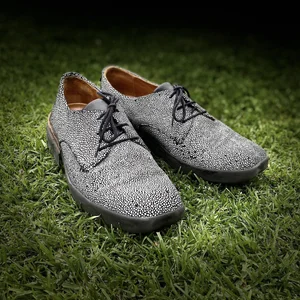
What Makes a Shoe Iconic? Birkenstock and Clarks Originals
Available on Spotify and Apple Podcasts:
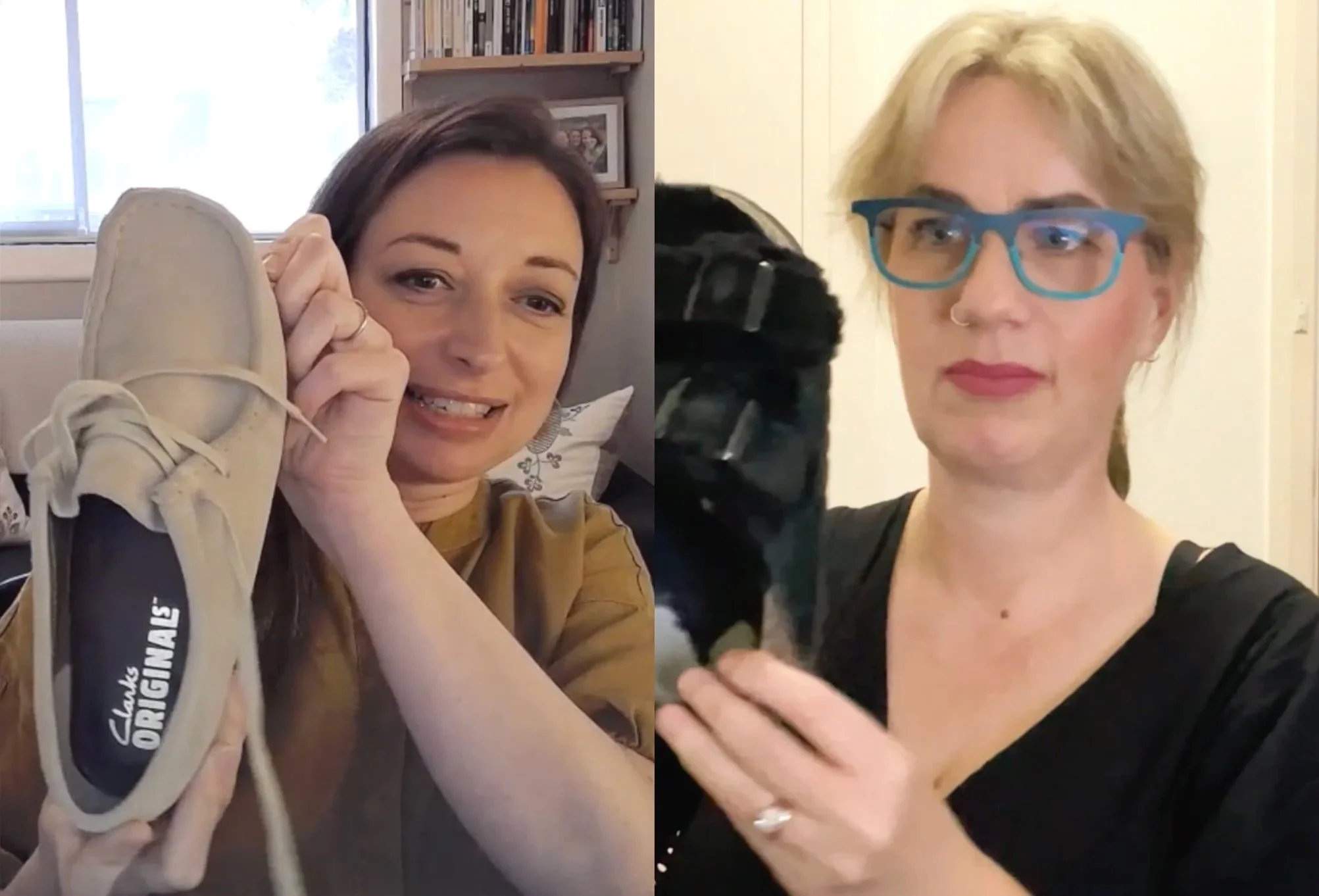
Dr. Alexandra Sherlock with her Clarks Originals Wallabies (left) and Dr. Emily Brayshaw with her Birkenstock Arizonas, 2026.
Overview:
What makes a shoe iconic, and what can iconic shoes teach us about sustainability, design, and cultural exchange? Dr. Emily Brayshaw and Dr. Alexandra Sherlock bring together their research on Birkenstock and Clarks Originals to explore how shoes become long-lasting cultural objects.
This conversation traces the journey of the Arizona sandal and Desert Boot from their origins in post-war German design philosophies (Bauhaus, Ulm School) and African cultures to their unexpected adoption by communities worldwide, from Jamaican musicians to Sydney's lesbian scene, from Silicon Valley's Steve Jobs to Gen Z's comfort revolution.
Emily and Alex discuss the role of business archives in authentic storytelling, how costume designers deploy shoes as narrative devices in film, why different shoes require different sustainability approaches, from repair programs for emotionally durable icons to biodegradable materials for more ephemeral styles, and how brands should listen to culture rather than trying to control it. Drawing on Appadurai and Kopytoff's theories of things in motion, they reveal how following shoes' social lives and biographies illuminates human values and creates a pathway to meaningful, relevant and sustainable design.
Credits:
Presenters: Dr. Alexandra Sherlock and Dr. Emily Brayshaw
Editor: Dr. Alexandra Sherlock
Links:
ACADEMIC PUBLICATIONS & RESEARCH
Alexandra's FRN Article about "Learning from the Social Lives of Shoes: A Cultural Approach to Sustainability"
Emily's FRN article about Birkenstock’s 250th Anniversary Book
The Society for Business History (Gesellschaft für Unternehmensgeschichte)
BOOKS AND ARTICLES
Appadurai, A. (ed.) (1986), The Social Lives of Things: Commodities in Cultural Perspective, Cambridge University Press: Cambridge (mentioned at 1:00:45)
Chapter: "The Cultural Biography of Things: Commoditization as Process" (mentioned at 1:01:22), by Igor Kopytoff, in The Social Lives of Things (above)
Newman, A. (2025), From Somerset to the World: Clarks As A Visual History, 1825 – 2025, One Love Books: London (mentioned at 25:44)
E. Brayshaw, “Birkenstock in Australia 1992 to 2002: A Stable Shoe for Shifting Terrains”, in Schneider-Braunberger, A. (ed.), (2024) Birkenstock: History of a Universal and Zeitgeist Brand, Prestel: Munich
E. Brayshaw, “From Hilarious Hippies to Hair-raising Horror: Thirty Years of Birkenstock Shoes in Film”, in Schneider-Braunberger, A. (ed.), (2024) Birkenstock: History of a Universal and Zeitgeist Brand, Prestel: Munich
Fingers, A. (2012), Clarks in Jamaica, One Love Books: London (mentioned at 41:44)
S. Woodward, "Accidentally Sustainable? Ethnographic Approaches to Clothing Practices", in Fletcher, K. and Tham, M., (2014) Routledge Handbook of Sustainability and Fashion, Routledge: London (mentioned at 57:20)
Griswold, W. (1987), ‘A methodological framework for the sociology of culture’, Sociological Methodology, 17, pp. 1–35, https://doi.org/10.2307/271027 (mentioned at 44:21)
ARCHIVES & MUSEUMS
The Birkenstock Group’s Archive is privately held in Germany. Recent details of the company’s use for design can be found in the press release, “Celebrating the Archive”
ADDITIONAL RESOURCES
Conversation article by Dr. Alexandra Sherlock and Prof. Andrew Groves: ‘8th Street Samba: here’s why the authentic collaboration behind the ‘perfect sneaker’ matters’
Emmy Lombard’s FRN article about the African origins of the Desert Boot
Chapters:
00:00 - Show Intro
00:49 - Episode Introduction
02:28 - Acknowledgment of Country - An Explainer for International Listeners
05:56 - The Social Lives of Clarks Originals and Birkenstocks
07:17 - Research Foundations: Clarks and Cultural Sustainability
08:39 - Archetypes: The Arizona and the Desert Boot
10:41 - Post-War Design Philosophy: Form Follows Function
14:07 - Steve Jobs and the Power of Simplicity
16:22 - Counterculture: From Hippies to Tech Visionaries
20:40 - Archives and Anniversary Books
23:13 - The Alfred Gillett Trust: Preserving Heritage
26:19 - Icons Without Advertising
28:02 - Queer Birkenstocks: Sydney's Lesbian Community
31:10 - Jamaica Claims the Desert Boot
32:15 - Hippies, Grunge, Gen Z: Meanings That Don't Compete
34:22 - Sticky Objects: Shoes That Attract Communities
35:05 - Ageless and Timeless: From 7 to 70
36:31 - Wu-Tang and Granddad: Cross-Generational Appeal
41:21 - Jamaica and Authentic Storytelling
44:05 - When Shoes Become Cultural Objects
44:32 - Costume design and characterisation
44:42 - Costume Design: Shoes as Narrative Devices
49:08 - The Symbolic Power of Footwear
49:38 - Brands as Listeners: The Importance of Cultural Capital
50:54 - World Shoes
52:29 - Cultural Exchange and Collaboration
54:33 - Gen Z, Authenticity, and Finding Your Tribe
54:45 - Building Cultural Capital
55:29 - Sustainability Through Meaning
55:42 - Accidentally Sustainable
56:56 - Repair, Patina, and Memory
59:15 - Horses for Courses: Different Models for Different Shoes
01:00:01 - A Social Lives Methodology: Following the Things Themselves
01:02:45 - Episode Outro
Transcript:
00:00 - Show Intro
Emily Brayshaw (00:11)
What if shoes could speak? What might their stories and the stories of those who make and wear them tell us about the ways we live, our values and our impact on the world?
Alexandra Sherlock (00:24)
Welcome to the Social Lives of Shoes, a podcast brought to you by the Footwear Research Network that brings to life one of the most underestimated and humble aspects of consumer culture.
Emily Brayshaw (00:35)
Whether you design, produce, make, market, sell, or, just wear shoes. These conversations will transform how you think about them and reveal new possibilities for a more sustainable future.
Emily Brayshaw (00:49)
OK, so hey, everyone. I'm Dr. Emily Brayshaw. Welcome to the social lives of shoes. On today's episodes, we are thinking about what we can learn from iconic shoes. So we're going to be looking at the stories and meanings associated with iconic shoes like the Birkenstock Arizona and Clarks Original Desert Boot, Desert Trek or Wallaby. We're going to be looking at how brands engage with and sustain the cultural meanings of their shoes. And we're also going to be talking about how brands might navigate the delicate balance between cultural value and commercialisation.
Alexandra Sherlock (01:30)
So I'm so excited to join you today, Emily, on this wonderful episode that brings our research together. So I'm Dr. Alexandra yeah, hopefully we've got an interesting episode of just generally free flowing conversation today. One thing that I've noticed in the few, is it years now that we've known each other? We both really like to talk, don't we Emily?
Emily Brayshaw (01:50)
I think it is. God, I could talk the hind leg off a donkey. Actually, I could talk the shoes off a horse.
Alexandra Sherlock (02:01)
So, this is pre-recorded and I think we will be making use of Riverside's editing facilities to cut down on the amount of talking potentially that is happening. But I really hope that actually these conversations will be enjoyable and engaging for listeners. We have got notes in the background to kind of keep us on track and keep us in the narrative.
Emily Brayshaw (02:23)
Very important.
Alexandra Sherlock
But I think part of what makes us us is that we do tend to go off on little tangents occasionally, and I hope that that is interesting for listeners.
I guess I just wanted to start as well by ⁓ we're both based in Australia, aren't we? And in Australia for international listeners, it is traditional to start with an acknowledgement of Country, to just acknowledge whose Country we're both speaking from. We're in different places in Australia. So I am recording from stolen lands of the Wurundjeri Woiwurrung people of the Kulin Nation known as Victoria and the city of Naam, otherwise known as Melbourne. And I pay my respects to ancestors and elders past and present from who we continue to learn about the importance of cultural knowledge, community, connection to Country and custodianship. Where are you recording from today, Emily?
Emily Brayshaw (03:16)
So I'm based on the Wangal lands of the Eora Nation, which is essentially Balmain in Sydney. And acknowledging Country is so important because Aboriginal and Torres Strait Islanders have experienced a long history of exclusion from Australian history books, the Australian flag, the Australian national anthem, and for many years as well Australian democracy.
So this history of dispossession and colonisation lies at the heart of the disparity between Aboriginal and Torres Strait Islander and other Australians today. And so by including recognition of Aboriginal and Torres Strait Islander peoples in events such as this, meetings, national symbols, acknowledging Country like we have done it kind of contributes to ending this exclusion that has been so damaging. And so essentially incorporating acknowledgement protocols recognizes their continuing legacy as the traditional owners of this land and it shows them respect. Their sovereignty was never ceded.
I think acknowledging Country is super important as well for us, particularly as we are discussing shoes. For millennia, First Nations people all around the world have been doing amazing things for their environments and this is another important dimension that I like to think about as well.
Alexandra Sherlock (04:50)
It is and I think as well, I'm hoping that that is actually something that we're to be able to focus on in a particular few episodes. We've got a really exciting schedule of interviews and topics to discuss over the coming year. And much of that is around some of these conversations around culture and footwear.
Emily Brayshaw (04:58)
Absolutely.
Alexandra Sherlock (05:11)
This is a podcast brought to you by the Footwear Research Network which is very much a global network of footwear experts and academics around the world. And many of you around the world will be in other places that are encountering similar conversations.
It is the summertime we're recording the end of 2025, just before Christmas for broadcast, think in 2026. What temperature is it with you, Emily?
Emily Brayshaw (05:41)
Oh we've got a balmy 41 degrees here where I am.
Alexandra Sherlock (05:45)
yeah, I think I haven't been out today but I've got the air conditioning on. I know it was 38 degrees here yesterday What are you wearing today, Emily? Are you wearing?
Emily Brayshaw (05:54)
⁓ On my feet, I hope you mean.
Well, it is Birkenstock weather. Yep, got my Arizonas on, just keeping the feet cool and comfy. Um, you know, and we will be talking about Birkenstock Arizonas today. So perhaps this is part of their social lives, right? They found their way, you know, before I did the research on Birkenstocks, I had never worn them, because I was like, oh my God, these are the ugliest frickin shoes. I am not wearing those. And then, you know, Birkenstock commissioned me to write two book chapters for them for their 250th anniversary book. And I thought, oh, I've been doing all this research. I’d better buy myself a pair and find out what the fuss is all about. I cannot take them off my feet. They are so freaking comfortable. I cannot believe it. Yeah. So I'm a convert.
Alexandra Sherlock (06:45)
That is quite funny.
Well I am wearing my Clarks Desert boots today, which funnily enough are also very well equipped for hot climates. And as we have found with their adoption in, well, originating from Africa, but also in Jamaica. And these ones that I bought recently, I similarly to you never thought I would ever be wearing a pair of Wallabies.
Emily Brayshaw (06:52)
Yay!
Alexandra Sherlock (07:18)
So this relates to some research that I did for my PhD with Clarks International. And I've sort of summarized some of that research into a journal article recently called ‘Learning from the Social Lives of Shoes: A Cultural Approach to Sustainability’. And it was taking some of the learning from spending time at Clarks Headquarters and understanding the stories, I suppose, of the different stages of the lives of iconic Clarks Originals shoes. So I'm talking specifically about the Desert Boot, the Desert Trek and the Wallaby to understand how they gain value.
Emily Brayshaw (07:59)
And that's really what is so at the heart of this podcast, I think, are these stories, you know, why they become popular, maybe with a particular subculture or a particular group of people or, you know, it can even be, the first person who decided it would be a good idea to make them or when they first appeared in Australia, like if they are a global brand and how people's views and the meanings of these objects change over time. The cultural meanings that people enscribe, I guess, onto these shoes have changed radically in the last 50 years.
Alexandra Sherlock (08:39)
They have and what I find really interesting about these particular archetypes, so I've obviously mentioned the Clarks Originals archetypes, but what is it for Birkenstock? It would be the Arizona. Yeah.
Emily Brayshaw (08:49)
It is definitely the Arizona. That's the one that everybody thinks of. So that was first invented in 1973. Shout out to the Arizona. That's when it was released. And that's the classic two strap Birkenstock. Yeah. really when people think of the Ugly Birkenstock, they're thinking of the Arizona.
Alexandra Sherlock (09:11)
And so what I find really interesting as well is sometimes with these iconic shoes it can actually be quite difficult to trace it back to the origin because what we find is that inspiration may have been taken from somewhere and then they go through these kind of various ⁓ iterations or lives I suppose.
So I just find it really interesting this idea of any brand really claiming ownership over a particular, iconic or archetypal style when these styles are just so enmeshed over time into all of these diverse kind of cultural stories And I think probably for you and I, Emily, and this is sort of zooming forward a little bit, but but I think we can return to this at the end have identified Birkenstocks and Clarks Originals as brands or in the case of Clarks Originals, like a sub brand that really do kind of think about and acknowledge, those social lives of their shoes incorporate those into their own storytelling to really celebrate that authenticity.
And as you said, sort of at the beginning, the delicate balance then that can happen in terms of really being careful not to commercialise it so much that it kind of kills that authenticity. And I think this is probably a really important conversation for many brands that find themselves custodians of what we might call, I guess, cultural objects that these kind of iconic shoes become.
Emily Brayshaw (10:41)
It is. And it's interesting you talk about sort of the heritage and the legacy of these shoes as well. So, a lot of contemporary footwear today comes from post-World War II. Things like Dr. Martin's boots, for example, sprung up after [World War II] you were saying Clarks, like the Desert Boots. Even these Birkenstocks, you know, came up around 1963 was the Madrid because you know every now and then in in the world there'll be some kind of massive event that creates a shift in how we live our lives and what we want from the objects that we live with and I think something that's really interesting with Birkenstock I was looking at it today is ⁓ since about the 1890s, I think they've really been focused first and foremost on supporting the feet and making it comfortable. And that's something that's always been at the center of what they do. Historically, you know, First Nations shoe styles and shoes that have been around for millennia, obviously Birkenstock aren't the first people to have ever made sandals or thongs or clogs, you know, but incorporating this idea first and foot most of an orthopedic shoe. First and foot most, that's exactly what it is though, right? Exactly what it is.
Alexandra Sherlock (12:10)
first and foot most, you said. There's so many puns. This is such a pun-rich topic.
Emily Brayshaw (12:19)
We could even get listeners to like, you know, give us their shoe pun of the week, you know?
Alexandra Sherlock (12:25)
Yeah, absolutely. So yeah, sorry, I totally interrupted you. First and foremost, yeah.
Emily Brayshaw (12:28)
Yeah, no, no, absolutely. So you know, first and foot foremost, ⁓ it was, designed for orthopedic use to support people, to heal people. And then it's sort of kind of quietly. That's where it evolved from, it took a life of its own. And I think that's kind of interesting, too, in that Karl Birkenstock Again, post World War II, where he's designing sort of in this school that comes out of Bauhaus. ⁓ It's sort of around the same time that the ⁓ Ulm School of Design with Dieter Rams, who kind of really got this very, very streamlined aesthetic in the sixties for electrical appliances, which actually influenced Apple and Apple designs. And this is kind of, I guess, if we're to be moving on to this idea of iconic footwear is it comes from this school of design thinking,
Alexandra Sherlock (13:19)
Hmm.
Emily Brayshaw (13:33)
So it's really looking at these principles of good design that were developed in Germany and also talked about in Switzerland in the 50s and 60s. This idea of being fit for purpose, being kind of streamlined, this relationship of the person to the object, ⁓ you know, using as few materials as possible, you know, and we see all of these principles in these early sort of the Madrid and the Arizona where it's just all been stripped back. That's what we have. And that's the focus. Yeah.
Alexandra Sherlock (14:07)
Well, I've got ⁓ a very interesting quote here that relates exactly to what you're saying. I wrote an article a while ago the Footwear Research Network about why Steve Jobs' Birkenstocks went for 21,000 US dollars or something at auction. ⁓
Emily Brayshaw (14:27)
They went for more than that, I think.
Alexandra Sherlock (14:28)
because he was a very famous Birkenstock wearer, wasn't he?
Emily Brayshaw (14:32)
He was, absolutely.
Alexandra Sherlock
And he was sort of inseparable. And this is what I find fascinating actually about the social lives of shoes. How, and you talked a little bit about how they sort of develop a life of their own. These iconic shoes, what we find is actually through their appearances on various feet throughout time, they sort of assume the character of those people. And also those people assume the character
Alexandra Sherlock (14:56)
of the shoes and I found this really amazing quote by Jobs ex-partner Chrisann Brennan I think who explained "the sandals were part of his simple side he was convinced of the intelligence and practicality of the design Birkenstocks he didn't feel like a businessman so he had the freedom to think creatively" and I think this kind of strikes to the core of our shoes, you know, starting with our feet, how we hold ourselves, how we walk, how they mediate our interaction with our environment, really have a huge influence on even how we think and how we behave and the things that we're able to do or feel able to do and we find that don't we when people feel that they have to wear a particular pair of shoes to perform a particular function, you know, sometimes you hear about women high heels to go into a meeting.
Emily Brayshaw (15:49)
Or athletes wearing the right shoes for the job, or safety boots.
Alexandra Sherlock (15:53)
I think what I find really fascinating is you've got the functional capability of them and certainly with my research with Clarks Originals wearers, the reason why they would wear their Clarks Originals so much is because they were so comfortable and they were so useful in all sorts of different climates and they have achieved popularity all around the world because of that. But also it's the cultural meanings that they acquire over time because of their associations with different people events and so on
Emily Brayshaw (16:24)
And that's, well, that's something that really came up with Steve Jobs, right? ⁓ Because also, so you get the ⁓ Birkenstocks first coming to America in the mid 1960s and a woman whose name escapes me, because I've got a brain like a sieve, was on holidays in Europe and an American woman, Margaret someone, and her feet were killing her.
And so she bought a pair of Birkenstocks and she was like, oh my God, these are so comfortable. America has to know about these. And so she took them back to the States. But the only sort of place that she could really sell them ⁓ because they were considered kind of ugly ~ was through health food stores. And this kind of got tied up with like the countercultural movement and hippies. Right. They sort of became the shoe of the hippie. And of course, with the Arizona being released in 1973, that's also part of this countercultural [movement] hippies just took to it like a duck to water because they're so comfortable, so practical.
But what's really interesting is Stewart Brand was one of Steve Jobs's idols, mentors in this tech space. And you have really in the very late 60s, early 70s, the rise of what they sort of call the hippie internet or the Whole Earth Catalog, which was like this shopping catalog that you could buy. And even though was kind of a lot of the items might have been impractical or expensive, it was kind of fostering ways to get people thinking of building an alternative world. And Stewart Brand was very influential in, you know, he was kind of the guy who set this up.
And it's just so interesting you know, I think Birkenstock's got a mention in the Whole Earth catalog as well. And so you've got kind of this also this movement splitting with counterculture where you get like the back to the earth hippies on the one side, but then you also get like the technology is going to save us hippies like Stewart Brand and then Steve Jobs is sort of coming a little bit later in the mid 70s out of this counterculture. And so by wearing these shoes, Jobs is also again, you know, this idea of being able to think creatively that you mentioned is also around sort of really kind of keeping himself grounded through his feet on this idea of, yeah, we're going to change the world.
Alexandra Sherlock (19:06)
Yeah. Yeah.
Emily Brayshaw (19:13)
And the aesthetics of these shoes as well being tied to these German schools of streamlined minimalist design that really Jobs loved. And we see that legacy today in our techware. It's, you know, it's just an incredible story.
Alexandra Sherlock (19:26)
So I love, yeah, I mean, I love, it is and I love the idea that the Birkenstocks are like the Apple laptop for the feet or, you know, like the, yeah. I think they
Emily Brayshaw (19:38)
kind of are in a way, except they haven't really changed. And I think that's what's interesting too. So, you know, Birkenstock might do collabs. You know, they did a collab with Valentino. They did a collab with Manolo Blahnik, but it's always been the footbed. And then the designers come and maybe will change the straps. You know, they might do diamante buckles or they might do like a velvet straps or something like that. But it's
Alexandra Sherlock (19:56)
Yeah.
Emily Brayshaw (20:07)
Always that foot bed, always the basis is there.
Alexandra Sherlock (20:08)
Yeah, so I want to come back to this idea around collaborations because I think this idea of iconic shoes being a canvas through which to tell different stories and bring different stories together is really, really important. I want to come back to. But what I want to do just quickly first is Emily, tell us how you came to study Birkenstocks in the first place. and tell us about the book that you were working on as well, because I think that gives us a bit more of an insight into, well, how you've approached, I guess, the social lives of shoes So yeah. How did you come to Birkenstocks? What did you do and what did you find?
Emily Brayshaw (20:47)
That's a great question. So ⁓ I speak German. I lived in Germany for a number of years. I studied at university there and that's on my academic profile. And so in Germany, there's a really strong tradition of industrial archives, but also pride around craftsmanship.
And this really comes through from the 19th century. And so there's a lot of German companies will have archives. A lot of them have been around because Germany, ⁓ you know, the different regions of Germany have been around a lot longer. ⁓ And so they've got kind of these stories. So there's an association called the Gesellschaft fuer Unternehmensgeschichte or the I guess you call it the society or association of business histories. And it's made up of like academics and historians. And basically these German companies will contact them to commission either having a historian come in and like tidy up their archives or write a piece about them.
And in 2024, Birkenstock was turning 250 years old as a company. And so this organisation for business history in Germany Birkenstock got in touch with them and commissioned an academic book, basically. So this association contacted fashion and dress historians from all around the world. There's a chapter in there about Birkenstocks in London, in Japan. There were German scholars working on it, scholars in America. And they reached out to me. And because I'm a costume designer and a fashion historian as well, they wanted a history of Birkenstocks in Australia and a history of Birkenstocks in film. And so I was able to focus on the last 30 years really. And that's the business. ⁓ and it was a paid opportunity for me as well. yeah, full disclosure there.
Alexandra Sherlock (22:59)
Yeah, which is...
Well, look, I think there's a few things that I just want to tap into there. If anyone can see me through the video, I am looking at my bookshelves because I'm trying to find the copy of the book that you contributed posted, didn't we, a little summary, I think, when the book was released on the Footwear Research Network. So I'll put the link to that in the show notes and people can go and look at a little brief overview. But
Emily Brayshaw (23:14)
Hmm. that's a great idea. Yeah.
Alexandra Sherlock (23:26)
There's so much there that kind of tallies with I think what I found through my research with Clarks Originals as well. First of all, the importance I guess of business archives, brand archives that I think obviously Birkenstocks have really invested in over the years. But also Clarks have their own archive. When I say Clarks have their own archive, they have a trust. So for anyone that doesn't know, the Clarks family was a Quaker family based in England and the company really employed most of the people in the area of Street and it became a real kind of shoe making area.
And so the family set up a trust, the Alfred Gillett, Trust to collect and hold the family archive and I worked closely with the archivist there, well the business historian there who I worked with during my research when I was doing my PhD sort of tracing the different stories through the different points of their value chain I suppose. And that archive has been such a huge asset to the I know the Clarks Originals team certainly when I was doing the research in 2012 worked very closely with Tim Crumplin in the archive to think about you know the legacies of those shoes, the past styles which really I think helped them remain connected to those values that we've been talking about.
And so I think what I found really great about the fact that Birkenstock commissioned all of these historians to do chapters on the book is really showing an engagement with that history, acknowledgement of that history, which actually serves lots of purposes. It shows consumers about the legacy and the value and authenticity of the product, but it also actually keeps the brand and everyone that works on it in touch with the values that make them what they are rather than of you know chasing trends and that kind of thing and I think that's a function actually that Alfred Gillett Trust known as the Clarks Archive sort of performs there as well and I was really heartened recently that the archive in Street has now opened the Shoemakers Museum.
Emily Brayshaw (25:43)
That’s fantastic.
Alexandra Sherlock (25:44)
And I just think, and look, this is gonna be a future episode because what I want to do is actually get archivists and curators in to actually talk about the importance of having brand archives, but also sort community-held archives to be able to remind ourselves of these values and these identities. But yeah, so I'm so glad that you mentioned that this commemorative book, anniversary book, and equally I think Clarks have just had their ⁓ 200th anniversary and they've produced a book as well which funnily enough is by another Alexander, Alexander Newman, who this is a beautifully illustrated book it's not so much of an academic book I'm supposed to be working on the academic book around Clarks in progress but beautiful kind of stories I guess about the heritage.
Emily Brayshaw (26:27)
Hahaha! I think that's a really good point though that you make about archives and stories and heritage, but also like around ⁓ something being iconic and what makes it iconic because this idea of the icon is a very visual idea, right? it's a visual thing and so you see this shoe and you immediately recognize what it. What's really interesting is ⁓ if you think about it, you never ever see an advertisement for Birkenstocks. Never. You will never see them. And because they don't advertise, they don't pay for product placement in movies or TV shows.
You know, if costumers want to use them, then they will, contact the firm directly or they will just, costume away as they will. And I think what is really important there is that by using these archives, we've actually uncovered the stories and the meanings that people themselves have laid onto these shoes, right? They're not being told what it means. It's not like, oh, buy this luxury perfume and you'll smell sexy and meet the man of your dreams. You know, it's just like, yeah, this is a shoe. You know, take it or leave it. And so you've got these communities that grew up around that grew up
Emily Brayshaw (28:18)
like wearing Birkenstocks, you know, in Sydney, for example, it's a lesbian community. They're very much a lesbian shoe historically, and they're part of like what's known as a lesbian clone style, you know, like the short hair, the dog on a string, the shorts, the sensible ugly shoes. Yeah, it was. Yeah, yeah. And yeah. And, you know, we see that like in a lot of, ⁓ you know, lot of lesbians
Alexandra Sherlock (28:36)
So this is one of your chapters, wasn't it? This is one of your chapters that you wrote. Yeah, the queer history of Birkenstocks. Yeah.
Emily Brayshaw (28:47)
wearing similar style around the world. Like it's instantly recognizable and picked up. But I think that's also because there's no heteronormative marketing. There's no like, you know, and they're also androgynous, right? So it's not like you only ever see pictures of women wearing Birkenstocks or you only ever see pictures of men. So it's a genderless shoe. And so it's as much word of mouth as well. So people talk about their experiences wearing them or their experiences in buying them or maybe, you know, they'll think about an experience or a time where they wore them to an occasion. So, for example, my work on Birkenstocks in Sydney, for example, Birkenstocks came kind of late to Australia, like their first store only really opened in the early 90s.
And they're ⁓ Melbourne based. but right from the beginning, like I'm like, ⁓ so I'm in Sydney. What about Birkenstocks in Sydney? And then I thought, that's a queer shoe. You know, that's lesbians, Birkenstocks. And of course, being an academic you've got to back it up, right? I'm like, OK, I've got to find me that evidence. If I'm going to say this, I've got to find that evidence. And what was just fascinating was almost as soon as Birkenstocks were available in Australia, I found pictures in the City of Sydney archives of lesbians at the Gay and Lesbian Mardi Gras Parade wearing Birkenstocks. You know, radical feminists at the Reclaim the Night rallies. And you'd see these huge banners of Reclaim the Night. And for global listeners, that's like ⁓ that was an evening nighttime demonstration aimed at highlighting issues around violence against women at night time. And so, you know, you'd have these big banners, photos of these big banners and then the little Birkenstocks poking out the bottom or you know.
Alexandra Sherlock (30:50)
I think again, a lot of the adoption of these shoes by particular communities for particular reasons with particular values, know, ultimately it comes down to the functionality. So you imagine walking around at night and you know, they're very practical shoe, Sydney, cool, you know, all of those kinds of things. this practical shoe. ⁓
Emily Brayshaw (31:07)
Well Lesbians are very practical people. Really practical and footwear is comfortable and hey And it's also sort of part of this androgynous style. So there are so many reasons just to like pick it up. They're also very well made as well. So there's quality there. They're built to last too.
Alexandra Sherlock (31:23
And so, Yeah, and that's not to say that they will forever be, you know, lesbian shoe or a lesbian shoe for everyone because my husband wears them and yeah, and I wear them and so it, but what is fascinating and I think in my research I've talked about because very, very similar situation with Clarks Originals. It's so interesting. They, the Desert Boot, the Desert Trek, the Wallaby. I remember there was a Jamaican wearer that I spoke to actually over email that Tim
Emily Brayshaw (31:34)
Well, yeah exactly.
Alexandra Sherlock (31:54)
put me in touch with who said that if shoes could speak the Desert Boot, I think it was the Desert Boot or it could have been the Desert Trek, would speak patois. It's a Jamaican shoe and no one's stupid enough to claim otherwise. It was something along those lines. It's in one of my articles. And so it is this ability for different communities, different cultures around the world to be able to claim this iconic shoe kind of as their own. And so they have this kind of these multiple meanings and they're not competition with one another they seem
Emily Brayshaw (32:31)
No, that’s an excellent point, this idea that they're not in competition. So, you know, we sort of see them first, they're the back to earth hippies, then they're the techno hippies, then they're, you know, lesbians, then from there, you know, in the 90s, you've got the rise of grunge and deliberately sort of comfortable, slack, ugly dressing and, you know, the grunge kids, they're not in competition with the lesbian movement.
You know, they're just a different group. And even, you know, they became really popular and fashionable in the 2010s, increasingly with the rise of athleisure wear, and dress becoming more casual. And then, of course, you've got like lockdowns because of COVID, which is another one of those massive global shifts that I was talking about earlier that really influenced our footwear and how we move in the world and what we want from our shoes. And of course, after COVID, we just still wanted to be comfortable, right? And Birkenstock's going to do it. So we get Gen Z leaning into these ugly shoes with socks. And of course, you've also then got influencers, right? We have social media now. We're an increasingly visual society. Coming back to this idea of the icon and visuals.
Emily Brayshaw (33:53)
And so things like a really quirky Birkenstock with quirky socks, you know, can really make you stand out on social media. You can express your individuality. You can express that you're part of the tribe. You can also, ⁓ you know, just express that you're comfortable and you DGAF.
Alexandra Sherlock (34:02)
Yeah. Mm. My goodness, everything that you're saying resonates so much yeah, I think in my research, I described these particular iconic shoes, which I would definitely describe Arizona and the Desert Boot. And then you've got the Air Jordan, the Croc and you've got, you know, all of these kind of different styles as sticky. They're kind of sticky objects. They seem to attract different kinds of wearers to the extent that those kind of wearers get stuck on those shoes and the shoes become those communities, those meanings, those cultures and those cultures become the shoes. There's this beautiful kind of dialogue I suppose where they make one another meaning.
Emily Brayshaw (34:54)
They do and I think with these shoes too and the comfort is they then become ageless. Right? And so, you know, you can wear Birkenstocks if you're 70 or if you're 7, you know, and that's sort of something too with the Birkenstock journey is, people grew up wearing them and now they're older, they still wear them because originally they are an orthopedic shoe. So you might start wearing them to signal something. But now that you're older, you, you know, they're just so damn comfortable on your poor old back and your feet arches and this idea of sticky and iconic and and growing up I think it's really interesting that you mentioned Crocs because we are seeing this happening now in real time in our lives. So Crocs were first invented around 2004. So they're only a very, very recent shoe. And we sort of see, oh, know, Gen Z gets slammed to the wall for wearing Crocs. And it's like, well, a lot of them got their first pairs of Crocs when they were teeny tiny kids, because they're super practical if you've got a toddler, right? They're no slip, you hose them out, you stick it back on your feet.
Alexandra Sherlock (35:51)
Yeah. Yeah. And look, I'm not, I'm not Gen Z but I wear Crocs in the garden. And I know lots of other people do because of their sheer functionality and, and they do what you need them to do. And, and so I think this speaks to the timelessness Crocs absolutely without a shadow of doubt are one of those iconic shoes that will, will not die. I don't think they will ever die.
Emily Brayshaw (36:18)
Yeah. Yeah, but they're all so sticky, right? But because they're sticky, right? They're sticking with the wearer. I wore them when I was a little kid. Why can't I wear them now that I'm 25? Why can't I wear them when I'm 50?
Alexandra Sherlock (36:36)
Yeah. Yeah. I remember I read an article where there was this like really cool DJ who was saying the thing I love about, I think it was Wallabies is that my granddad wears them and also like Wu Tang Clan wear them. And that they have this capacity to cross generations. And there's a beautiful connection there that happens between generations because of this kind of timelessness.
I do remember having conversations with one of my participants and because all of these iconic shoes go through the peaks and the troughs of trends, right? So they will have their peak where they will be selling everywhere. And I know some of my Clarks Originals wearers that I interviewed in focus groups considered themselves to be the really authentic wearers. And in a sense fashion turned them off. So I just kind of said know, well what happens then if you the shoes that you have worn forever become fashionable? Would that stop you wearing them? And he was just like no, wouldn't stop me wearing them because they're just too useful. They're too functional. They're part of my identity. So I found that really interesting.
And also the other thing is that I think often with these iconic shoes because you have different turnovers of teams and staff you have teams that can be really sensitive and in touch with the cultural meanings of the shoes to the extent that they know what they can and can't do with them in terms of collaborations, campaigns, you know, sponsorships, advertising, like you say, advertising. So you could have a really authentic product that a new marketing team could come in who don't have the cultural capital that don't have the knowledge about the cultural significance of those shoes and make marketing decision that actually undermines or kind of like maybe sells out a bit or kind over commercializes on those meanings.
But when I was interviewing it was Marijka Bruggink who was the I think senior designer of Clarks Originals back in 2012 I said does it worry you that you know that one day something might happen and and a decision will be made and you know, whatever and she said no it doesn't because these shoes like have a life of their own they will die down and they will you know kind of Become everywhere and then people will lose interest, But they always come back. They will always find a place again for a new generation for a different reason and I think ultimately again it comes down to the functionality the materials and that iconic classic silhouette that is unmistakable and if you think about each of those iconic shoes and I've mentioned some of them but they all have a significant silhouette that never changes that you can't mess about too much so even collaborations they just change like exactly like you say they keep the silhouette they keep the pattern but they change the materials to bring a different story in or yeah like you say that with
Emily Brayshaw (40:00)
Yeah, yeah. So, know, Manolo Blahnik, Valentino, they're very, very high fashion, you know, and this was all happening around the time that, you know, the Barbie movie comes out and Birkenstock's become sort of a visual metaphor for the real world and not fun and comfy shoes and their crazy Barbies, actually the lesbian Barbie. So played by an actress who is in fact a queer actress. So you know, there are all these kind of meanings and layers all on top of them. they're very, the costume designers are very aware of all of these layers of meanings and are tapping into absolutely all of them. and I think this idea of like the generations as well and the silhouettes is important too. So Dr Martens boots, for example, we might do an episode on those, but again, they're another one with an iconic silhouette. They were first released on the 1st of April 1960. So they're called the 1460s because of that. And Pete Townsend of The Who famously wore them on stage because they are so comfortable and he could kick them up and then they kind of traveled through skinheads, through punks, through goths to grunge.
Emily Brayshaw (41:19)
And now, you know, my daughter, who's a teenager, is wearing Dr. Martens boots, you know, and loves it when I call them the boomer boots because they are the boots of the baby boomers, you know, my generation. But, you know, these iconic styles haven't changed. There've been those collabs, but that silhouette is always there.
Alexandra Sherlock (41:25)
Mm. Yeah, no. And I think when they find themselves, when those shoes find themselves on musicians or sports stars it tends to be so so similarly I think for I was going to mention um Clarks in Jamaica so Al Fingers who also wrote the um recent book the 200 year anniversary book um when I was doing my research remember the head of marketing sort of saying oh and we're working on this thing at the moment this guy came to us and said Clarks are really massive in Jamaica and I really want to do this kind of visual history of it and have all of these amazing images of these Jamaican musicians wearing them and this was something that I think at the time they kind of knew but they certainly weren't really focusing on.
But she was just like she was listening they were listening and they were just like yep we said that we would support him like we didn't pay him because we didn't want to kind of like undermine the authenticity of this thing that was kind of ground-led but we really wanted to support him to just really find out more about you know this this kind of Jamaican legacy and so yeah since then this this kind of Jamaican story has really come through and it's been something that think that Clarks have responded to.
You mentioned earlier about that Birkenstocks don't do adverts and I think this is a really interesting point that I think some of those more authentic marketing strategies are about storytelling and so you've got things like you know this book that sort of emerges from the community from culture but also I've noticed that yeah Clarks Originals now are doing these kind of like mini documentaries that actually pay tribute to these kinds of stories and interview all of the wearers and the musicians and and like the the Wallaby very famously ended up on the feet of Richard Ashcroft on Bittersweet Symphony on the on the album cover and became quite iconic. The Wallaby, which is colloquially kind of known as a geography teacher shoe, ended up on the feet of Walter White in Breaking Bad. Because it's kind of like this kind of, it's a boring, ugly shoe that your geography teacher would wear, but also it's a bit deviant, you know, and it's, it's got this whole life in hip-hop and it's got this whole life, other life.
But here I just want to focus really quickly on this idea of endorsements. So you're talking, you mentioned about obviously Barbie and the Birkenstocks ending up on the feet of one of the characters in Barbie
Emily Brayshaw (44:17)
Well, ending up being on the feet of Barbie herself, right? At the end when she joins the real world and goes to the gynecologist.
Alexandra Sherlock (44:23)
It's so symbolic. I sort of feel like the measure of an iconic shoe, you know a shoe has become iconic, you know it's become a cultural object that has "shared significance embodied in form" and that's by Griswold and is when it ends up on TV and movies on the feet of a character. Now you are a costume designer as well as ⁓ a dress historian.
Emily Brayshaw (44:49)
Yes.
Alexandra Sherlock (44:51)
Tell us about the process from a costume designer's perspective about how that happens, what that process is.
Emily Brayshaw (45:00)
Yeah, so basically costume design is a collaboration, right? You're working with the director, you're working, you know, with the actor, you're working, you know, with a team to bring these characters to life. And so also you'll read a script and there'll be like points in the script. It's interesting you talk about films a bit different from stage. You don't always see people's shoes on film. It's mainly kind of lot of the time it's more close ups and upper halves.
Alexandra Sherlock (45:32)
Unless they're being used as a narrative aid, I've noticed. So sometimes the camera will specifically go, won't it? Yeah. Yeah.
Emily Brayshaw (45:35)
Or a comedic device, right? It's a joke, right? And the thing is costume designers are totally aware of, like really good costume designers, every single item that appears on the body of the actor will be imbued with some kind of significance, even if the audience can't see it. Right. There'll be something there. So if you actually spot Birkenstocks on film, the costume designer is leaning into all of the meanings like historically. There's a lot of research that goes into costume design, to good costume design. And so you'll read about the history of an object. You'll read about how these stories around the object have changed.
And then you'll think about the significance of the object to your contemporary audience to decide whether or not you are going to bring those meanings and deliberately choose that object. So a lot of the time, historically in film, Birkenstocks have been used kind of almost like clown shoes, like because they're funny, right? They're ugly shoes. And even since the 1960s, before they popped up in films, they popped up in these satirical underground comix about hippies, right? By people involved in the countercultural movement.
So for film directors to say, I want my character in Birkenstocks or, you know, some kind of reference, they'll be pulling on these aspects of countercultural identity. Right. You know, in 2006, there was a film made called Thank You for Smoking and the ⁓ Senator from Vermont wants to completely regulate smoking and everything. And of course the tobacco lobby is against this. And they portray this Senator from Vermont as an older guy, but you know, in his very traditional looking, you know, politics suit, but he's got Birkenstock's on under the desk. And the director, even went on record saying, nothing tells you how to live your life more than somebody wearing Birkenstocks, you know. I want you to be this way. So they're pulling in these jokes, jokes, jokes, and using them as a comedic device. But then, of course, these stories change and the costume designers are aware of that too. So, you know, there was a movie in 2022 called Do Revenge, which was like a glam teen movie that they wanted to make a bit of a spoof of teen movies as well.And so they're like costumes, also really a visual art as well. So there'll be reference into previous films or previous genres to see what other directors and designers have done. So Do Revenge wanted to kind of be a spoof of like all those 80s and 90s teen movies. So they had one of the characters wearing Birkenstocks because in the movie Clueless, you actually never see Birkenstocks, but the good-natured stoner slacker guy is called Travis Birkenstock. And his backstory is he's the heir to the Birkenstock fortune. ⁓ You know, so it's just all these layers and jokes, but of course, they're fashionable in 2002 [error. I meant 2022] as well. So there's that element as wellYou know.
Alexandra Sherlock (48:52)
Mmm. Yeah so this I just think this capacity for shoes to tell stories ⁓ is because they are so symbolic shoes are so extraordinarily symbolic and I do think that is because of this ⁓ indistinguishable connection they have with their wearers and the communities and the cultures within which they're worn. They become such a powerful narrative device. And I think that's why I'm so excited about,I think with this podcast, you know, really exploring the stories that can be told through shoes in many different kind of perspectives and what those stories can actually teach us about ourselves, our values and who we are, how we relate to other people.
The the article that I wrote recently I think one of the things that I noticed was that the importance of brands to be in touch with all of these stories because as you say, the meanings and significance of iconic shoes as cultural objects is never frozen. It changes, it shifts as fashions change. And as you say, in relation to the environment, the climate, disasters or pandemics, you know, it kind of changes how we use our shoes and the meanings that become attached to them.
And I think possibly one of the most dangerous things brands can do is lose sight of that and just kind of remain closed in within the headquarters and not actually observing what their shoes are doing out there in the world or worse trying to control that narrative through like trademarking and IP-ing when actually it's those lives of the shoes organically as they're behaving out in the world even if they are being copied actually give those shoes their authenticity and their value
So to try and control that narrative I think is a dangerous game. Obviously there are reasons to do that like when shoes enter the popular vocabulary you know iconic shoes or particular brands their names become part of culture you know we've seen things like Kleenex and those kinds of things. Brands actually lose trademark but I think there needs to be balance between saying yes we're the brand that's responsible for these shoes but these shoes actually do belong to the world and we're listening and we're acknowledging those stories that are emerging even if they aren't necessarily the stories that we had envisaged I mean did Birkenstock feel about finding out that their shoe was a lesbian shoe you know and leaning into it yeah
Emily Brayshaw (51:58)
They had no idea. They hadn't actually thought of that because culturally in Germany, they are a shoe that's worn in the home. Right. They're called house shoes and that's why you wear them with socks. You know, because German houses will often have like wooden floors historically or tiles, you know, so you want to protect your feet. So they weren't aware but equally they were delighted, you know, about these stories, about it.
And I think that's why they commissioned this book for their birthday was to get a kind of feel of the gauge of what these stories are around the world, how these shoes are behaving in the wild, who's wearing them, what the meanings are, you know, they doing? Yeah, yeah what are they doing? And I think this kind of plays into this idea of like... we were talking, weren't we, about this idea of the danger of brands kind of commercialising and almost appropriating these cultural meanings but there's a danger there then of killing that authenticity. And so I think it's that kind of importance of listening and acknowledging and collaborating and actually kind of this process of cultural exchange that can happen through responding to these stories. that comes through all of these kind of initiatives I suppose and this is where really good teams earn their stripes is not just taking that story and using it, but it's actually collaborating with those cultures, with those communities to create actually really authentic storytelling where actually both parties are learning about one another and evolving together. And through that process comes this beautiful kind of innovation.
Emily Brayshaw (53:49)
And I think I think we're seeing that a lot too with Gen Z and Gen Alpha as well is authenticity is such an important thing for them, like expressing their identities, expressing their selves, doing it in an authentic way ⁓ increasingly because, you know, their lives are online. They're so curated, their images are so curated.
They're under the microscope all the time, know, ⁓ social media, never know who's going to have your camera be filming you, put it online. And so this idea of like authenticity and being yourself is such a key thing. I think that they are really valuing and, you know, the footwear can play such an important part in this, you know, whether it's like a generational joke that they all love and laugh at, but it's still authentic and still you know, finding your tribe, you know, whether it's having the ugliest Crocs on the block, you know.
Alexandra Sherlock (54:50)
Yeah, that's right. I think sometimes you find brands that try to kind of freeze and capture a cultural moment and the meaning and kind of rely on that.
Emily Brayshaw (54:58)
Yeah. Nothing's gonna kill your brand faster.
Alexandra Sherlock (55:03)
And so I think like one of the recommendations that came out of this article, Learning from the Social Lives of Shoes, that actually listening to culture, building that cultural capital, the cultural knowledge through going out into these communities, understanding, engaging with them and building that really deep embodied knowledge about what the shoes mean and how they achieve that meaning leads to much more authentic business decisions in terms of the kinds of collaborations that one might be involved with or initiate, the kinds of marketing strategies that are appropriate, how many products you produce, you know, not flooding the market. Yeah.
Emily Brayshaw (55:47)
I think also from a sustainability perspective, right, if you're making claims that your brand is sustainable, then don't flood the market.
Alexandra Sherlock (55:57)
Yeah, absolutely. And I think the thing is as well that and this is this is kind of the relationship to sustainability. Like I found that the Clarks original shoes and I would say as well, Birkenstocks are accidentally sustainable not because they're sort of recycled or made from recyclable materials. You know, maybe that could be the case. But because they are so meaningful, because they're so relevant and because they're so...
Emily Brayshaw (56:20)
But they're also deliberately designed. So Birkenstocks are actually designed to be sustainable. So it's not just the cultural meaning for them. It's this physical relationship that you have with the shoe and it molds to the foot. And so they become so bloody comfortable that you just… wear them. And one of the things they did in Australia in response to this sustainability issue was we wear our shoes in Australia very differently from Germany. So in Germany, the shoes [Birkenstocks] are going to be worn ⁓ inside most of the time and you will maybe wear them outside a couple of months of the year. Whereas in Australia, you wear your Birkenstocks all year round and so the soles wear out so much faster.
So one of the first things they did was set up places where you could go and get your Birkenstocks repaired. And so, you know, it's this thinking about sustainability, this long term relationship of keeping that foot bed that you first bought, that is so molded to your feet and then, you know, constantly getting them repaired, getting them fixed, that maintenance.
Alexandra Sherlock (57:20)
Yeah, so this is this I guess this comes back to the my point that I think if the shoe means something to the wearer, if the wearer is able to build that emotional relationship with their shoes and I think Sophie Woodward, you know, she she uses this term accidentally sustainable, there's this saying that the most sustainable shoes are the shoes you already wear. Like as in, the longer you can keep your shoes in use and the longer you keep and wear them, actually that's the best way to kind of, guess, or one of the best ways. We don't have very good solutions for sustainability in relation to footwear production at the moment. So actually this kind of keeping shoes in use. And I think what you've identified there is that people have very, ⁓ we call it emotionally durable. Birkenstocks for example, and also Clarks Originals are emotionally durable. People develop really durable relationships with their shoes that outlast, for example, the soles. And so there's wonderful opportunities for brands to think about other kinds of business models, like you're talking about, like re-soleing. And I've said this before in other interviews that I've done, but I got the sense from my participants that the patina that the shoes develop and everything and the journeys that they've been on, the gigs and the bands that they've been to in those shoes, the uppers outlast the soles. They want to keep all of those memories, they want to keep the leather uppers, they want to keep those shoes in use. They don't probably spend almost as much as a new pair of shoes on re-soaling the ones that are just rich with these memories and these emotions.
Emily Brayshaw (59:20)
Definitely, definitely. And the comfort factor too. That commitment to quality, I think, is really important too. And that's something I think that we need to have more conversations about going forward, these ideas around commitment to quality.
Alexandra Sherlock (59:36)
Yeah, we do. I think, you that's not for everyone. So for example, you know, have runners, you perhaps don't want to keep them for years, But then there's a different business model for that. There's, you know, we make them out of, biodegradable materials, or industrially compatible, or recyclable, or non-toxic. And that's where you get those next generation…
Emily Brayshaw (59:42)
No, that's. Non-toxic glues, yeah.
Alexandra Sherlock (59:57) materials really important. But I think it's horses for courses, isn't it? And really the only way to know how to tackle these kind of sustainability issues ⁓ is to really pay attention to how they're actually being used, their meanings out in the world, and actually how that can inspire that process of innovation and the responses of how you sort of you take that brand forward. And I think just sort of on that note,
Alexandra Sherlock (1:00:23)
I want to finish with this lovely quote that I use often in my research because I think it just sort of coins kind of what I'm talking about here. And so I need to, I'm not sure I mentioned at the beginning of the podcast that the Social Lives of Shoes is inspired by this book, very famous book, particularly in anthropology material culture studies,
Emily Brayshaw (1:00:45)
yes, Appadurai
Alexandra Sherlock (1:00:52)
to ideas around material driven design, user driven design, know, thinking about actually how people are using things and how we're actually designing for use. yes, the
Commodities in Cultural Perspective edited by Arjun Appadurai, very iconic book I've used it really as a foundation for my sort of research methodology. And also the chapter by Igor Koytoff Yeah, it's beautiful.
Emily Brayshaw (1:01:18)
⁓ that's gold, that one. Pure gold.
Alexandra Sherlock (1:01:22)
So it's ‘Cultural Biography of Things, Commoditization as Process’, So, Appadurai argues that to genuinely understand the relationship between people and objects and to comprehend how items gain value, we need to follow the things themselves. And then his quote, he says,
"for their meanings are inscribed in their forms, their uses, their trajectories. It is only through an analysis of these trajectories that we can interpret the human transactions and calculations that enliven things. Thus, even though from a theoretical point of view human actors encode things with significance from a methodological point of view it is the things in motion that illuminate their human and social context".
So unless we're really considering these things in motion we're really not able to understand their value and therefore I guess kind of capitalise on that value I suppose and think about how that value informs kind of more sustainable meaningful relevant products, less destruction of dead stock, less disposal by consumers of things that don't mean anything to them. Yeah, so I think that kind of, I guess summarises maybe this episode a little bit.
Emily Brayshaw (1:02:41)
I think that's a great note to finish on. I hope you've all been enjoying it and we look forward to you joining us on the next one.
Alexandra Sherlock (1:02:50)
Yeah we've taken a few twists and turns, there's been a few little tangents there. to want to it.
Emily Brayshaw (1:02:52)
We have! A winding footpath.
Alexandra Sherlock (1:02:57)
Absolutely.
Brilliant. see you next time.
Emily Brayshaw (1:03:03)
See you next time. Bye!
Alexandra Sherlock (1:03:10)
Thank you so much for listening to this episode of the Social Lives of Shoes brought to you by the Footwear Research Network If you enjoyed this episode, don't forget to follow the show so you're updated when the next one appears. And we'd love to know what you think. Please do feel free to add comments, or contact us on LinkedIn or Instagram.
Alexandra Sherlock (1:03:29)
You can find us at Footwear Research Network.