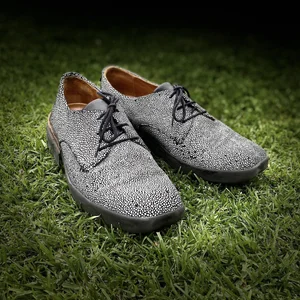
Storytelling Through Shoes: Art, Activism and Social Change with Jo Cope
Available on Spotify and Apple Podcasts:
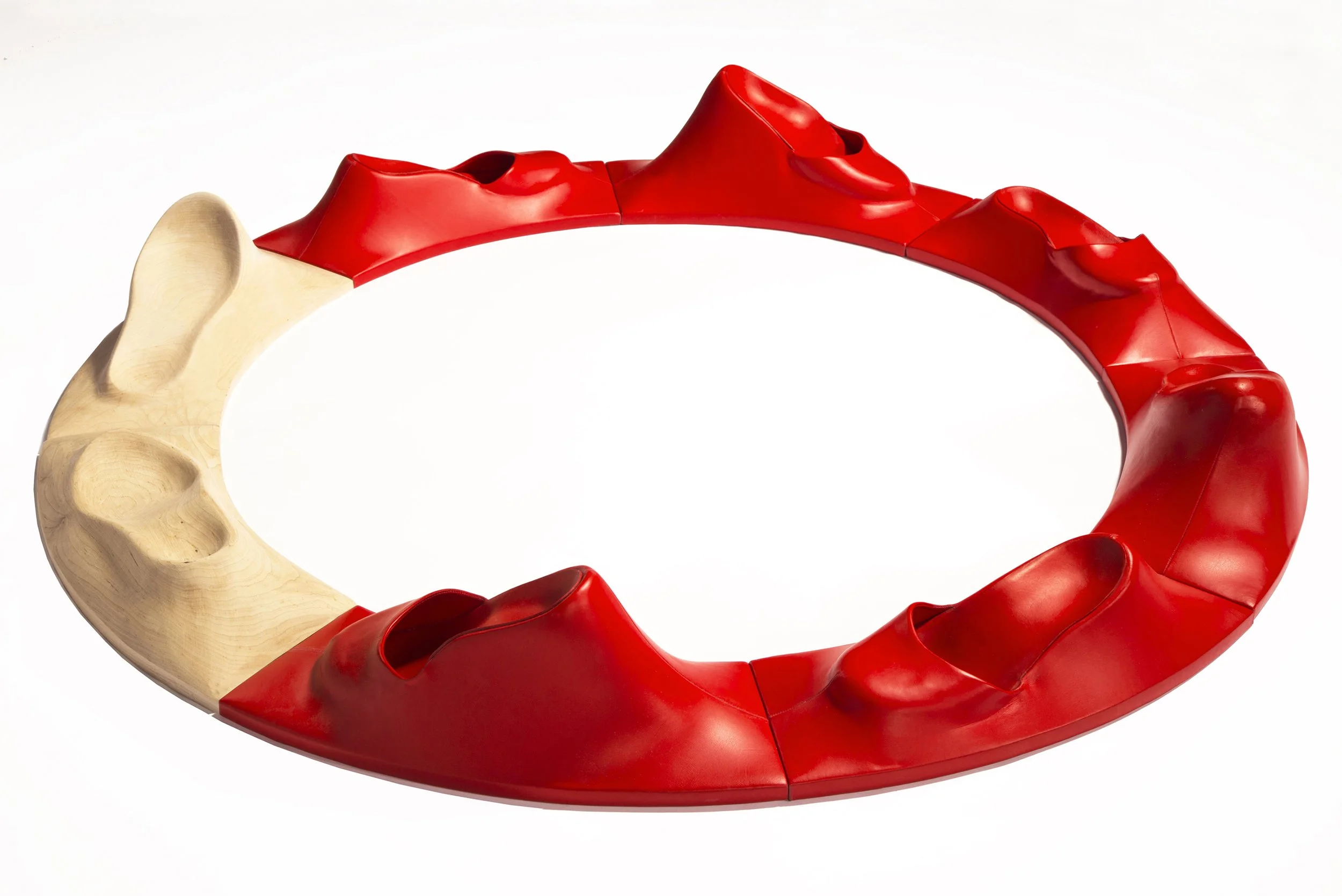
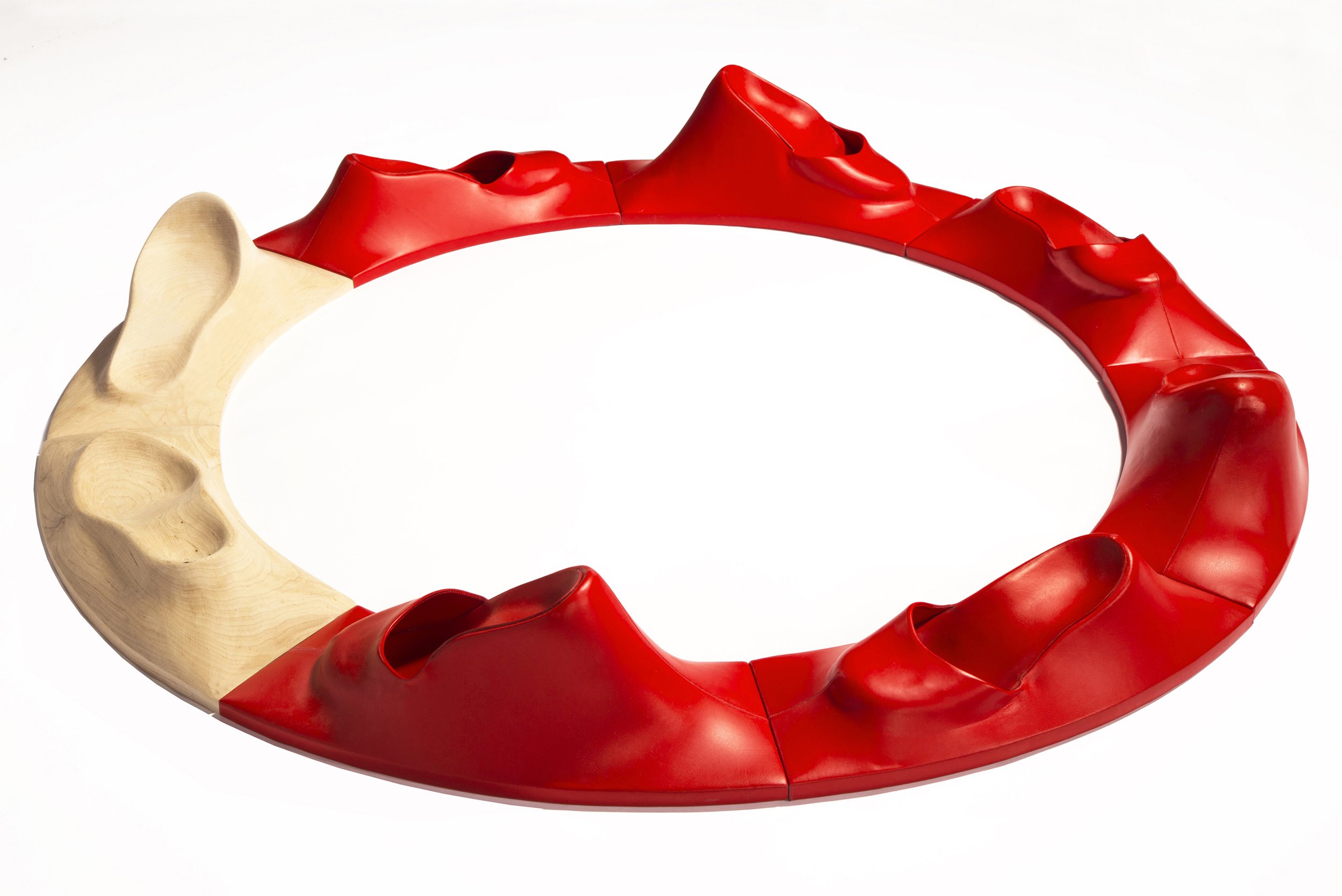
Walking in Circles, Jo Cope, 2016. Photograph: Nigel Essex
Overview
In this episode of the Social Lives of Shoes with Dr. Alexandra Sherlock, contemporary fashion artist Jo Cope joins us to explore shoes as powerful vessels for storytelling and social change. From her collaborative project with Shelter addressing homelessness to her evocative twisted stilettos embodying feminist struggles, Jo reveals how craft and performance art can create empathy and drive meaningful dialogue. We discuss her therapeutic making process, the political power of red shoes, and how footwear can connect communities through shared experience. Jo shares insights from teaching ethical social practice and her current reflections on using art to navigate our challenging political climate—all through the humble yet profound medium of shoes.
Links
Jo Cope's Work:
· Jo Cope's website: https://www.jocope.com
· Jo Cope on Instagram: @jocope_studio
Projects & Exhibitions Mentioned:
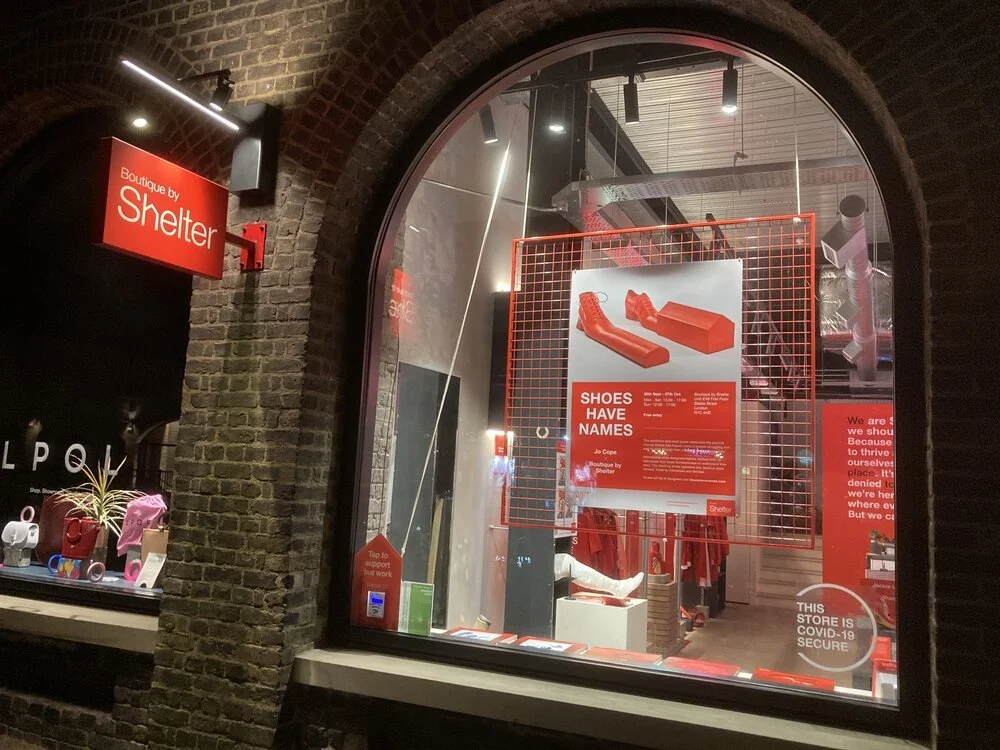
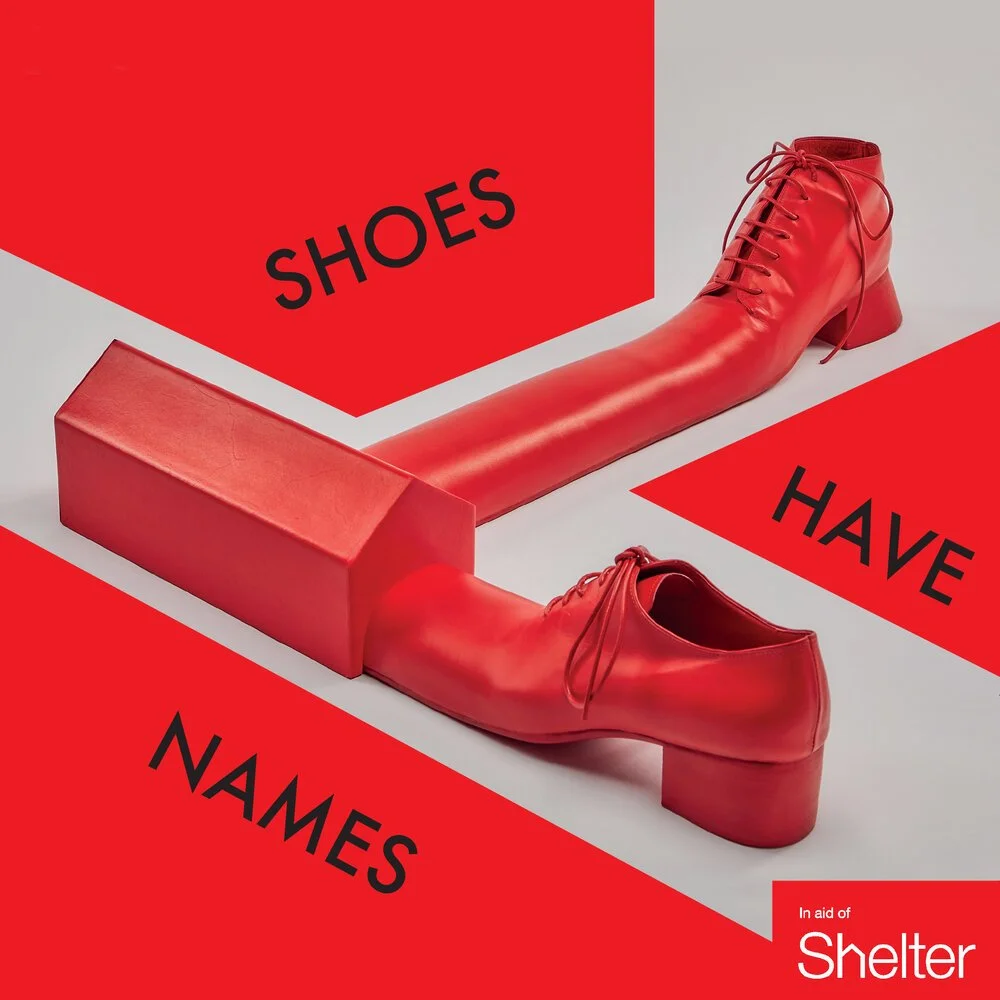
· Shoes Have Names with Shelter, 2020, Coal Drops Yard, London.
· Walking on Water, 2021, Venice Design Biennale
· Global Footprint Project with Northampton Museums and Galleries (Northampton Boot and Shoe Museum)
· No Woman Is an Island of Shoes, 2025, Gallerija Velenje, Slovenia.
· Not all Roses are Romantic, 2022, The Garden Museum, London.
· Art Against Knives project
Organisations & Charities:
· Empathy Museum - A Mile in My Shoes
Educational Institutions:
· London College of Fashion MA Fashion Artefact
· De Montfort University Leicester
Footwear Industry:
· Edward Green shoes (Northampton)
· Northampton Museum and Art Gallery (shoe collection - previously Northampton Boot and Shoe Museum)
Additional Reading:
· Alexandra Sherlock's article about Jo Cope on the Footwear Research Network blog.
Credits
Interviewee: Jo Cope
Interviewer & Presenter: Dr. Alexandra Sherlock
Editor: Dr. Alexandra Sherlock
Photographs: Credits in photograph captions
Chapters
00:00 Show Intro
00:47 Episode Intro: Jo Cope
02:55 The Power of Shoes as Storytellers
04:29 Jo Cope's Artistic Journey and Philosophy
06:52 An unexpected Trojan horse
08:19 Personal Experiences with Shoes
10:28 Educational Journey and Training
15:21 Family Legacy
16:39 Social Justice and Community Engagement through Shoes and Art
20:16 Shoes Have Names: Jo Cope x Shelter
27:22 Exploring Femininity and Feminism through Shoes
32:27 The Colour Red and Taking up Space
34:54 Movement and Performance in Shoe Design
37:11 Transformative Experiences Through Shoes
40:03 Collectivism and Connection Through Interactive Art
41:45 Social Connection and Authentic Experience Through Shoes
45:47 Hand Craft vs. Digital Technology in Shoe Making
50:32 The Importance of Reflection in Creative Practice
52:53 Teaching Ethical Social Practice
56:42 Social Practice as Collaborative Learning
58:35 Future Plans and the Creative Process
01:00:51 Conclusion



Transcript
1. 00:00 - Show Intro
Emily Brayshaw (00:11)
What if shoes could speak? What might their stories and the stories of those who make and wear them tell us about the ways we live, our values and our impact on the world?
Alexandra Sherlock (00:24)
Welcome to the Social Lives of Shoes, a podcast brought to you by the Footwear Research Network that brings to life one of the most underestimated and humble aspects of consumer culture.
Emily Brayshaw (00:35)
Whether you design, produce, make, market, sell, or, just wear shoes. These conversations will transform how you think about them and reveal new possibilities for a more sustainable future.
2. 00:47 - Episode Intro: Jo Cope
Alexandra Sherlock (00:50)
Happy New Year, and welcome to the second episode of the Social Lives of Shoes, again with me, Dr Alexandra Sherlock. In this episode, I chat with contemporary fashion artist Jo Cope, known for using red shoes as a medium for exploring the human experience. In this episode, we explore shoes as vessels for storytelling, examining femininity, identity and social justice through craft and performance. We discuss the therapeutic power of the making process, how shoes can create empathy and drive social change, and why they serve as profound metaphors for the human experience, communicating hidden emotions and connecting us through shared stories.
Jo has been an invaluable friend and contributor to the Footwear Research Network over the past few years, particularly for her natural ability to connect and her extraordinary capacity to join the dots between so many working in the footwear space.
If you'd like to read more about her work, I wrote an article about her a few years ago, which you can find on our blog. I'll include the link in the show notes, which you can find at www.footwearresearchnetwork.org. At one hour, it's at the upper end of the length of our episodes, but it's an important topic, and we felt Jo was a really great contributor to help set the tone for further conversations to come.
This episode was recorded produced in Australia on the unceded lands of the Wurundjeri Woiwurrung people of the Eastern Kulin Nation. I pay my respects to their ancestors, elders and custodians.
I hope you enjoy.
3. 02:55 - The Power of Shoes as Storytellers
Alexandra Sherlock (02:22)
Hi, Jo Cope, welcome to The Social Lives of Shoes by the Footwear Research Network. Thanks so much for agreeing to this conversation. I don't know if you remember the last time we saw each other in person?
Jo Cope (02:35)
Yeah.
Alexandra Sherlock (02:38)
We were wading across a street in Leicester, I think, in a flash flood, ruining both of our shoes. And my shoes are still ruined from that day.
Jo Cope (02:46)
yeah mine too. All the dye bled it was a nightmare I actually managed to replace them for an identical pair, because I was yeah so upset
Alexandra Sherlock (02:54)
Yeah. But yeah, thank you so much for joining me. This, I think, is gonna be the second episode of the Social Lives of Shoes. And as we were sort of putting the idea for the podcast together, I just really wanted you to be very early on because I remember having a chat with you a few years ago and you said something poignant that resonated with me. You said that shoes are a perfect vessel for telling stories and I just really feel the same. I think there's so many things that you can do and say with shoes because they're such powerful metaphors. And I think of all of the people that I know in the field of footwear, kind of broadly, if we think of it as a really multidisciplinary space, you have taken this idea of storytelling through shoes and really embracing their metaphorical potency to its fullest. So I was just really excited to get your perspective on all of those things, you know, why they are so powerful and how you've ended up sort of making such a name for yourself really and ⁓ from using shoes.
But I think for anyone who sort of isn't aware of your work, I wonder if we can start with you just explaining a little bit about who you are and what you do. And I will put a few photographs or links on the show notes so that people can see the pieces that we're talking about because they are really evocative. But yeah, take it away, tell us.
4. 04:29 - Jo Cope's Artistic Journey and Philosophy
Jo Cope (04:28)
Yeah, thank you Alex and yeah, I just want to say, you know, thank you for inviting me, but also how important the Research Network is as an open resource for students, researchers and anybody interested in shoes. And the community is obviously growing. We're creating more connection points with people across the globe. So I think, such a brilliant thing that you started and very happy to be part of that.
Alexandra Sherlock (04:58)
⁓ thanks, Jo.
Jo Cope (05:08)
Yeah, it's great because you know, we're all individuals working with shoes. And I think we needed something to tie us together. Like we are a shoe community and a lot of us know each other, but there's also wider, kind of, boundaries. So yeah, it's brilliant.
So, to introduce myself, yeah, as you've said, my name's Jo Cope. I'm an artist and I use shoes as a vessel to explore the human experience. I'm exploring my own experiences in life, often kind of difficult or challenging experiences and exploring those of others. And also I'm looking at historical, kind of, narratives or stories I'm looking at how that relates to contemporary narratives how we live what we're doing right now that might be socially it might be politically and ⁓ yeah I work in kind of the context of galleries and museums that's kind of the primary audience for the work but not exclusively. And yeah I explore work that involves craft, performance art, installation. Most of the work starts as an emotional reaction to something. So it's often something that I'm kind of frustrated about, angry about, trying to emotionally process myself. And so shoes have become a really therapeutic object. And the intention is not that it's just therapeutic for me, but that there's something that I'm passing forward to other people.
So, so yeah, that's the essence of the practice.
5. 06:52 - An unexpected Trojan horse
Alexandra Sherlock (06:52)
So you're sort of thinking through shoes and processing through the medium of shoes for yourself and for other people. And I think what I really love about the work that you do is that you… I mean, red is obviously a significant colour and we can talk a little bit more about that, but this idea of kind of red shoes or particularly like a red heeled court or whatever, those archetypal iconic shoes that have associations, as you say, in folklore and storytelling but also in popular culture around femininity. And I just love this idea that I think often there's this stereotype associated, particularly with that kind of shoe, that it is kind of frivolous and not serious in some way, but the things that you address through using those shoes are very serious. And there's a lot of kind of politics in your work and I just love this idea of kind of taking this item almost using it as like a Trojan horse to, kind of, people are attracted by this kind of these beautiful objects but actually then there's a much deeper message that you're sort of exposing them to and getting them to reflect on.
So yeah, I wonder if you can talk a little bit about like how did you arrive at shoes to be able to do this and particularly the colour red or red shoes, what was the sort of journey there?
6. 08:19 - Personal Experiences with Shoes
Jo Cope (08:19)
I think, I mean, like going back all the way with, I think my first encounter with shoes as a child was like disappointment because I would go to the shoe shop and my foot always went over the widest fitting. And so I would be surrounded in the shoe shop with all of these boxes and all of these possibilities of things you could wear. And they would just always reach for just this one pair of shoes that was always really dull, you know, it would be black or blue, and there was no choice. So I think that's like the earliest memory of kind of encounters with shoes. And then think my passion for shoes grew as a teenager. I mean, I collected books on shoes. I collected kind of those quite tacky trinkets and ornaments, you know, ceramic ornaments of shoes when they came out and had those everywhere.
And for me as a teenager, it was about expressing kind of individuality, but I really liked wearing shoes outside of the context of eras. So I would buy, say a pair of 1970s platforms and, you know, I was wearing them in the 90s and they would, you know, they would look kind of just quite odd. And I really liked the idea of drawing attention to them. So people kind of would stare.
You know, my husband says the first time that he remembers seeing me before we knew each other walking through town and I'd wear like shoes with big springs on the front and you know he sort of quite intrigued about you know who's this person who wears these strange shoes. And, I don't know, I just like the idea of people looking at them and not really knowing what was going on or just finding them strange or... I don't know, something about that I found really interesting and...
So there was something going on with shoes quite early on and then… you know, I had a career in beauty therapy. It was a lot about using hands and touch and body, no connection to shoes, but definitely feet. I went on to think about... what is it that I want to do? Like, who really am I?
7. 10:28 - Educational Journey and Training
And I realised that, I have this real intrigue and interest and connection to fashion. So I went to study fashion. That was at Nottingham Trent University in the UK. Nearer the end of that degree, I became interested in the extremities of the body and the peripheral spaces. There was something about these like extended parts, and I started to think about fashion as an extension of the deeper self.
And so the early work was working with bags, conceptual accessories. And there was 10 years exploring that creatively and then I went back to do an MA and this was at the London College of Fashion and it was a course called Fashion Artefacts. And I think what's interesting about the idea of a fashion artefact is that it can be something that is on the body or off the body, you know, the nature of what an artefact is. There was kind of a strong leaning towards the idea that you could explore accessories from a social or political perspective as well, which, you know, was the first time I started to think about that.
So, I arrived at the London College of Fashion and it was in the Golden Lane, and it was an old Victorian building. And they had all of the beautiful footwear machinery, so real Victorian industrial machines. So I fell in love with the equipment, you know, essentially.
Jo Cope (12:03)
So during that time on the course, what was really fundamental was the technicians. One of the guys that I worked with, Ian White, who I'll forever be grateful to, had 30 years experience in leather work. You know, he started, he was a hippie, he lived on a canal boat. He started by making cigarette covers and selling them on the streets in the seventies out of leather. You know, he just had lovely stories. And yeah, he wasn't traditionally trained in footwear either, so I think we had some camaraderie around that. I think also, we would often make mistakes together, so I'd say, want to try this. We'd come back the next day to something had gone wrong. And we, so we were kind of in it together a bit. really appreciated his support.
During that course, I think I became interested in body language, psychology and how, you know, being dyslexic, which I was diagnosed with when I was doing the course. I think that I'm more of a thinker than a talker. And so I'm really interested in non-verbal forms of communication, like what we emit from our bodies and what that might mean. And so I also, I know the intro to your, the Social Life of Shoes and I could really identify with the clicks and the sounds of the shoes in the fun intro that you've got for the podcast because I would often follow people in a non, hopefully, creepy way like having enough distance but I would follow people home while they were while I was walking back to where I was living in London at that time. And I'd just listen to the rhythms of their feet and take on like the sounds and I don't know everything was just a whole experience and I tried to learn how to embody my own walk. So I almost became one with my own walk during that time.
And just prior to that course, knew that I had to do some preparation, because I could see the alumni and how exceptional the craft was. And I felt that I was really void of the right craft skills out of coming out of fashion. So I went and did a leather course with McGregor and Michael in Cirencester, who are like really well-known figures
Jo Cope (14:35)
Yeah, that was really important. Yeah, there's so many aspects to the journey. I think prior to going and doing that course, I was also asked to make a pair of shoes for the Global Footprint Project. And this was a project with partners, one of the partners was the Northampton Boot and Shoe Museum. So they asked me to make a pair of shoes which celebrated the history, the rich history of the boot and shoe industry in Northamptonshire. And I'd never made a pair of shoes before. I decided that I wanted to understand what shoe making was.
8. 15:21 - Family Legacy
And so I went to visit the Edward Greens factory, which is one of the last remaining footwear factories, traditional footwear factories in Northamptonshire. So I spent a couple of days there and this helped me connect back to my own family history. I think, you know, I do talk about that a lot now. But at this time I knew my mum worked within shoes. I knew all the stories of my grandmother as a heel coverer. My grandfather who made shoes for people, covered, re-healed shoes and re-soled shoes for poor families in the area. But I think going to a factory, a traditional factory and meeting each individual person who are part of a bigger process of making shoes and realising that there's over 300 processes to make a shoe and each person had a role, a really important role that they did every single day. I don't know, that grew my respect for the craft and what shoe-making kind of meant.
So there was so many, yeah, so with any journey, there's been a lot of different things that have kind of led to my understanding of the industry and shoes.
9. 16:39 - Social Justice and Community Engagement through Shoes and Art
Alexandra Sherlock (16:39)
Yeah, so you've really, your work then intersects, as you said, fashion, art and craft, doesn't it? Which is kind of an unusual intersection, isn't it? Like I love the fact, I think you have described yourself as a fashion artist. And I know when I sort of got in touch with you, I think it was through our mutual friend, Ellen Sampson, because I was doing a course at the time at RMIT called Fashion Design Strategies and Environments. So it was thinking about how you can use fashion as a medium to raise awareness about things or solve problems or, kind of, generate connections and respond to some of the significant social, cultural, environmental challenges. And, I don't know if you remember this, but I contacted you and we did that interview and I showed the students what you do. And I think at the time, it was 2020, it was your project with Shelter, which was addressing homelessness. Yeah, I wonder if you can talk a little bit about what you did with Shelter and the Shoes Have Names, which is another, I just love the title as well because I always just love this idea that shoes are kind of alive and have agency in a sense. And so that name really kind of struck me.
Jo Cope (17:54)
Yeah, I think, you know, going on from what you're saying, Alex, so when I was studying sort of 2003, 2006, I was sort of thinking, you know, fashion is essentially like this really superficial layer and it is a means of, you know, communication and it is an extension of who we are. But yeah, just I guess just that idea of fashion as only existing as a commercial commodity. I just felt that there was something, kind of, missing, for me, and I guess you're from like an academic background and that it's more that academic side of things. It's the reading, the learning, the embedding things within fashion.
Alexandra Sherlock (18:44)
The critical thinking that's involved not just following convention but kind of thinking why…
Jo Cope (18:45)
The critical thinking, exactly. Yeah, questioning, and I'm really interested in like the semiotics of fashion, like those hidden codes connecting with all of those things. so, yeah, with the project with Shelter, I guess it was a process. I'd previously worked on a project called Art Against Knives, and this was an opportunity to work with people who had had negative relationships to knives, so they might have been part of gangs and different things like that. And the idea was that we kind of re-skilled them working with leather and craft knives and that they created... a wonderful leather bag at the end of it, which was, you know, retraining that thinking about what the art of knives were.
Alexandra Sherlock (19:42)
Wow.
Jo Cope (20:00)
And so that was that was something that had the opportunity to kind of be part of. And, yeah, I kind of really thought that fashion just had so much more to offer that it could be something that could be more socially engaged and could have an impact on society. And that, you know, we shouldn't think of it as something just completely frivolous and without that kind of weight behind it. You know, we all wear clothes, we all wear shoes. But I think that's my vessel of choice and I have to push it as far as I can in terms of what else it can do. Like that to me is the challenge.
10. 20:16 - Shoes Have Names: Jo Cope x Shelter
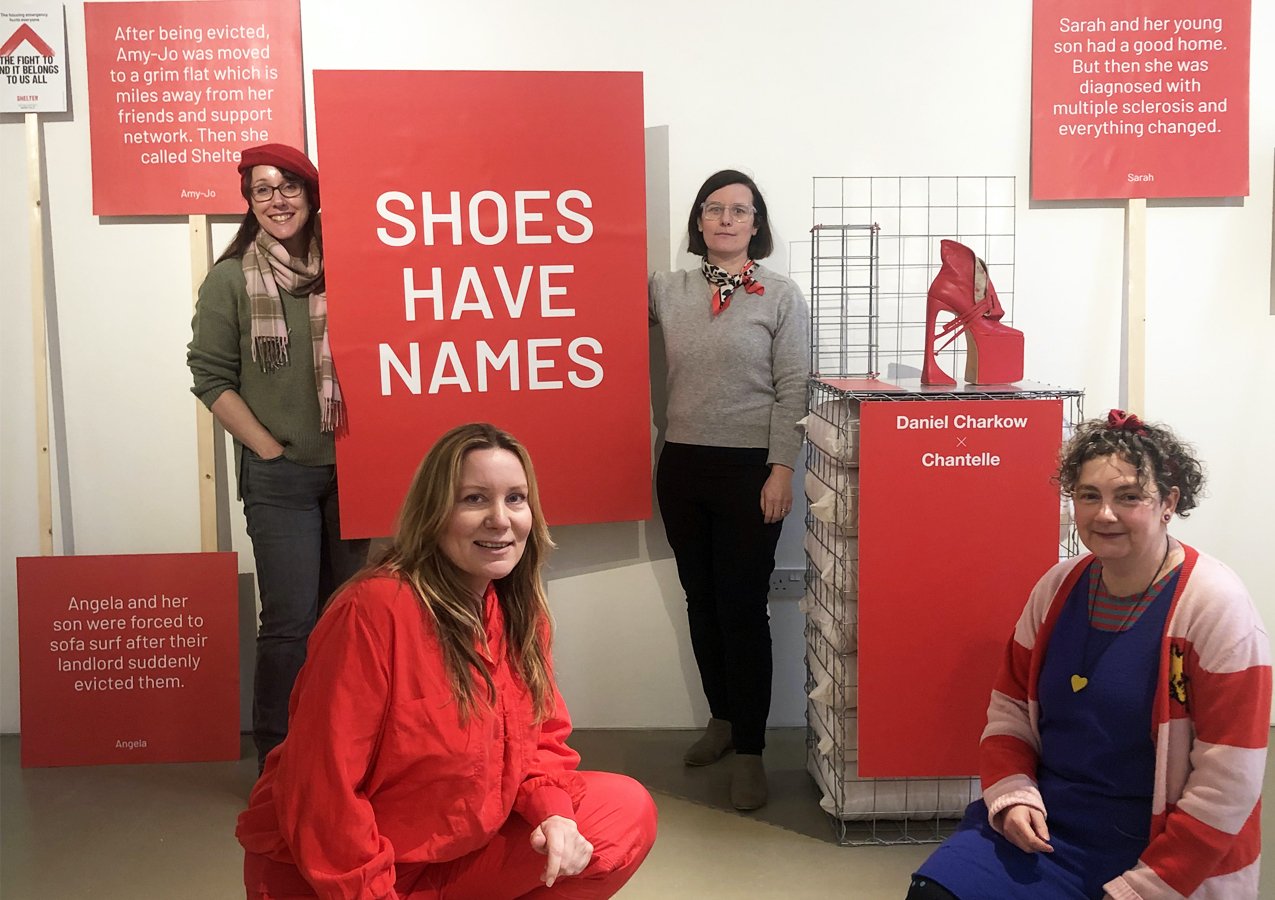
So with the Shoes Have Names project, yeah, I started to just have these thoughts that shoes could tell the stories of previously homeless individuals. I approached the Shelter charity through the Shelter boutique at Cole Drops Yard in London, which is a really beautiful place where they sell more designer pieces. I'd previously been into the shop and I could see that they were selling clothes. They also had like political messages and posters, you know, they work with individuals and help to house individuals. And so it's just really about connecting the dots and thinking about the symbolic value and how I could bring a community of artists and shoe people together to use their skills to create shoes that represented stories of these previously homeless people.
The idea was that we would talk about the positive steps forward. I think the initial conversations with Shelter, their concerns were that it would highlight negative things like, you know, when we think about homeless people, we think about holy shoes or we think about flapping soles, or we think about the struggles. But this was something completely different. This was about the idea of elevating people, giving them like a literal platform sole, or whatever the designer decided to do.
So I started by bringing this community of 10 designers together. And I explained to them, yeah, how to design, I guess, symbolically. I wanted to share my practice and my way of thinking and ask them, give them like a set of values and rules and then it was all about pairing people up. So, Shelter asked their service users who would be interested in being involved in it.
We wanted to make sure there was a really diverse range of stories. If we're gonna tell stories through shoes, then they needed to be educational. When people learnt about homelessness, they needed to gain a new perspective. And for me as well, I learnt a lot of things like around the hidden homeless. I think that was the biggest learning process that we tend to think that street homelessness is the only kind of homelessness. But actually the hidden homeless are people who are sofa surfing, people who have very transient situations with housing and no fixed abode.
And we wanted to find people, yeah, diverse ages. You know, there was one lady and her young son who was involved in it. There were older people, there were younger people. So, I think that was really important as well. The same with the designers, one of the designers was a student, one of them was a really high-end bespoke maker, one was a sustainable shoe-maker. It was about getting that really interesting mix of people together.
Then we connected with London Craft Week because another idea was how can we raise awareness for shelter in front of a new audience? So, the London Craft Week audience is just not somebody that they would usually be involved with, so they became like the third partner, and the idea was that it became an exhibition. So there were 10 shoes, they were all in red and the idea with everybody having to make them in red was because it was both the colour that I use and that Shelter use, is red, and in the context of Shelter, it's a call to action, which was kind of perfect. So each of the shoes was laid out on building materials to represent the idea of stability and instability of housing. And so that was part of the curation, and as the audience came to view them we actually gave them tours so we actually spoke to them about each individual piece, to just add more depth and meaning. And yeah, we did have people tell their own stories of homelessness when they came round, which was really unexpected. We had people who would tear up when they were learning about the stories of others.
And I think the power of shoes in that context is that it was about getting past this cold interface of telling people about charitable work. You know, I remember really well being approached in the street. It was always a person with a clipboard, and yes, of course, you want to listen to what people have got to say, but it's very easy to say no. It's very easy to walk away. And there's not, kind of like, a lasting visual impression that gets left. But with shoes, because you've brilliant makers who have made inspiring visual forms. What I've always found is that craft really draws people in. You know, people are spellbound by beauty and by the materiality of craft and the skill.
Alexandra Sherlock (25:49)
Mmm, the effort and the skill that it takes to do something
like that is really quite impressive isn't it? Yeah. ⁓
Jo Cope (26:00)
The skill, yeah. So people sort of say, they really love the shoe. And then because they love the shoe, they say, tell me more. And they just stand staring at the shoe fixated on its kind of, yeah, its skill, its craft, its beauty. And then they become more kind of, yeah, open.
Alexandra Sherlock (26:20)
Is it like susceptible to the story or something?
Jo Cope (26:32)
Yeah, yeah, you've kind of taken their barriers down and then they want to learn about it. And then more, they've got, there's more intrigue.
Alexandra Sherlock (26:34)
Yeah, it's wonderful. And I think also because shoes is something that everyone can identify with in one way or another. Like it's something that everyone has experience of. Even if you don't wear shoes, you still have a relationship with shoes, the absence of them, I suppose, isn't it? So it is that thing that we all have some sort of orientation…
Jo Cope (26:48)
Exactly. Yeah.
11. 27:22 - Exploring Femininity and Feminism through Shoes
Alexandra Sherlock (26:57)
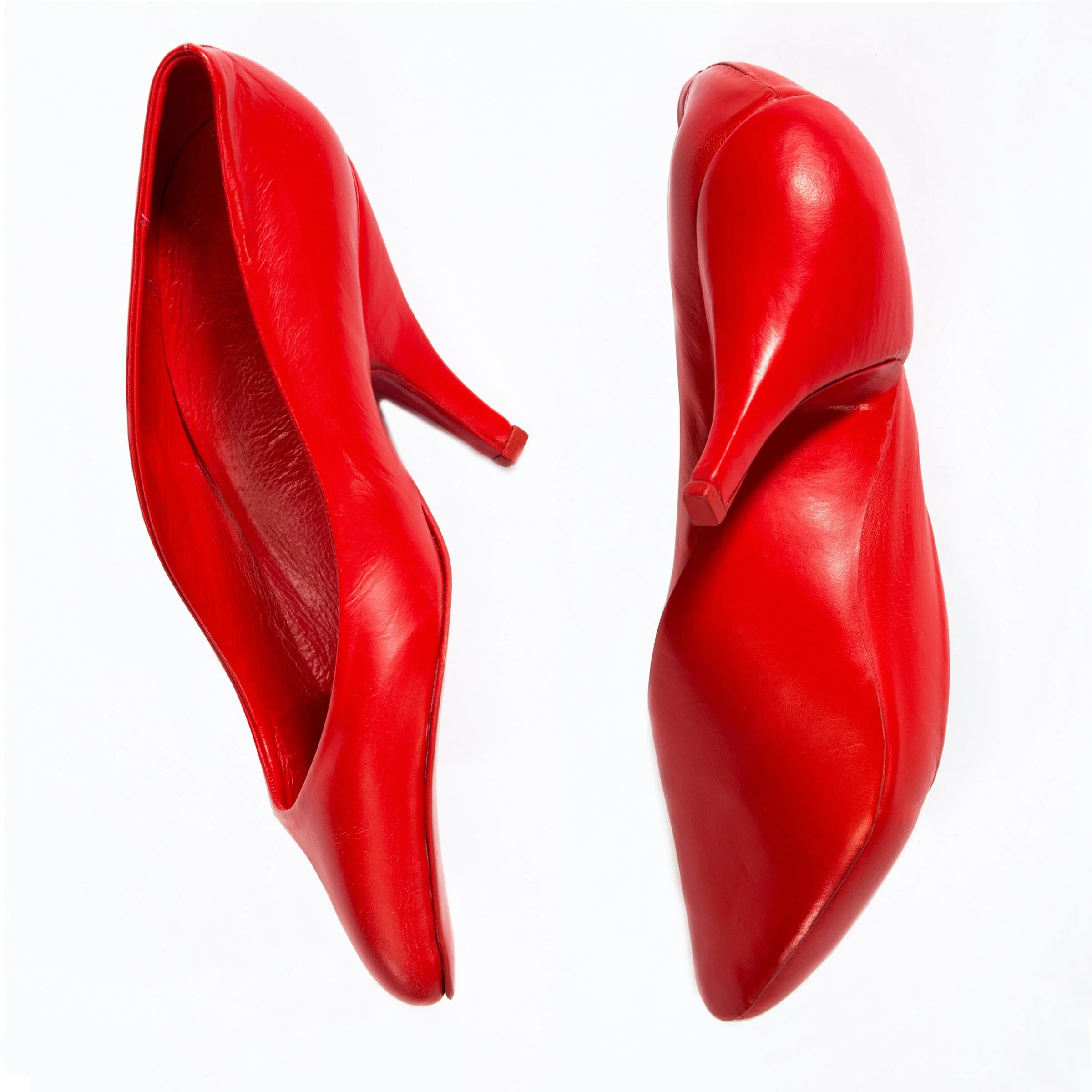
…to and I think that's why because I've also followed the work of the empathy museum and they do that Walk a Mile in my Shoes and so using shoes as a gateway to be able to build empathy and understanding of one another, I just think it works so well. But I think also it's that emotional connection like what you're creating is an opportunity for a powerful emotional connection with someone else or with your own experience and I think I really wanted to come back to this idea of femininity and what it means to be a woman and I think the piece of yours that I find arresting, is the only way that I can describe it, is the twisted stiletto. I just look at that, and I just feel it in my body. JI just feel that twisted stiletto just feels like the encapsulation of what it means to be a woman, in a sense. You know, just twisted and contorted to society's expectations. it's almost like for me, the shoe is the body.
Jo Cope (27:54)
Yeah.
Alexandra Sherlock (28:04)
…there is almost no distinction in some senses between the shoe and the body that we might imagine wearing it. And we do often see shoes, don't we, standing in for their wearers in lots of different circumstances, or when you see an empty pair of shoes, you know, it's referring to the person that would wear them. But sometimes I just sort of feel that that blurriness is just so... indistinguishable that actually you see the twisted stiletto and it just sort of really represents an experience of being a woman in the world. And I find that with a lot of your work it has quite a kind of in an academic way, you would call it ‘affect’, you can't really articulate what it is but you feel it in your body. Is that something that you're aware of when you're doing it? Or something that you're kind of going for, or...
Jo Cope (28:58)
I think what's really interesting, listening to your description of it, Alex, is when you've got a shoe that is disconnected from the body, the idea is that that internal space and the void of the body means that you enter the shoe emotionally and with your, yeah, your mental being ,so you're entering it from that emotional state of imagining. And that's what I find interesting. So I'm having an experience… I'm kind of, yeah, it is a lot about the evolution of being a woman and all of the difficulties that that brings and the double-edged sword, ⁓ you know, which the stiletto often kind of like represents. With the Twisted Stiletto, it was a lot about this kind of disparity between how our emotional physical states, how we might look very put together, you know, this idea of dressing and the psychology of dress and what we might be wanting to project about ourselves. ⁓
Jo Cope (30:02)
And I started to think about what if a shoe could speak of our more deeper or hidden psychology, you know, what's really going on and what would the stiletto actually look like? And I think that those two things are often at odds: how we look and how we feel.
But yeah, I think that I load the work with a lot of emotional baggage. The shoes that I create originally started off as being a form of self-therapy. And that in creating the shoe, it was a method of overcoming an issue, whatever that issue was. You know, it's not something that's relevant for me to talk about. But somehow by putting all of this... emotional content into the shoe. So many of things that we go through as women are really shared experiences. You know, when we think about the idea of a woman on the road to feminism, and learning about why they need to be a feminist, or what that might mean. So I think that people naturally pick up on all of those things that I've embedded in it and.... It's a mirror, isn't it? Ultimately, there's kind of my experience and there's your experience. And when you're looking at the shoe, you're gonna mirror it in a different way and you're gonna take something else from it.
Alexandra Sherlock (31:25)
I think that's sign of really good art, isn't it? It doesn't really matter, as you say, the exact story that piece was the outcome of. If that emotion went into it, that's the thing that resonates. I guess lots of people would have very different reactions, and some no emotional reaction at all to the twisted stiletto. I know what it feels like in my body to look at that stiletto and it could mean something quite different to someone else, but that's the wonderful connection I think that you get with the artist, you know.
12. 32:27 - The Colour Red and Taking up Space
But I think particularly in relation to kind of femininity, you were talking before about red shoes and your fascination with shoes, and you loved wearing shoes that people would notice that would stand out. And I, on the other hand, was, a very self-conscious child and I was talking to a friend about this recently and she sort of said yeah, it's that kind of thing of around women and not wanting to take up space. And red, as a colour, it takes up space! It grabs people's attention! And so, I love that when you were growing up, you were like, I'm not going to be afraid to grab people's attention. So I find that really empowering. So I just think there's a much bigger narrative there, isn't there, around the red and the, yeah…
Jo Cope (32:46)
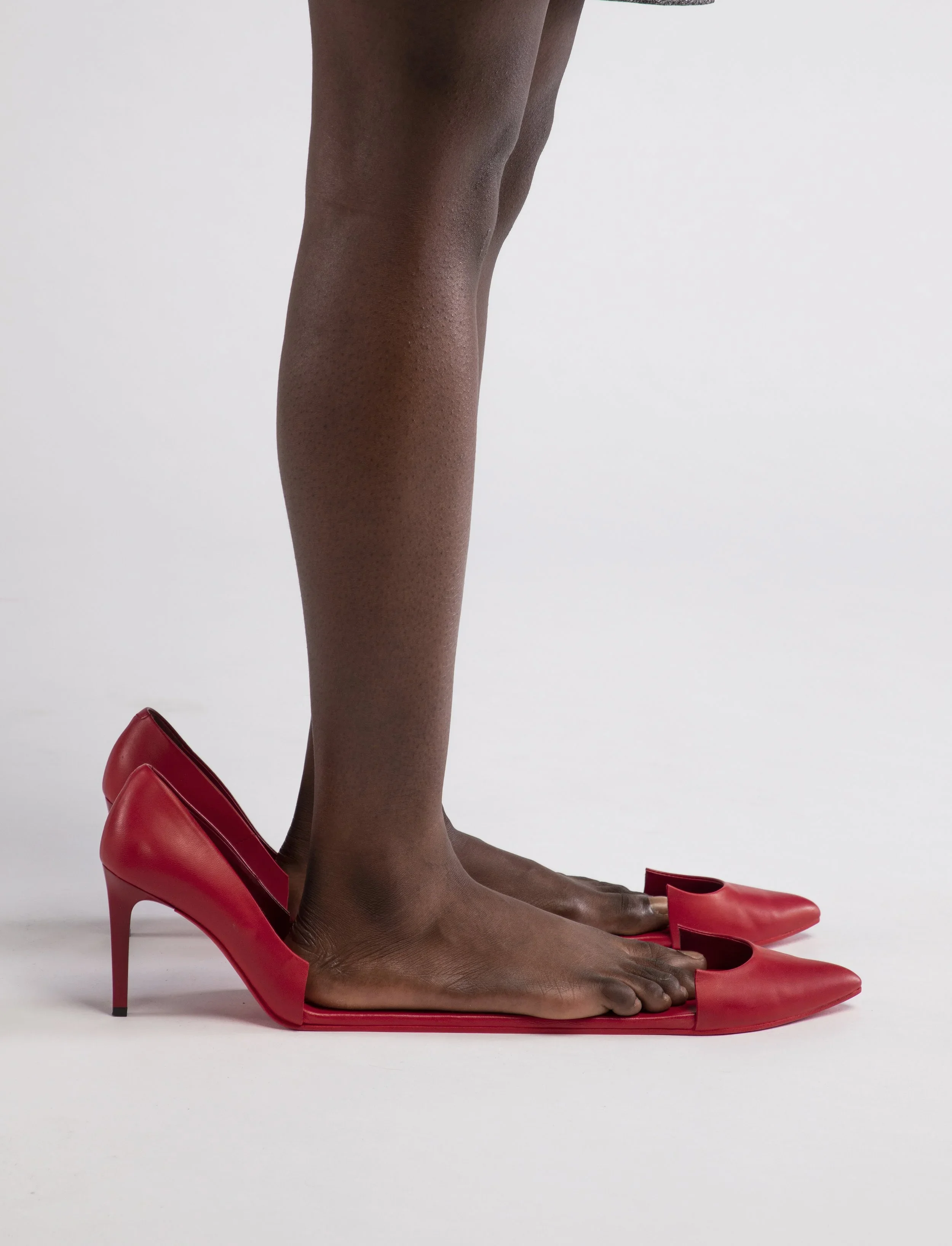
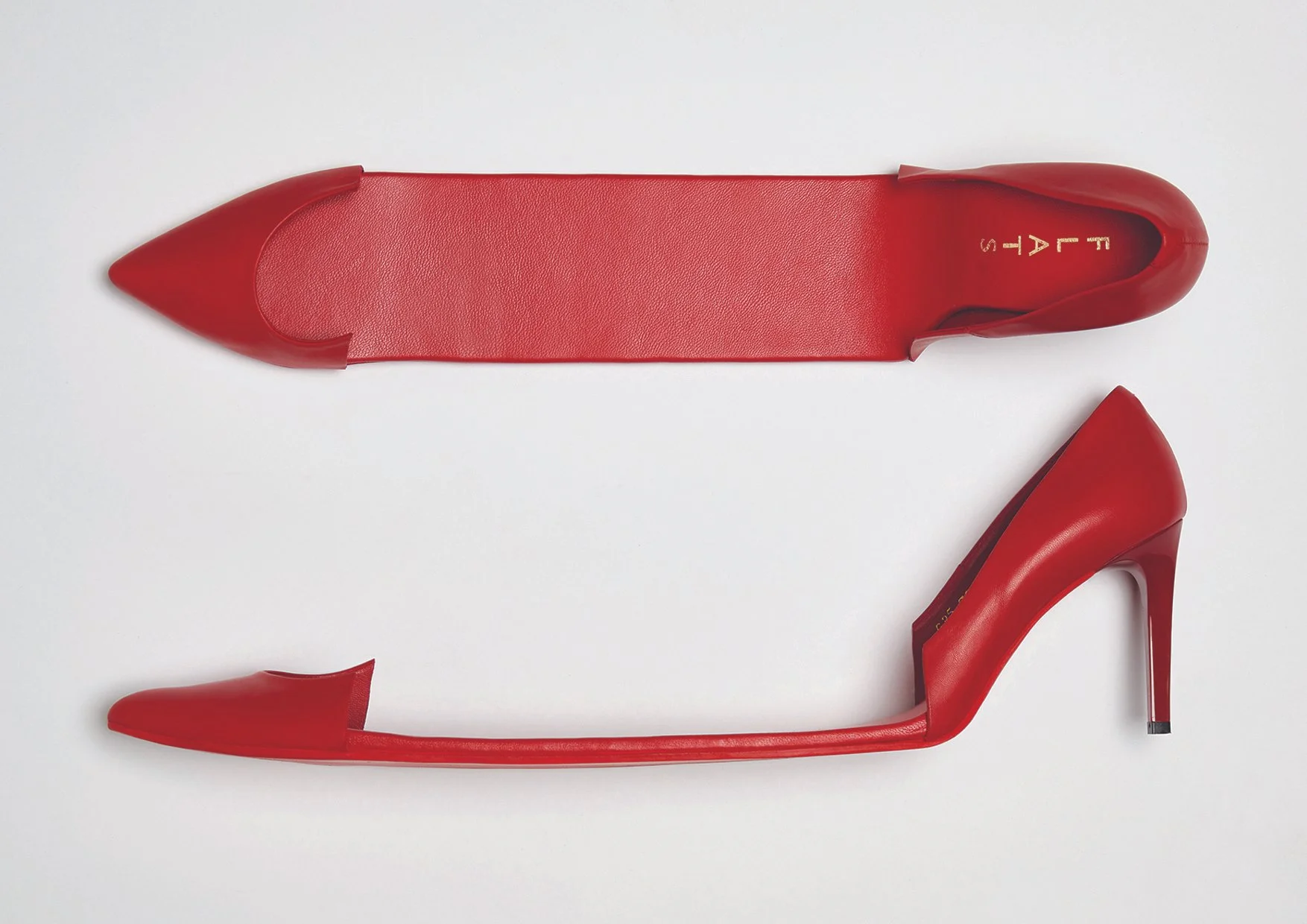
Yeah. The fact that you're talking about the taking up space, I think is really important from the feminist perspective. And there's a pair of shoes that I created, which are called flats, and so it's an extended stiletto with a middle space, and the middle space of the stiletto is flat. And that's the area that you stand on. And it's that idea that as women, can choose how we stand, we can choose that space we take up and it can be a bigger space, and we don't have to be, kind of, polite or we don't have to fit into expectations in terms of femininity and so on. Yeah, so I think that taking up space is an important subject for women to think about. And I think, you know, I was self-conscious also, but I think it was like a defiance against those things. I remember having people say things about things that I was wearing. People would laugh. People would point in the street. And there's something about that defiance against that. Yeah that
Alexandra Sherlock (33:40)
Like reverse psychology. Yeah.
Jo Cope (34:01)
Yeah. That I almost, I don't know, I think because I felt compelled that that was who I was, and that those things were part of me, that I was actually willing to stand up against any of that negativity. But yeah, it's very difficult, isn't it?
But I think that we are too polite often in the things that we wear, and we try to, kind of, fit in and blend in. I think I made a conscious decision when I started the masters. Again, I'd been through some difficult life things prior to doing the masters and I felt that I was kind of almost disappearing and that I was losing myself and my practice. Again, red became an act of defiance against that: I am going to be visible, I do matter. You know, and so, yeah, red was a conscious decision from that perspective to be seen and yeah, it was, yeah, it's part of a rebellion, I guess.
13. 34:54 - Movement and Performance in Shoe Design
Alexandra Sherlock (34:43)
It's so interesting, the significance, of particular colours and particular shoe styles and, you know, for a range of identities. I'd love to know more about the performative aspects of your work as well. I love the Turning Point ones, you know, where the sole of the shoe kind of is going in a semi-circle, and you feel again, that kind of like, life’s a journey, this is a turning point. But I guess in terms of the movement, the directions that they affect, you've played around with that a lot. I mean, obviously shoes do change the way we walk and the way that we move through the world. But I wonder if you can talk a little bit about, how you've engaged with that idea of movement through performance and metaphor again.
Jo Cope (35:40)
Yeah, I think, you know, you brought up the Turning Point shoe. And I think for me, that is a really significant shoe in terms an evolution in the thinking that a shoe can have a positive, psychological impact that we can actually affect our cognitive processes through an action. So, you know, for me, it started off with me making shoes where I wanted to move forward, and I was struggling, so I would manifest it in a shoe. And sometimes kind of making the shoe was more than just a therapeutic act, it was about making something solid and real and that made me believe that I could change my own thinking. So, so it's kind of started off with me changing my own psychology, and then I started to think about the idea of, could I help other people to create positive mental changes? So Turning Point is something that I have explored as a, kind of, performative act, where I ask people to think about things that they want to leave behind and then we do an action and then we do actually turn.
So, yes, it is symbolic. You know, it is… I think that when people have a physical experience, it manifests in the body, and it just it just makes it real. So…
14. 37:11 - Transformative Experiences Through Shoes
Alexandra Sherlock (37:11)
And really memorable and transformative as well, I suppose, when it's, and particularly when it's involving other people as well. I wonder, what are the most powerful experiences that you've seen with the work that you've produced, the most transformative experiments… are they experiments or are they quite…
Jo Cope (37:28)
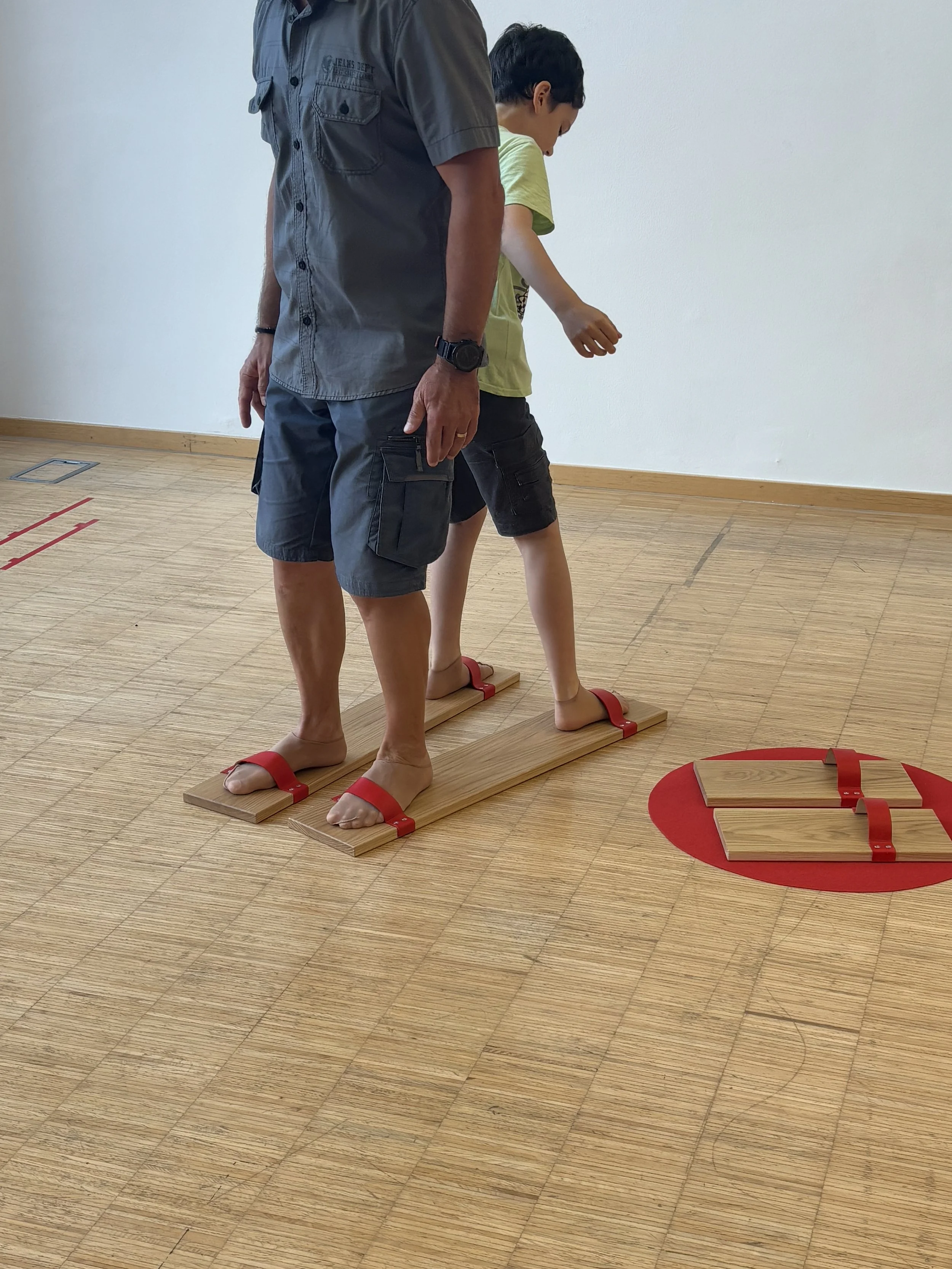
I think, yeah, some of them are experiments. I mean, with the most recent exhibition in Slovenia, this was working with a series of shoes, I was thinking a lot about the political climate, the problems that we're in at the moment and how we have like the left and the right. And there's this idea of opposition that you're on one side or you're on the other. Yeah, how do we discuss that? How do we find places in the middle? And I don't know that there are any answers to these things, but I started to think about a series of shoes where people would engage with them. So there's one where somebody will stand on one side of the shoe, somebody stands on the other, they're pointing in two different directions and they have to find a way of actually walking together in a unified way, yeah, which is actually not easy. So there's something about…
Alexandra Sherlock (38:22)
I think I saw it on your Instagram, and they're back to back, aren't they? And so the inclination is that they want to walk away from one another. But in fact, you are forcing them to walk together even though they're pointing in different directions. And that metaphor of that…
Jo Cope (38:29)
Yeah, they have to communicate that. So what I like to do after I've created it, as I imagine what might happen, but then when people embody them, I can observe them and see what happens. And then that's kind of like that reverse learning, or the full circle learning. So, what most of the people in that situation did, they had to do a little bit of talking, but then it became about intuition. They stopped thinking about their individual bodies and started to, intuitively kind of work together. And they often found a different way of walking, which I found, really…
Alexandra Sherlock (39:17)
⁓ wow!
Jo Cope (39:27)
Yeah, so it wouldn't be one person taking the lead, or the other person taking the lead. It would be that they had work in unison to walk sideways. I suppose it's always about, you know, wouldn't we love to change the world, through the power of shoes? And I'm just trying to experiment with them, that kind of thinking through shoes.
Alexandra Sherlock (39:40)
I really want to try those. I feel like you should… as like a tool of diplomacy, a diplomatic tool, can you please send them to various politicians around the world to try, because I just think that idea of having to find a different way to walk together, just the idea of that just feels so powerful to me.
15. 40:03 - Collectivism and Connection Through Interactive Art
Jo Cope (40:03)
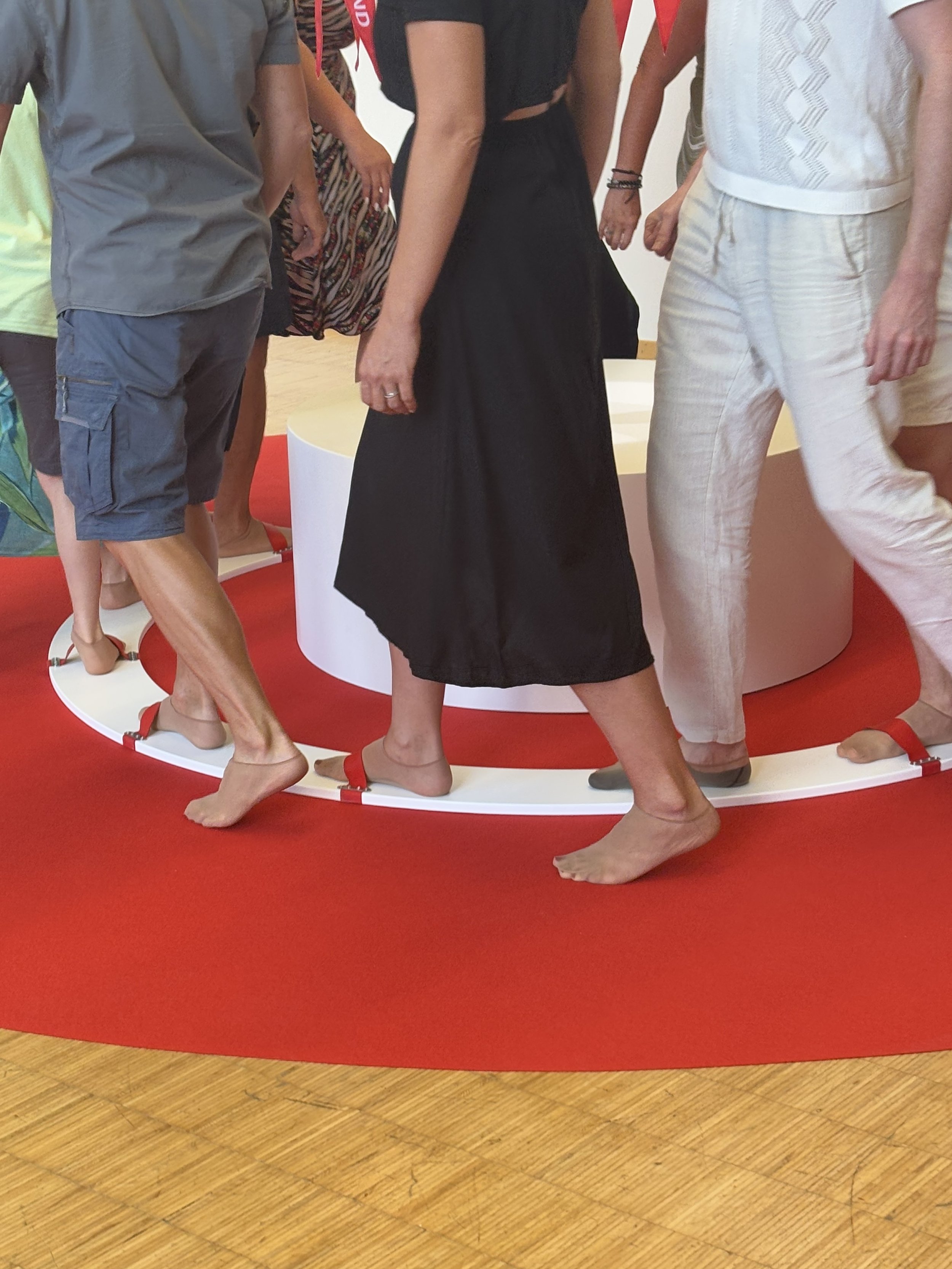
Yeah, and the bigger piece of that was, there was a really large circle. What I've observed in the more recent years in exhibition spaces is that people don't just want to be observers, they actually want to be participants. And, you know, we've got, I guess with the Instagram generation, you know, people want to be part of something. They want to have immersive experiences. Yeah, so a lot of the things that I've started to do, do involve people and their bodies. And so, the larger piece in that exhibition was a huge circle that people could enter ,and they put, you know, one foot in it, and the idea is that this large heavy circle can only be moved in an act of solidarity. So it is about collectivism and people coming together, not to work individually. And the idea is that there was concepts around individualism and collectivism and what kind of society do we want to live in? And in that piece, you have to work together to make it move and people became joyous, people, you know, like it raises people's energy and spirit. And at the end, they're like, yeah we did that together. Yeah, it is about multiple feet, multiple people, you know.
Jo Cope (41:27)
Because I know myself, when I go to exhibitions, I want to be able to sit and stare and think on my own. But actually in the way that society is we need each other and we, you know, that's the the powerful force of people walking together is just, you know, what we need right now.
Alexandra Sherlock (41:27)
Mm. And shoes are a wonderful connector, aren't they?
Jo Cope (41:47)
They are, yeah.
16. 41:45 - Social Connection and Authentic Storytelling
Alexandra Sherlock (41:48)
They connect us with... I mean it’s one of the first things, isn't it, when a child has their first shoes, and you say, look at your shoes, they're so beautiful. And then that child is really proud. And it is that first experience. I think I've said it before, of entering the social world and sort of identification that comes through shoes.
And I find it really interesting that you're talking about this idea of shoes as a medium for connecting people at a time when we desperately are craving connection. I mean, certainly within the footwear industry there's been a crisis for some time around marketing and storytelling. People need authentic stories and experiences, and you've got online shopping, you don't have to go to a high street store anymore. Like I'm thinking about all the different listeners and what we can learn from arts, humanities and social sciences perspectives to think about how we can make a more meaningful, relevant, sustainable, healthy footwear industry that is actually contributing to some of the things that you're saying there…
You know, I'm not suggesting that brands should be producing art from their collections, but I think this idea that shoes are more than...commodity fetishism, you know, capitalism, and that actually they can perform a really important function. And when brands are meaningfully and authentically engaging with that, they are actually doing something that helps people to feel part of something as opposed to, you know, a sole consumer, pardon the pun. But yeah, I just think that connection through these shared experiences, which, at times it feels like they would be absolutely hilarious, and there's nothing more disarming than people dissolving in fits of laughter ⁓
Jo Cope (43:44)
Sure.
Alexandra Sherlock (43:44)
particularly around really difficult subjects…
Jo Cope (43:49)
Yep, I think one of the things is you're talking about this idea of brands and how we connect to brands. You know, for me, obviously, I'm not working from a commercial perspective to sell functional shoes, but a number of years ago when I worked with the Venice Design Biennale, I partnered with the Venetian shoe brand Piedàterre, and we created a meaningful project with the furlane slipper, which is what they create. There were lots of aspects to that project, but one of the things that I really wanted to celebrate with them, were the artisan makers. So there's this really beautiful story of these little, we say, little old women, is how they describe them, but a series of beautiful older women who live on the Isle of Frulli, so an island just off of Venice, and they hand-make these furlane slippers. And, you know, for me, it's about all the different things that we're trying to explore and the stories that we're trying to tell. And the learning that goes on, you know, it starts with shoes. It's as much about the dialogue and the learning when you come together as a group as well as the conceptualising of shoes and the performance itself and then what people take from that. So, for me it's just a whole, it's a whole exploration, you know.
Alexandra Sherlock (45:24)
Mmm, so I guess it's that idea of kind of what new things can be made through bringing all of these different influences and stories together. You're never repeating the past, you're building on, and evolving, things by bringing new people together and different experiences together, and our experiences of being human.
Jo Cope (45:34)
Yes.
17. 45:47 - Hand Craft vs. Digital Technology in Shoe Making
Alexandra Sherlock (45:47)
I'd love to, as well to–we should probably wrap up at some point, I could talk to you all night–but the craft itself, I mean, we're talking about the major shifts that we're going through in the world and one of those shifts is through technology and 3D printing and all of those kinds of things. Obviously, craft and the making and those kind of traditional skills are important to you in terms of working through the emotions of a lot of the stuff that your work deals with. Where do you sit in relation to some of these emerging technologies in terms of achieving the things that you kind of, I don't know, am I putting you on the spot there?
Jo Cope (46:27)
Yeah, I think I've gone backwards. I actually think, so for me… OK, so because the work is about being human and it's about emotional connections to things, the first material that I had a real kind of intimate connection with was like a really soft, like lamb Nappa type material, because you know, when you're lasting it, it is like working with skin. It almost feels, you know, like the body and so that was something that yeah it just felt like it really reflected that that kind of humanistic aspect. So leather also is very sustainable if it's used, you know, your vegetable tan leathers and, you know ,I recently went to see new technology in vegetable tan leather in Tuscany with the Leather Consortium. You know, there's so much, kind of, science that's happening to create this circularity for vegetable tan leather. If I'm going to use leather or continue to use leather, I need to understand its sustainable future. So that's one side of it. I kind of think in terms of 3D printing and those sorts of technologies, for me, because it's created by a machine rather than the hand, you know, I find that quite difficult to look at. And when I was at university, you know, one of the technicians said to me that when somebody's looking at an object of craft, they can tell how many times it's been touched. You know, so if you've touched it and worked on it, or worked with it 50 times, then people can sense it. So there is something about technology that I find a really cold interface. So I suppose that I've actually started to, kind of, go in the opposite direction where I think, how can I use less materials, simplify the materials. So, for instance, the piece we're talking about previously with the two people in opposition trying to make something work, that's a singular piece of Oak, you know, that's been hand finished and worked. Now, it will look exceptionally minimal in all of its aesthetics, but it will have taken a long time in terms of, you know, how much, labour has to go into it, you know, sanding it and all the other aspects of it. So, I don't know, there's something for me where I want the work to be more potent in what it can do, and how people can connect with it, rather than making it more complicated. So I think I'm trying to strengthen the message but simplify the object, and that's kind of maybe where my head's at.
Alexandra Sherlock (49:18)
Yes. I guess lots of people have done interesting kind of combinations of craft with technology and that in itself, I guess, there's a really interesting story and conversation to be had there about the relationship between machines technology science bodies and craft and… But yeah, I do find it interesting, there's that cultural philosopher Walter Benjamin wrote a famous essay, Art in the Age of Mechanical Reproducibility, which was the fear that happened around the time of the printing press, as to what that would mean for the work of art if everyone could have a copy of it. And I think it is that when there are copies of things or mass produced by machine, people crave the authenticity more, I suppose? Or that it becomes more precious, that touch, that craft and that skill, and particularly when it's passed down for generations. And really hard-won as well, like really painstakingly developed. There's an aura, I suppose, of authenticity to that, isn't there, that I guess maybe wouldn't happen so much if it was, kind of, designed on a computer? I don't know. It’d be interesting, I think, we need to interview someone who does work in that way to...
18. 50:32 - The Importance of Reflection in Creative Practice
Jo Cope (50:35)
For me, I've designed, I've 3D scanned feet. I've designed things on computers. In the piece, Walking in Circles, which was, you know, an early piece. Yeah, I scanned the feet, produced things as 3D printed forms, you know the extensions of the feet. That was the logical thing to do with the technology that we have. But once those prototypes existed, then they just lacked that humanness and they just lacked the emotional content of the hands. And so I went back to re-sculpt them and then re-scan them, and then CNC them. The machines were involved in the process, but... the pieces that I was scanning were made by the physical hand, and had that aspect of touch.
And, you know, the very first project that I talked about that was for the Global Footprint project, you know, that was about challenging how a CNC machine could cut through leather, you know, and it kept setting on fire and burning and doing all sorts of crazy things. And I was really intrigued by making a machine do something that it's not meant to, or working with the material it's not meant to. So, you know, it's I'm not saying I'm opposed to machinery. I think that it's how we explore it. Yeah, Yeah. And what we do with it, and maybe just not… just accepting it for what it is. You know, if you say that, I think that's with all the work, it's kind of questioning it more, isn't it? It's kind of saying we know a 3D printer does that. But is it okay for it to just do that? And is that going to create something that's original or that feels different? So I think that would be the standpoint.
Alexandra Sherlock (52:27)
And then also for you, guess it's the… if you were to 3D print one of your pieces, you then don't get the transformative impact of going through the process of it developing and the, yeah, the effort, the time, the reflection, the mindfulness, the challenges that, you know, that come along with that, the learning. Then it, yeah, it's interesting for you as an artist, that process that you need to go for something to evolve.
19. 52:53 - Teaching Ethical Social Practice
Alexandra Sherlock (52:54)
So What are you working on at the moment? What are your plans?
Jo Cope (52:58)
At the moment, I'm actually taking some time to just kind of breathe and think. You know, one of the things that I've been doing is working on a book chapter for a doctor at Parsons University in New York. And that is about creating a template from the Shoes Have Names project, that anybody could follow who want to get involved with social practice, but don't know how to start, how to build those relationships. Because one of the things that maybe I didn't give enough emphasis to is that, you know, you don't start those things lightly. It was a two year relationship that I built with that charity. It wasn't something that was like, let's do this thing, won't it be fun? You know, it was something where we had to really build that understanding, that respect, make sure that everyone that was involved was treated with the utmost respect and was kind of protected in the right ways. You know, so there's lots of ethics involved in it. So this is kind of working on a chapter of a book that looks at that ethical framework and makes sure that… Because there's so many people, you know, after we did that project, I spoke to the Graduate Fashion Foundation and we started a Fashion for Social Cause award where students could get involved in creating socially engaged work. And there's so many people who want to do good, and there's so many people who want to use their practice in meaningful ways but just don't know how to go about it. So that's been really great kind of putting that down.
Alexandra Sherlock (54:36)
I was going to say there is actually a… can in some cases be a risk, while the intention may be wonderful to go in and help with something. And I've noticed this a lot with my students. Without properly understanding a situation, without having those relationships and connections and having built that over a period of time, it can be really quite risky and potentially quite dangerous, and you can actually do more harm than good, can't you, if you are kind of engaging with something that you don't fully understand.
Jo Cope (54:59)
Yeah, 100%. Yeah.
Alexandra Sherlock (55:08)
So that chapter sounds wonderful, it sounds really useful. Unfortunately, I think teaching in higher education, you're bound by semesters, and assessments, and things have to happen quite quickly. And I wonder if there is a way to kind of help students develop that kind of… the long game, you know, it's all about the outcome isn't it? You know, thing.
20. 56:42 - Social Practice as Collaborative Learning
Jo Cope (55:31)
Yeah. And you have, I think exactly as you're saying, it's, yeah, jumping on the bandwagon of kind of doing good, as you say, can do a lot of harm. It comes with a great deal of responsibility. And I think that as creatives often, yeah, we can imagine the end goal, we want the shiny end product. But the most important thing is about the dialogue between yourself and the partner, whoever that partner is. Since embarking on social practice, it's something that I've kind of pushed to have embedded in the courses that I work on at De Montfort University in Leicester, with the support of the course leaders and the people around me, have really embraced that idea of bringing social practice as a module, you know, every year with students. So we've worked on projects that have involved things like domestic violence charities and local charities, Crisis and Shelter. We're working with a mental health charity at the moment.
Alexandra Sherlock (56:43)
And it being an exchange, isn't it? So it's not that you've got someone going in and solving something for someone.
Jo Cope (56:49)
It is. And actually, so we think about the charity as the client and we sort of say, you know, how can we be of service to you? You know, what is it that you need? How can creativity empower your message? I work with students on the fashion and communications course. And so one of their strengths is social media, and sometimes the charities will have a lack of resource, and that's something that they can help with. So they come up with, you know, within a set framework that we put forward, they have to research and understand the depth of the charity, and then they work out how they create artistic visuals that will inspire people to connect more, or understand a story in a different way.
So yeah, it's all about that respectful relationship and asking what their needs are and how you can be of service, I suppose. As well as, for the Shoes Have Names project it was actually about presenting something that they didn't know that they needed or wanted. You know, when I first spoke to them about shoes as vessels, you know, I think that they thought I was completely bonkers. And I really had to spend a lot of time helping them understand art. And so that was my goal was to convert them to the things that I know that I can do, that they're not aware of. You know, and they learnt a lot from the process, and I learnt a lot from the process. I'd say it was kind of really an equal experience.
21. 58:35 - Future Plans and the Creative Process
But at the moment I'm just really trying to feel the… I feel very kind of weighted down by the lack of democracy, you know, the direction of the way that the world is going. And I've kind of just had to sort of sit with that. And, you know, if I'm going to create work, I want it to be work that is important for me, and for other people. So at the moment I'm in the process of… I like to spend a lot of time kind of thinking, it's not always about you know project after project. So I'm in the thinking stage, which I think really undervalued in people's practice. So yeah thinking, breathing, conceptualising, reading, you know, thinking about how I can process those emotions, but also how I can have a positive impact, so.
Alexandra Sherlock (59:29)
So what does that process look like for you then? How do you go about that thinking?
Jo Cope (59:35)
I feel like there's so many things that I don't understand and it might be about politics or anything. So it might be that I start to, yeah, read to try and understand more about, let's say it was about the far right or something, then I might spend some time kind of reading around that, and then looking at maybe the histories, and it just spans out from a feeling or an anger or a thought. And then I go on like research journey. But sometimes I just like to kind of sit with the feelings, and just like, it almost feels like doing nothing, but it's like you're not ready to do something until those thoughts and feelings start to actually formulate. I start to see visuals, and I start to form, yeah, they start to become physical in my mind's eye, and that's usually the starting point. But yeah, I'm kind of manifesting at the minute, a number of proposals around lots of different subjects. But yeah, it's just a lot of walking. A lot of walking and thinking essentially. Walking, thinking, feeling, sitting with emotions and then doing the research to kind of back-up the understanding.
22. 01:00:51 - Conclusion
Alexandra Sherlock (1:00:46)
Ahh It's wonderful, well just thank you for everything that you do, your work is so inspirational and thank you for your time. If anyone wants to see any of your work, where can they go to have a look, you've obviously got your Instagram and your website.
Jo Cope (1:01:06)
Yep so you can go to the website to see all of the different aspects of the work, the performative, the projects, the individual artefacts, and that's at www.jocope.com and the Instagram, which is the social media platform that I use the most, that is @jocope_studio
Alexandra Sherlock (1:01:31)
Lovely, thanks so much Jo. Speak again soon.
Jo Cope (1:01:35)
Thank you, Alex. Yeah, thank you for having me. I really appreciate being part of the amazing shoe conversations that you’ve put together.
Alexandra Sherlock (1:01:45)
Thank you so much for listening to this episode of the Social Lives of Shoes, brought to you by the Footwear Research Network. If you enjoyed this episode, don't forget to follow the show, and we'd love to know what you think. Please do feel free to add comments, or contact us on LinkedIn or Instagram. Find us at Footwear Research Network.