More Stitches, Less Riches: Reconnecting with Our Shoes, Each Other and the Planet with Wendy Ward
Episode 10 Overview:
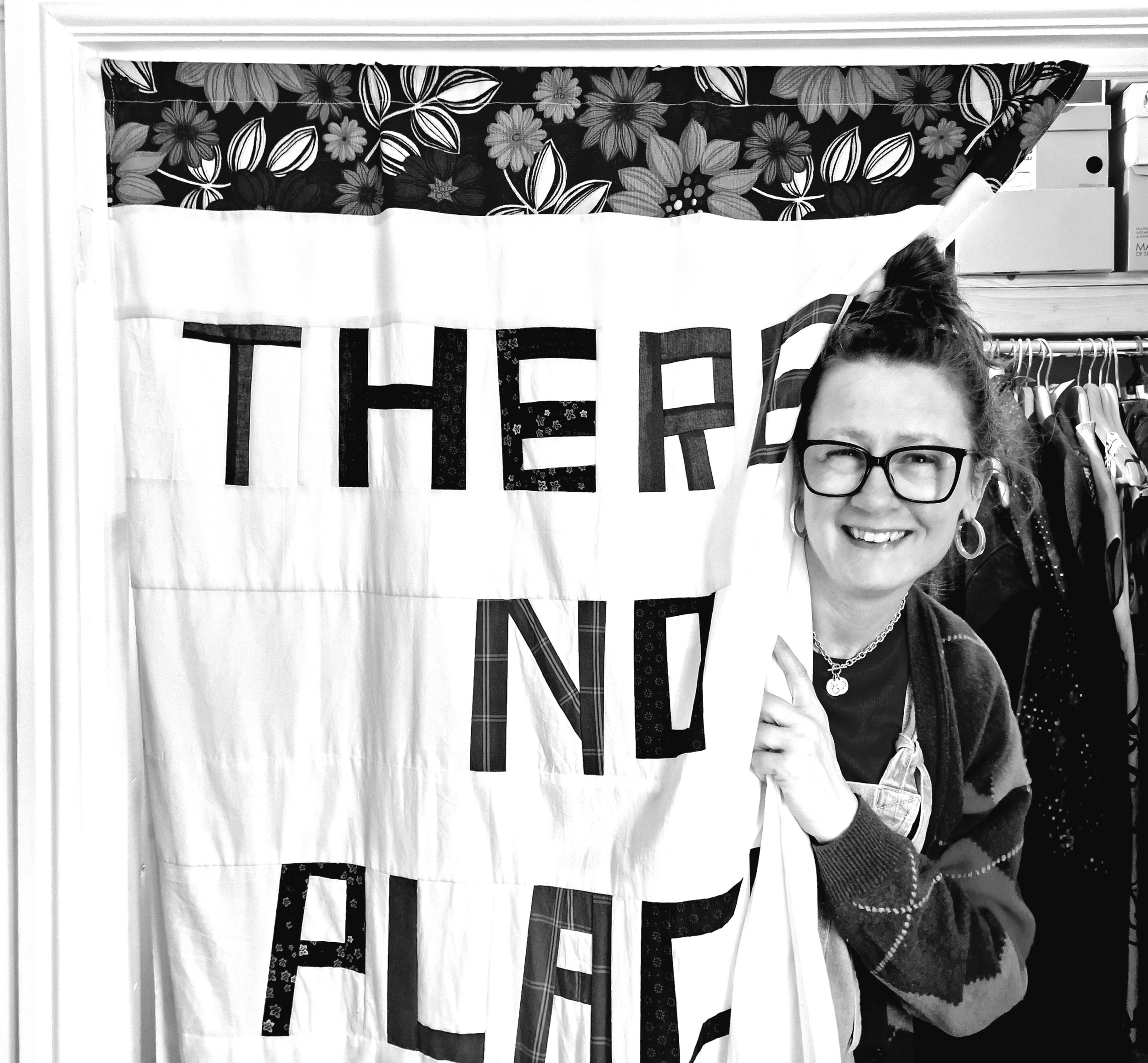
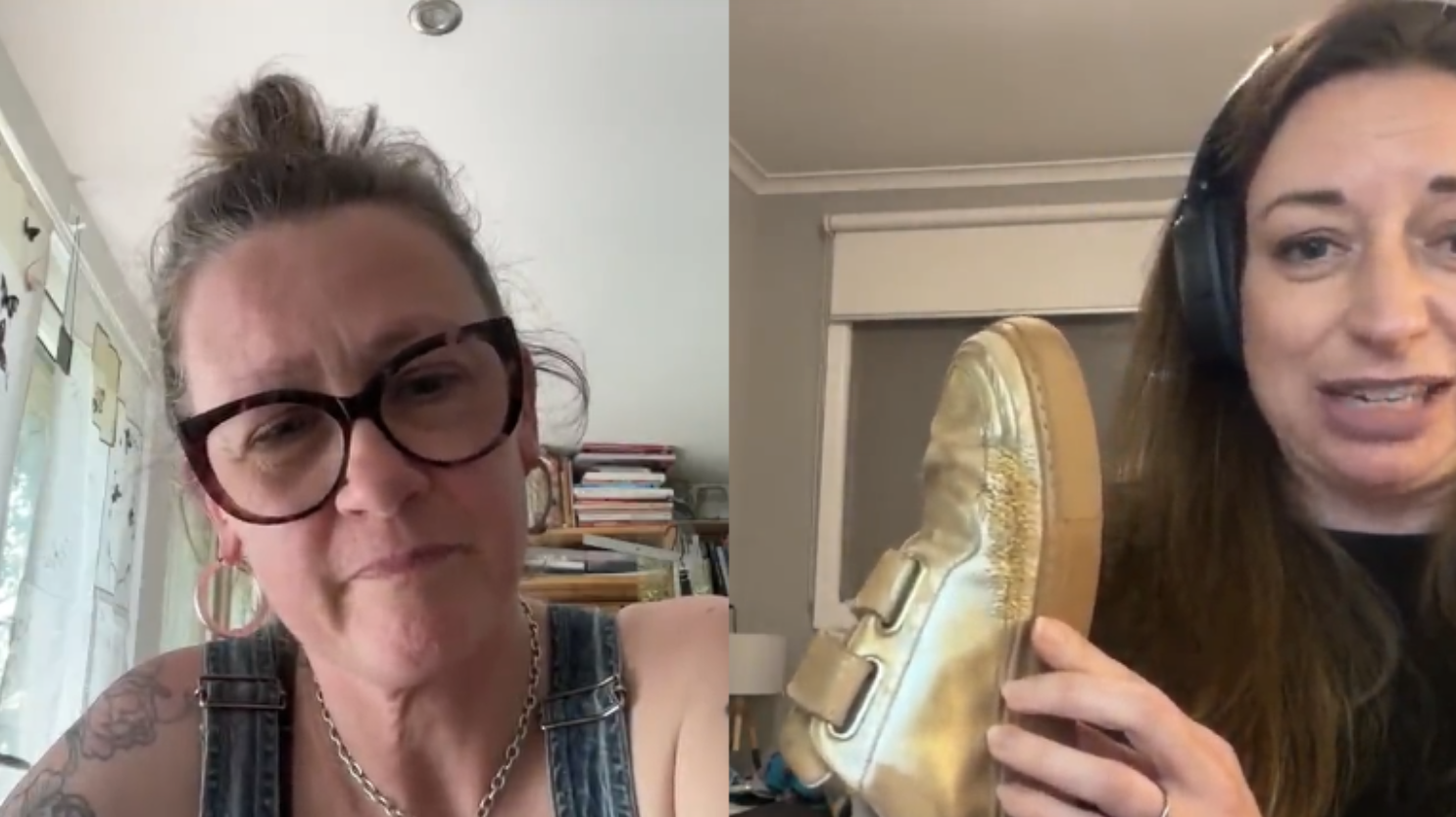
In this episode, Alex speaks with Wendy Ward, PhD candidate at Sheffield Hallam University, about the relationships and connections we build with our clothes and shoes, and how they might encourage more sustainable behaviour. Wendy shares creative practices from her doctoral research, including wardrobe audits, ink prints of "broken" garments and her daily stitching ritual, all designed to deepen attachment and mindfulness rather than provoke guilt. The conversation explores how paying attention to what we already own can restore connection with our belongings, each other and the planet.
Credits:
Guest: Wendy Ward
Presenters: Dr Alexandra Sherlock & Dr Emily Brayshaw
Production and Editing: Dr Alexandra Sherlock
Links & Resources:
In order of appearance:
Wendy Ward's Linktree [02:04] — Wendy's investigations into where donated clothing actually goes: https://linktr.ee/thatwendyward
Aldous Huxley, Brave New World [02:04] — Huxley, A. (1932). Brave New World. Chatto & Windus. The "ending is better than mending" and "the more stitches, the less riches" slogans appear in Chapter 3.
George Orwell, Nineteen Eighty-Four [03:26] — Orwell, G. (1949). Nineteen Eighty-Four. Secker & Warburg.
Wendy Ward online [07:37]
Substack: https://thatwendyward.substack.com/
Instagram: https://www.instagram.com/thatwendyward/
The Conversation profile: https://theconversation.com/profiles/wendy-ward-1513485
Enduring Fashion [09:13] — Wendy's practice-based PhD, "Enduring Fashion: Building Sustainable Clothing Practices Through Wearer-Garment Relationships," at Sheffield Hallam University. Her account of the wardrobe audit method: https://clothingresearch.oslomet.no/2024/01/15/an-arts-practice-approach-to-wardrobe-audits/Concernedresearchers
Previous episode with Dr Ellen Sampson [11:43] — https://footwearresearchnetwork.org/podcast
Jonathan Chapman on emotional durability [11:43] — Chapman, J. (2015). Emotionally durable design: Objects, experiences and empathy (2nd ed.). Routledge. https://www.routledge.com/Emotionally-Durable-Design-Objects-Experiences-and-Empathy/Chapman/p/book/9780415732154
Wendy's article in The Conversation [12:11] — Ward, W. (2024, March 12). Three ways your wardrobe could help you avoid fast fashion. The Conversation. https://theconversation.com/three-ways-your-wardrobe-could-help-you-avoid-fast-fashion-224293
This Is Not a Shoe [17:54] — https://www.thisisnotashoe.org/
Closing the Footwear Loop [24:51] — Fashion for Good & Circle Economy. (2026). Closing the Footwear Loop: Material flow and composition analysis of non-rewearable post-consumer footwear waste in Europe. https://www.fashionforgood.com/our_news/new-report-closing-the-footwear-loop/Fashion for Good
If the Shoe Fits project [31:56] — https://footwearresearchnetwork.org/about
Clare Daněk [47:31] — Website: https://claredanek.me/stitch-journal/
Claire Wellesley-Smith [47:31] — Website and Stitch Journal blog: http://www.clairewellesleysmith.co.uk/blog
Wellesley-Smith, C. (2015). Slow stitch: Mindful and contemplative textile art. Batsford.
Wellesley-Smith, C. (2021). Resilient stitch: Wellbeing and connection in textile art. Batsford.
Temperature blankets [51:12] — Smithsonian Magazine on crafters using yarn to visualise climate data: https://www.smithsonianmag.com/smart-news/knitting-enthusiasts-are-using-their-craft-visualize-climate-change-180974231/
Climate stripes [51:43] — Created by Professor Ed Hawkins at the University of Reading in 2018 https://www.reading.ac.uk/planet/climate-resources/climate-stripesUniversity of Reading
Annette Weiner on keeping-while-giving [1:08:58] — Weiner, A. B. (1992). Inalienable possessions: The paradox of keeping-while-giving. University of California Press. https://www.ucpress.edu/books/inalienable-possessions
Alex's drawing of her backpacking sneakers [1:10:27] — https://footwearresearchnetwork.org/articles/2011/05/16/my-shoe-story?rq=Trainer
Fashion theorists referenced [1:30:01]
Veblen, T. (1899). The theory of the leisure class. Macmillan.
Simmel, G. (1904). Fashion. International Quarterly, 10(1), 130–155.
Marx, K. (1867). Das Kapital.
Opening Up the Wardrobe [1:35:03] — Fletcher, K., & Klepp, I. G. (Eds.). (2017). Opening up the wardrobe: A methods book. Novus Press. Free ebook available since 2023: https://omp.novus.no/index.php/novus/catalog/book/26Fashionecologies
Support the podcast: GoFundMe [1:36:00] — Funding link
Footwear Research Network — https://footwearresearchnetwork.org/
Chapters:
00:10 — Introduction
02:04 — Brave New World: "The More Stitches, The Less Riches"
07:37 — Meet Wendy Ward: Enduring Fashion
13:13 — From Fast Fashion to Fair Trade
16:53 — Material Engagement and How It Changes Us
22:51 — The Waste Problem: Clothes and Shoes
27:06 — Beyond Guilt: Creative Methods for Change
30:12 — Wardrobe Audits and Data Visualisation
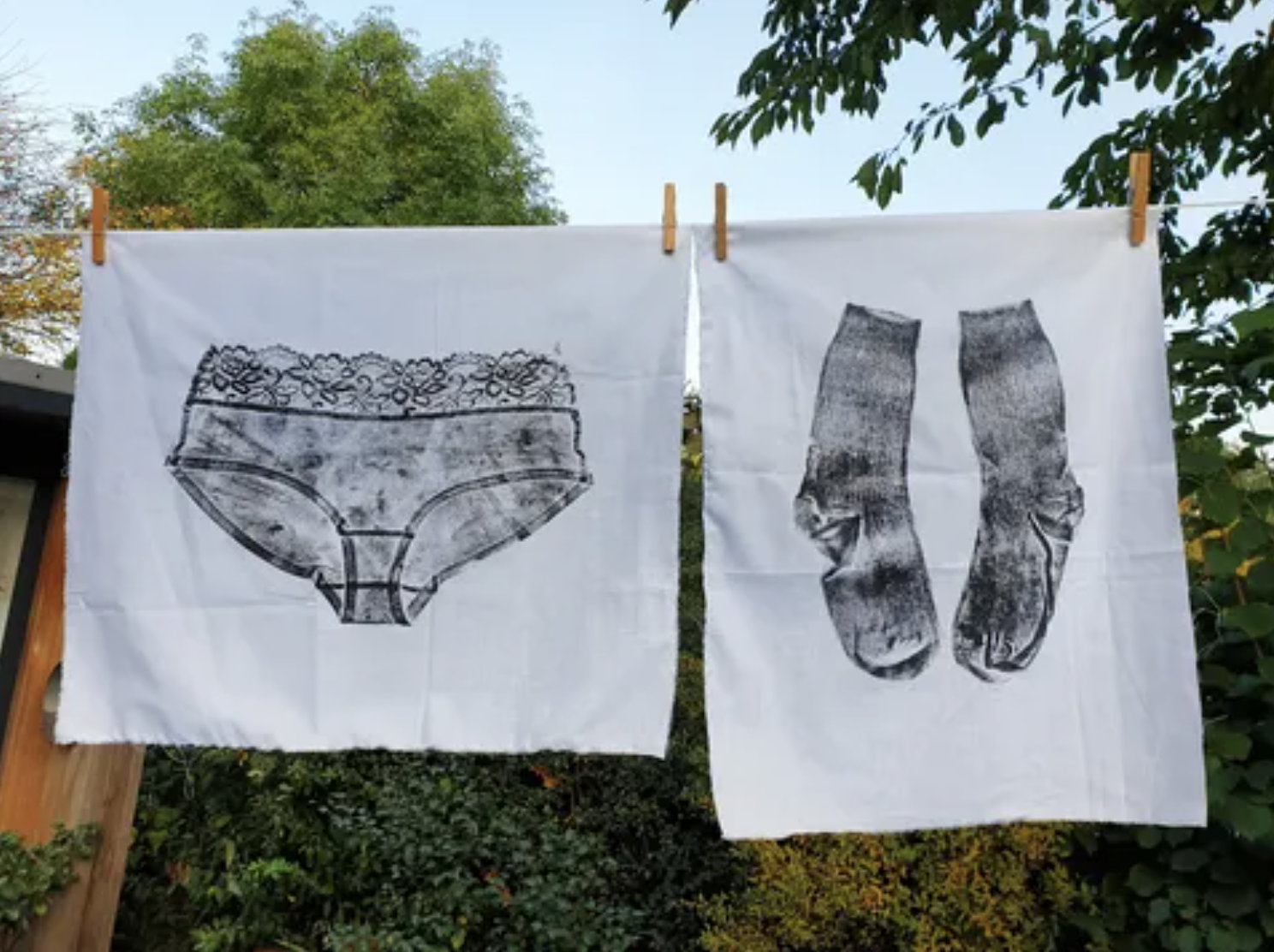
32:44 — Loved and Broken Garments: Prints, Rubbings and Break-Up Letters
47:06 — The Daily Stitch: French Knots and Seasonal Colour
57:13 — Slowing Down: Attention, Drawing and Keeping-While-Giving
1:15:17 — What Could Industry Do Differently?
1:20:42 — Shoes, Mending and Future Collaboration
1:26:15 — Debrief: Repair, Sole Prints and Conspicuous Waste
1:33:58 — Debrief: Wardrobe Studies and What's Next
Transcript:
Introduction [00:10]
Emily [00:10]
What if shoes could speak? What might their stories, and the stories of those who make and wear them, tell us about the ways we live, our values and our impact on the world?
Alex [00:22]
Welcome to The Social Lives of Shoes, a podcast brought to you by the Footwear Research Network that brings to life one of the most underestimated and humble aspects of consumer culture.
Emily [00:32]
Whether you design, produce, make, market, sell, or just wear shoes, these conversations will transform how you think about them and reveal new possibilities for a more sustainable future.
Alex [00:46]
This episode was recorded and produced on the unceded lands of the Wurundjeri Woi Wurrung people of the Eastern Kulin Nation and the Wangal people of the Eora Nation. We pay our respects to their ancestors, elders and custodians.
Emily [01:00]
Hi everyone, welcome to our podcast The Social Lives of Shoes. I’m Dr Emily Brayshaw and I’m here with Dr Alex Sherlock. How are you this week Alex?
Alex [01:11]
I'm very good, thank you, Emily. I had the great pleasure of meeting Wendy Ward, PhD candidate at Sheffield Hallam University, who I've been following for some time. So that was really exciting. And I think you've just listened to our interview. What do listeners need to know before we play it?
Emily [01:30]
Well, there's a lot of really great stuff in there for listeners and for industry as well. This is about, essentially, attachment and divestment, like a lot of our previous chats have been. Wendy's got her own fabulous, unique take on this, and it really has made me also think and rethink my wardrobe and shoe-wearing practices, and I thought I was pretty good on the sustainability front these days. So yeah, it'll be exciting to know what the listeners think.
Brave New World: “The More Stitches, The Less Riches” [02:04]
Alex [02:04]
Yeah, I think what I love about Wendy's work, and it will come up in the episode, is that she does go into a lot of the background around how terrible fashion is for the environment, and how the stuff that you give to the local charity shop or op shop doesn't go where you think it's going to go. She's done lots of investigation into that, which you can actually access through her Linktree, which we will put in the show notes. But we don't dwell on that too much, because I think the value of Wendy's work is moving away from that shame and the guilt and the kind of overwhelm, to introduce some really wonderful creative methods to get us re-engaging with our wardrobes.
So, I hope listeners, whether they're just wearers or work in industry, will actually really enjoy how innovative some of these strategies are and how creative and fulfilling they can be.
Now, Emily, something happened as I was recording these episodes on attachment and prolonging the lives of our garments that was strangely coincidental. For some reason, I started to listen to Aldous Huxley's book Brave New World, and there was a chapter in there that was uncannily relevant, particularly to this conversation with Wendy today. Have you ever read it?
Emily [03:22]
A long, long, long time ago. I haven't read it for a while.
Alex [03:26]
Yeah, so it's one of those books that for some reason I've never read. I've read Nineteen Eighty-Four.
Emily [03:31]
Yeah, which was never meant to be a how-to guide, to be honest [laughter]
Alex [03:34]
Well, can I just say that Aldous Huxley's Brave New World is even more frighteningly a how-to guide. And the relevance to Wendy's conversation will become clear.
For anyone who hasn't read it, my little AI summary of Brave New World is: it was written in 1932, and it's set in a future world state where humans are mass-produced in hatcheries and conditioned from birth into a rigid caste system, alphas down to epsilons. Stability is the highest value. People are engineered and psychologically trained to love their assigned roles, consume constantly, avoid deep attachments, and self-medicate with the drug Soma whenever discomfort arises. Family, monogamy, religion, art and solitude have all been eliminated or made taboo, replaced by promiscuity, community rituals and endless entertainment.
So it's a really disturbing read, and I think it's one of those things that, like Nineteen Eighty-Four, has become a bit too close for comfort.
But in chapter three, there's a conversation between, now let me find it, Lenina and Fanny in the women's changing room, talking about her worn-out zippicamiknicks which needed mending. Lenina brushes her off with hypnopaedic slogans. So hypnopaedic slogans are these slogans that they're fed in their sleep to brainwash them. “Ending is better than mending”, and “the more stitches, the less riches”.
So, in Aldous Huxley's Brave New World, the idea of repairing is against one's civic duty. You have to consume and you have to waste so that the economy and producers can produce more things to sell and make more riches.
So I'm listening to this as we're discussing attachment and mending and prolonging the lives of our garments with Ellen and then Wendy. How scary is that?
Emily [05:41]
That is super scary. And you know, stitches not riches is really what we need to be going for. And you know, Vivienne Westwood was very much championing the slow fashion movement while she was alive. And there is something quite punk about mending your own clothes, and I don't think punk's dead. I think it's just patching itself up.
Alex [06:06]
Yeah, so I think, relating to the conversation today, this idea of the more stitches the less riches is a huge conundrum for industry. And anyone who works in industry today who may be listening to this episode may think that this episode isn't for them. But actually, we do turn towards the end to consider how industry can collaborate with this idea of prolonging the lives of garments, thinking about alternative business models. And ultimately, what working with your garments in this way does, which is create a greater sense of community connection, identification, that actually is what fashion is all about, when we think beyond this kind of, sort of over-exaggerated big fashion system that we've arrived at.
Wendy makes this beautiful connection at the end about what fashion is about, which is finding your tribe and connection, which ultimately leads to brand loyalty and brand community. So, I would encourage anyone today who is listening to really stick with this episode all the way to the end, and think about actually how we might build on some of these exciting ideas to create more meaning and value in relation to the things that we buy and wear.
So before we talk any more, let's have a listen, and we'll come back at the end with a bit more of an analysis on the relevance of this conversation and what it might mean moving forward.
Emily [07:35]
Fantastic. Let's do it.
Meet Wendy Ward: Enduring Fashion [07:37]
Alex [07:37]
Wendy Ward, thank you so much for joining us on The Social Lives of Shoes podcast. It's wonderful to have you here.
Wendy [07:47]
Hi Alex, thank you for inviting me. It's really nice to join you and have a conversation face to face through a screen, because we've had lots on social media and various places. So yeah, it's nice to have a proper chat.
Alex [08:03]
I know, I feel like I've been stalking you for years, [laughter] because you contacted me a while ago about some of my research and I thought, who is this person? And then I was following you and I just love everything that you do. And I keep on mentioning you, whether it be to my students, or I know I've mentioned you a few times in the podcast. And although your work doesn't directly address shoes, I think the fact that I feel the need to constantly reference you suggests to me that I think your work is definitely transferable to footwear.
And so I'm really excited to discuss what those crossovers are, and actually how your research might be relevant to the field of footwear, which is in many ways quite different to other forms of clothing and garments.
But maybe we'll start by explaining who you are. So you are based in Sheffield at Sheffield Hallam University, and your current identity is as a PhD candidate at Sheffield Hallam. And I believe you're coming towards the end of your doctoral journey, is that right? Do you want to tell us a little bit about what your research is and where you've got to with it?
Wendy [09:13]
Yeah, so I'm at Sheffield Hallam. I'm doing my PhD part-time, so in theory that's six years, which when I began I thought, how lovely, six years. That just feels like a really long stretch of time, which it is. But now all of a sudden, I feel like, my gosh, I have kind of 15 months left.
So I've definitely switched gear now and I'm very much in full-on writing mode, which is a bit different. So I have to try and resist carrying on doing creative practice all the time. So it is a practice-based PhD, so with a practice-based PhD, we're finding out new knowledge and insights through our creative practice. And the fact that I have been doing it part-time has lent itself really nicely to working with a small group of participants, because I worked with eight people for 18 months, which was lovely. So we built a really nice, close little community.
So the title of my PhD at the moment is Enduring Fashion. So I'm interested in sustainability in fashion and clothing, but particularly I'm interested in the relationships and connections that we've got with and through our clothes, and the possibilities for using that as a way of encouraging more sustainable behaviour.
My starting point with that whole approach really is that even if industry and brands and businesses are managing to produce the most sustainable items of clothing, then if the wearer doesn't value that item of clothing and look after it and care about it and love it and use it, then all that effort in design is a bit wasted. So I'm really, really interested in how people use their clothes and how they value them and what they think about them and what they mean to them.
Alex [11:43]
Wonderful. It follows on really nicely then from the episode with Ellen Sampson, when we were talking about Jonathan Chapman and emotional durability and reconnecting with your clothes. And I will just reassure you that I did a full-time PhD and it took me six years to complete, so maybe I should have started as part-time, realistically.
Wendy [12:06]
I don't want to spend 12 years doing this, Alex!
Alex [12:11]
No, you won't. Because actually what I was going to say is you have been incredibly industrious, because you have done numerous articles and you did a wonderful article in The Conversation. So you've sort of been publishing on your research as you've been going, haven't you? And obviously extensively on social media, and you've got a Substack as well.
And I think that's really wonderful, because so much of this research is so relevant at the moment. It would just be a travesty to be waiting until the end of the PhD to release it. So I can see that your research is already having impact around the world in terms of its influence. You've got like 22,000 followers on Instagram, I noticed.
Tell me about how you arrived at this kind of topic, because you've got a prior life before the doctoral research.
Wendy [13:04]
I'll try and give you the edited version.
Alex [13:07]
The potted history of Wendy Ward, yeah.
From Fast Fashion to Fair Trade [13:13]
Wendy [13:13]
So I did a fashion degree and I did work in the fashion industry for around about seven years. And interestingly, I worked at two extremes. So I worked straight out of my degree for a fast fashion brand that was, and is, quite big in the UK. So that was quite eye-opening as a fresh, eager graduate, to live the reality of how that worked in a fast fashion brand, which resulted in me mainly sitting at a computer, copying lots of clothes and being completely disconnected from anyone that made the clothes, or even any materials that went into making the clothes. So that was quite disillusioning for me and I didn't stay there an awful long time.
But then I went to a small brand that was focused on using organic fair-trade cotton to create a clothing brand, and I joined them quite near the beginning. It was a really small team, so I got to travel to India, work with the people that were actually making the clothes. So complete opposite extreme of my first experience.
And then I slowly moved into education. I worked in adult education for quite a lot of years, so really hands on, teaching people how to make, alter, adapt, repair their own clothes and do more creative things with fabrics. I had my own workshop at the time. I lived in Brighton, so I had my own business doing that kind of thing as well.
And that's what led into the books. So I had my own sewing pattern brand and then got approached to write books. And yeah, I was very much on a conveyor belt of teaching, designing new patterns, writing books, eventually editing other people's books as well, which I enjoyed.
And then I moved back to Sheffield and carried on doing a bit of teaching. But I had noticed over all them years that a lot of people that I was teaching these sewing skills to, it had an effect: they started behaving differently with their clothes and thinking differently about their clothes, questioning clothes that were available in shops and the prices and the quality, and lots and lots more questions and interest generally in clothes, which I found really interesting. Obviously that was just anecdotal, my experience.
But then when COVID came along, I was able to take a pause. I was sort of part way through writing another book at that time, so I was lucky, I had a source of income, I could work from home. But I did start having a bit of a pause and thinking, hmm, is there anything else I want to do? Do I want to take this work further in different directions? So yeah, I then ended up applying to do a PhD, and here I am.
Material Engagement and How It Changes Us [16:53]
Alex [16:53]
Well, it's great. And I'm fascinated by what you've said there around noticing a transformation in people once they start materially engaging with their clothes. Are you talking about specifically repairing them, or just making them, or all of it?
Wendy [17:10]
The whole thing really. I think it's just my experience of that world, that work. And it wasn't universally every person, but quite a big proportion. Just slowly they started questioning, taking more interest, and I suppose it is that they were gaining new material knowledge. Suddenly they had this new knowledge about fabrics and how clothes are made, and they started using it in ways outside of their own experience of learning how to make and adapt and repair clothes.
Alex [17:54]
Yeah, so what I've noticed with the This Is Not a Shoe project that we've been getting people to do is that, because people don't generally tend to make their own shoes, it's quite a complicated process, and I think a lot of people are quite scared of repairing their own shoes. And sometimes, obviously, because shoes are so cheap in many ways, I think a lot of people just consider it to be easier just to buy new shoes and figure out what to do about the old ones. Which I guess, obviously there are commonalities there just with clothing generally, but I guess shoes are a bit more complex in lots of ways.
What I have discovered, and my colleague Pennie and I have discovered, through getting people to deconstruct their shoes, is that actually the response after they've deconstructed their shoes, or even if they've seen one of our exhibitions and they've seen the shoe laid out, all its components and pieces, they just say, I've never thought about my shoes in this way before and I will never buy shoes the same again. And so people who've participated in the workshop will say it's really got them thinking about buying shoes, about the materials, the components, the quality of the materials, better understanding of why they might be paying a bit more for them.
For me, it's been a case of now I buy shoes to think about what they could become at the end of their lives. So I buy shoes that have interesting shapes or really good quality materials that I can go, I know what I'm going to do with that, to the extent that I'm almost looking forward to the day when they're irreparable, because I kind of know what their next life is going to be.
So yeah, I think these kinds of practices of materially engaging with things, and either making things, repairing them or upcycling them, actually does get you thinking beyond the object in its arrested form as it is there and then, and thinking more about materials and material flows. So is that something, it sounds like that’s something that correlates with what you're discovering as well?
Wendy [19:53]
Yeah, and that's really interesting that you mentioned then about how it's affected the choices you make when you buy new shoes, because you're thinking about their end of life already.
And so, not talking about my participants, but me personally in my own practice, the process of going through the PhD and how my personal practice has developed, that's definitely the way it's impacted me. So, I find it really difficult to acquire new clothes in any kind of way. Now I'll buy secondhand clothes, but I couldn't tell you the last time I bought an item new. And even making clothes, I really question myself now, how much do I need to?
And part of all that is because it's become quite a theme through my practice, of managing with what we might call clothing waste and what a problem it is. And that aspect has had a real big impact on me, because I think, okay, so if I'm going to let this new item of clothing, usually pre-used clothing, into my life, is it filling a need? How much do I love it? How much do I think I'm going to wear it? What kind of materials is it made of? And ultimately, what's going to happen to it at the end of its life? Either if it becomes unwearable, and then I deem it unwearable for somebody else, what can I do with it? And in a way that's become quite a weight of responsibility. I mean, I know it's only me, one individual person, but yeah, it's definitely impacted how I behave with clothes and my consumption of clothes.
I mean, speaking for my participants, I can't speak as clearly as that, because the way that my PhD was set up, it's qualitative, it's practice based, it's a small group of people. It was never really set up as – this is a study that is going to collect evidence of behaviour change, because a) that's not my field of expertise, and b) it is quite a small group of people. But yeah, in conversations that we've had in creative workshops, it's been really insightful, the kind of things they've said about how much more aware they've become of their clothes and how many they've got and what they do with them and how they acquire them and what they do with them when they're finished with them, and how few options there are really.
The Waste Problem: Clothes and Shoes [22:51]
Wendy [22:51]
Particularly in the UK, I mean, what we might categorise as waste clothes: the clothes that we think, that's unwearable for me and I don't think it's wearable by anyone else for whatever reason. Then, there's really not an awful lot you can do with those kinds of clothes. And they're full of all these different materials and components that are really difficult to separate. So so little of it is actually recycled, even though so many schemes are there that use that word, recycled.
I mean, really in the UK the only options are to kind of repurpose it in some way yourself, and for a lot of that you need some skills to know what to do with it. Or it goes in the general household waste system, or it goes in one of the big collection skips, and we all know what happens to clothes that go in them.
I've found out specifically what happens to them in Sheffield, but it took me seven months and two Freedom of Information requests to find out what happens to them. And 100% of them are exported.
Alex [24:10]
Yes, to landfill, to other countries to deal with. And then we've seen lots of reports on what the consequences of that are as well, haven't we?
Wendy [24:19]
Yeah. And that's when that trail of information is really difficult to follow up in any detail, because once it's exported, it leaves the responsibility of that company, that country that's exported it. So yeah, it's difficult to know exactly what happens to this stuff. I mean, like you said, we've seen some horrific images of what happens to some of it.
Alex [24:51]
We have. And I think the data, what little there is of it, it's a very similar picture in footwear. There's been very much less data. I think there was a statistic that 95% of footwear was going to landfill or being incinerated. That was from a study in 2007, that in itself, if you go through that study, it wasn't particularly robust, but it's the thing that everyone hangs onto. Really nobody has any idea of the exact scale of the problem at the moment.
There's been a recent study by Fashion for Good, which I think is the first one of its kind to go into a fair amount of depth in terms of what the problem is for footwear. They looked at 1,200 post-consumer disposed shoes in the Closing the Footwear Loop report, which was released just a few days ago, very, very recently. That found, I think they estimated, around 90% was unrecyclable, because of the complexity of the construction, the glue, the adhesives, the fact that they're not really able to identify what a lot of these materials are. You've got all sorts of metal components which cause problems for shredding machinery.
There were 24% that were written off as non-wearable but they had no physical damage, they were just unpaired, dirty or unsellable. So I think what that kind of data showed me is that lots of people are getting rid of their shoes when they're actually still wearable. It's just like you say, they've sort of fallen out of love with them, or they've become unfashionable or whatever.
I mean, the scale of the problem is quite astronomical, because I think the number of shoes that are produced yearly fluctuates up and down. I think it's around 22 billion pairs a year, when you consider there's how many people in the world? Like, is it like eight billion?
Wendy [26:46]
Mind-boggling. Yeah, something like that.
Alex [26:49]
And you think about the number of those people that would not be buying shoes every year either, like in countries around the world that don't have this kind of insatiable consumption practices. And where are those shoes going? Where are they going?
Beyond Guilt: Creative Methods for Change [27:06]
Alex [27:06]
But I mean, without wanting to go too far down this road of making us all feel terrible and making it feel like it's unsolvable, or just futile, or aren't we terrible, which really doesn't precipitate any kind of positive action. I think what I love about your work is that you are covering that, you are covering the realities, and you are looking for the evidence. But more importantly, I think through the creative practice, you are actually producing these wonderful, fun, engaging activities that actually motivate people to want to prolong the lives of the clothes that they already have, in creative ways, not through guilt and shame, but just because there's so much to be gained from it.
And I think that change of narrative, in terms of going from shaming people to actually motivating them through creativity and connection and all of the things your experiments do, I think just has to be the way forward.
So, do you want to take us through a little bit? What are some of the activities that you've been doing? What has this PhD looked like?
Wendy [28:18]
Okay. I'm glad you introduced it like that as well, Alex, because that is a big motivator for me. Yeah, I kind of feel like we've known about the problems of the fashion industry probably since at least the 90s, and various organisations have tried to communicate that, but it has been in that guilt-shaming, negative way. Which has relevance, but it kind of turns people off, and it's clearly not worked, has it, because here we are doing worse than ever.
So, I really wanted to use creativity, creative practice and individual experience and storytelling as a more positive way to enable people to think a bit differently maybe about the clothes that are in their wardrobes.
So, I've done a whole range of different things with my participants, but it's always come from my own practice. So, there's been this lovely kind of circular, iterative cycle that we've gone through, of I've been working on ideas and I've done things myself, and then I've tried things out with participants and they've maybe seen different things in it, which is then fed back into my own creative practice.
So, I do wonder whether one of the reasons I've managed to get people on board with it and stick with it is that everything that I've asked participants to do, I've actually done myself. So, you know, it's not like I've come up with a collection of crazy ideas and gone, hey, how about you do this. I've actually tried it out myself.
Wardrobe Audits and Data Visualisation [30:12]
Wendy [30:12]
So we started off with a version of wardrobe auditing, because I did that myself very early on in the PhD. And, you know, I thought I behaved quite responsibly with clothes and everything, and I was just horrified at how many clothes I had. I thought, oh my God, what have I been doing? Am I creating the Wendy Ward Museum of Clothes here? Why have I got all this stuff?
So I thought, wow, if even someone like me who is really aware of all this stuff is shocked at how many I've got, I wonder what would happen with participants.
So we did that. And I did mine in a very, very boring way, with a notebook and an Excel spreadsheet, which was just like, God, this is so tedious and so boring. So I tried to use data visualisation with my participants. I made each of them this lovely booklet and we used coloured pencils and different length and different colour lines to represent the different lengths of time that they'd owned the clothes, and when they'd last worn them. And, learning from the mistakes I'd made, I tried to make it a much more manageable task for my participants. And I have to say, most of them had the same reaction that I did of, wow, why have I got so many clothes?
So yeah, that's where we began, with a kind of scene setting, getting to grips with what the situation was.
Alex [31:56]
Yeah, we did it with shoes in the If the Shoe Fits project, and similar thing. If you just ask people how many shoes they've got, they say they’ve got 10 pairs of shoes. In reality, you realise that's the 10 that they're wearing at the moment, or have in the last year, and they have got numerous shoes stashed away in all sorts of little nooks and crannies. So yeah, it's very revealing.
Wendy [32:19]
It is really revealing, and I think that's an important part of beginning the process, is to understand what you've already got and your existing behaviours. Because if you want to do things a bit differently, you have to understand the situation as it is before you start, otherwise you don't really know what it is that you need to change, or want to change even.
Loved and Broken Garments: Prints, Rubbings and Break-Up Letters [32:44]
Wendy [32:44]
So we moved on from the auditing to some creative workshops where we were focusing on two extremes: so loved garments, and then what I described as broken garments. So the garments that people considered they were ready to part with, and they were going to part with them in a way that meant they couldn't be worn by someone else either. So these were garments deemed sort of unwearable, unusable, no longer functioning, which is a really problematic category that I was talking about before, because there aren't any good options for what to do with those clothes.
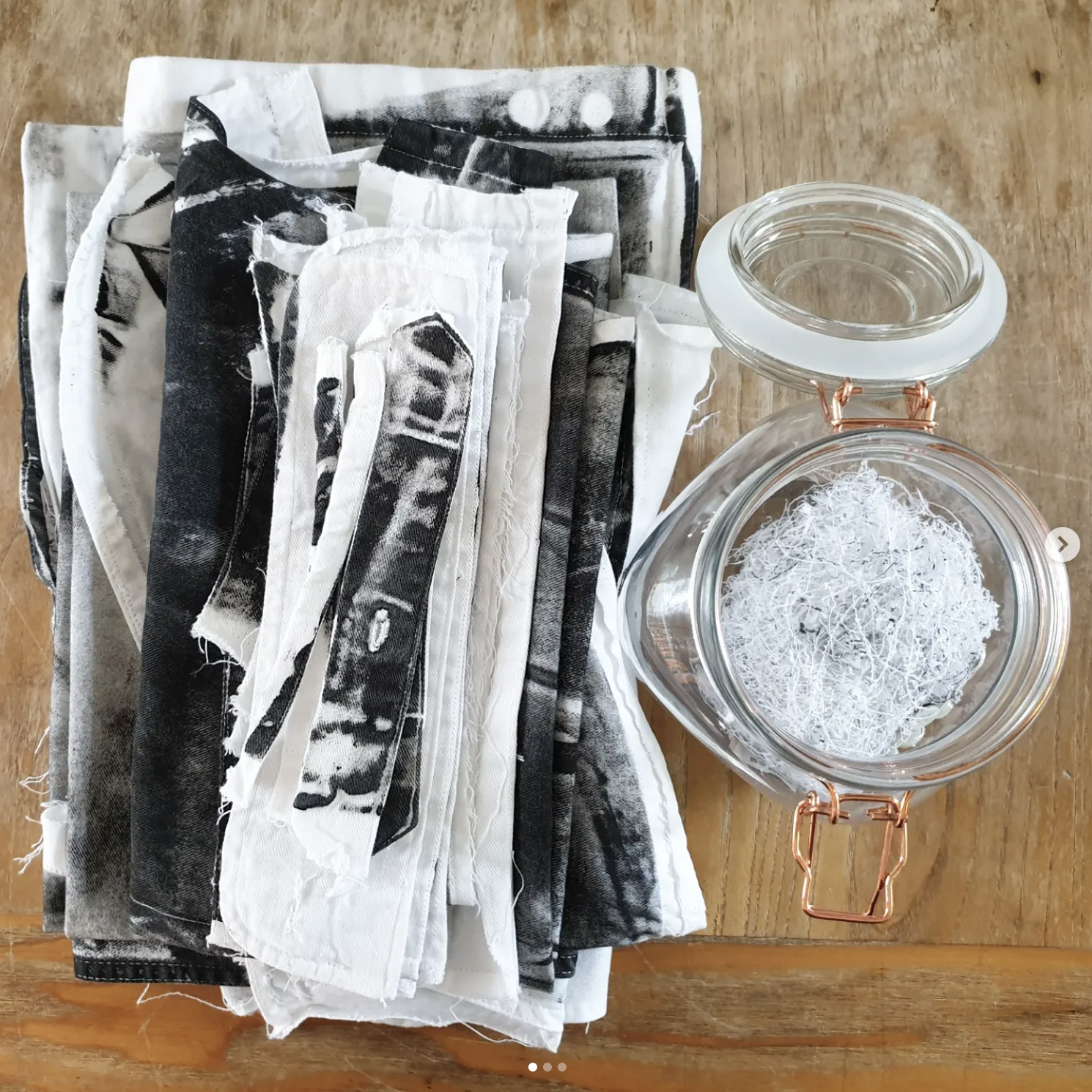
So that workshop in particular was very interesting, because that also had developed out of my practice. I had been using printmaking as a way of documenting clothes that were no longer being worn. So I was covering them with screen printing ink, water-based, so that I could take a print from them, like a life-size impression of that garment. And I found it a really powerful process myself, and found the resulting prints really fascinating and beautiful, and they revealed lots of details that maybe I hadn't noticed before.
And I started thinking, this would be something really interesting to try with participants, because I've got my own experience of it, but I wonder how it would be experienced by other people not so deeply interested in clothes as I am.
And yeah, it was a really, really powerful session. So people brought in clothes that seemed very, very average, ordinary, stuff that they weren't going to keep anymore, definitely weren't going to wear anymore, were in such poor quality that they thought no one else is really going to wear this, so it probably is just going to end up in the bin, so let's take it to this workshop. Exactly the kind of garments I was looking for.
And then yeah, that workshop, there were tears, there were all kinds of interactions. So from these garments that seemed quite unimportant in a way, you know, they weren't the garments that I described as loved or precious. So I worked with participants, we inked them up, made prints of them. We were having conversations as we were doing this, which were quite revealing, because obviously people are talking about the garment, what it meant to them, their experience of the process as you're actually in it and doing it.
And then I also asked them to write a break-up letter to that garment. So I gave very little direction, I just sort of said, I want you to write a break-up letter to your garment. Which, on the face of it, if you pull that exercise out of nowhere, it just seems a bit like, okay. But because it was part of this creative workshop where we'd made prints of garments, covered them in ink, my participants kind of realised things about these garments.
So they brought them in and initially they'd been really unimportant, maybe they had been sat in a bin bag for a few months waiting for the person to decide what to do with them, maybe they'd been sat in a pile to go in the bin. And then through this process, they'd sort of realised lots of things about that garment and what it had meant in their lives and their connection to it.
Alex [36:52]
That they'd just forgotten?
Wendy [36:54]
Either forgotten or hadn't acknowledged or hadn't realised. But in doing this process, it all came out, in a lovely positive, supportive way, because by the time we did this workshop this small group of people had built up this lovely supportive community and it felt like a really safe space where people could open up and talk about lots of different things.
And a lot of people as well talked about these prints as like a better version of their garment, and a lasting reminder of that garment, and a lasting reminder of the experience that they'd had with that garment and what it had meant.
So yeah, really powerful stuff. And it just makes me think, the alternative experience for that person and that garment, if this workshop hadn't happened, would have been quite likely that garment just being placed in the bin. And where is there any kind of value or meaning or material understanding in that? There's none.
Alex [38:15]
So when you say the experience, that they had engaged with the experience of that garment, do you mean that they'd engaged with their experiences of the garment in their lives as they had worn them, or that the experience of doing this activity with you was an experience that had infused that garment with a specialness that meant that they could no longer get rid of it, because they had gone through this process with you and had built a new connection, which is the memories, the sharing, the stories and creating the artwork?
Wendy [38:50]
I think there's a little bit of both. So I think that the actual experience of the workshop was almost maybe more important than the prints that were made at the end of it.
I was really strict right from the start that these garments, they were sacrificing them. I would be taking them away at the end. They weren't going to get them back. That was it. That was final. And I did check a couple of times before we started covering their garments with ink that they were sure and that they were definitely wanting to do that. Because imagine, imagine the horror of, Oh, I really love this garment now and you've just covered it in black ink.
Alex [39:44]
Wendy, Wendy, we get people to take apart significant shoes. I have to tell you, there's a lot of conversations that go on between the participants of the workshops, and I get them to bring backups, because I do not want to be responsible for any regret.
Wendy [39:59]
Exactly, exactly. I find your This Is Not a Shoe workshops really fascinating, because obviously I can see so many connections between what you're doing with shoes and what I'm doing with clothes. And it is that material engagement, that exploring that item in a really deep way, both materially and emotionally.
Alex [40:27]
Yeah. So your participants then would take away the print, but you would take...
Wendy [40:32]
No, I kept the print. I kept the print as well [laughter]
Alex [40:35]
Oh my god! So they didn't have anything. They were literally having to now give away this thing that they have this renewed connection with. How did that go? And what did you do with them?
Wendy [40:42]
Yeah, unfortunately, yeah. So I have kept them very safely, and as it's part of my ongoing practice, I think one of my really grand plans when I very first started doing this with people... I think in the future it's something that I would really like to do. I would really like then maybe to get the same group of people together again, bring those inked-up garments back and take them apart. Because I've also done a lot of that in my own practice, of unmaking, dissecting things, taking things to pieces. Because also, when you've covered a whole garment with ink, when you then take it apart, some really nice interesting effects are revealed.
Alex [41:39]
Oh yes, the bits that didn't get the ink. Yeah, lovely.
Wendy [41:40]
Yeah, yeah. And so I would really love at some point to then do this with a group of people, make the prints, do a subsequent session where we have the inked-up garments and they're all swapped around and people then take apart someone else's garment.
But yeah, that wasn't something that I was able to incorporate in my PhD research, but I think that would be an interesting extra level of involvement.
I did a pilot workshop for the printing exercise before I did it with my participants, and that was a question I asked my volunteers at the pilot workshop. How would you feel if then your inked-up garment was given to someone else to then take apart? And there were some quite interesting responses, ranging from, well, that would be fine, to, oh, I'm not really sure how I feel about that. Which is interesting, as it was something that they would have thrown in the bin anyway.
Alex [42:46]
Yeah, it is really fascinating that this whole process, this creative process, is kind of reinvigorating, I suppose, the garments and the relationship.
So then what was the next activity that you did? So you did the inked garments, which I think you do have some of those on your Instagram, don't you? They're really beautiful. Artworks in themselves, aren't they?
Wendy [43:09]
Yeah, yeah, I've done a lot of them myself as well. And we also did a workshop. So the broken ones with the printing was one of the last activities I did with my participants. One of the first creative workshops that we did after the wardrobe audits was with loved garments. So obviously we didn't cover those in ink. So I wanted to find a way of making images of those garments, so I had developed a way of making rubbings of garments onto fabric.
And that has an equally powerful impact on people. But I think the difference is that these were garments that people already saw the value in, and they were already very meaningful and precious in people's lives. They almost weren't searching for any meaning in them. I think that's why the broken one was so interesting, because it often seemed to really transform the status of that garment.
And so running alongside all of this, I also had my participants completing a kind of analogue wardrobe tracker. Not particularly tracking what they wore, but tracking what was coming into their wardrobe and what was leaving their wardrobe. Which was quite an interesting exercise to have done after the wardrobe audit, and lots of the participants being quite shocked at the extent of their wardrobe and maybe how little some of the pieces in there had been used. It was then quite interesting to ask them, for a whole year, to record what extra stuff came in and maybe what stuff went out.
And yeah, I was wondering whether it was realistic to expect people to maintain that for a year, but they did. They were really great participants, I have to say.
Alex [45:28]
Yeah. I mean, what I would say, though, is that speaks to how engaging this research was for them, because I've been involved in research before where people just drop off because they're just not engaged by it, it's not fun. And it sounds to me like the activities that you were doing, there was a lot in it for them. By the sounds of it, connection with one another, these creative activities, coming back together, they'd obviously bonded with each other through their shoes, sorry through their clothes, I’m just constantly thinking of this in the context of shoes! It's so transferable.
But I think that's the thing: if you get anyone to do these kinds of wardrobe audits and accounting for their items going in and coming out in isolation, that is quite tedious. But if there's some kind of reward for it, and I think sometimes researchers offer vouchers or money, but again that doesn't motivate them. I think from what it sounds like, the motivation, I can absolutely see, because I can imagine what I would be like, meeting up with this group of people who you've already bonded with through your stories and these creative activities, and learning from one another and discovering from one another, rather than it being a researcher-participant relationship where you're being studied. I mean, gosh.
So you can see that there's a social reward, I suppose, for participating. But I think there's a social reward in all of the activities that you're talking about here, and it is that idea that the reward of engaging in these things is that it actually connects people with one another.
The Daily Stitch: French Knots and Seasonal Colour [47:06]
Alex [47:06]
So talk to me then about the… the technique that I first noticed, which I thought was absolutely genius, which was the little French knots that you put on garments to track how often you're wearing them. Because as well, I think the social aspect of that, what I loved about that, is that it was a conversation starter as well. So can you tell us about that?
Wendy [47:31]
Yeah, so that emerged out of my wardrobe audit. So like I said earlier, I was really motivated to do it, I really wanted to know the extent of my wardrobe and was a bit horrified by it. But I'd found the experience of actually doing it just really quite tedious, as you were describing. Just kind of like, this is really not a fun activity to be doing, and the way that I did mine didn't really capture anything about how often something was worn. And I thought, well, really that's kind of the heart of a lot of the stuff that I'm interested in, so how can I record that? I don't want to have a notebook where I write what I've worn every day. How boring is that? How useful is that data going to be?
And I follow a couple of people, Clare Daněk and Claire Wellesley-Smith, who have daily stitch creative practices, which I absolutely love. Love reading about it, love listening to them talk about it, love seeing the work grow and evolve and how it's a lovely record of a person's time.
Alex [48:59]
What's the daily stitch? What kind of things do they produce with the daily stitch project?
Wendy [49:04]
Well, in various iterations, and I don't know actually whether the originals are still ongoing, but they've both written about them quite a lot, especially Claire Wellesley-Smith. I think she kept a stitch journal where she stitched onto a length of linen every day for 10 years, I think. So she's got this incredible work of art.
So I felt really inspired by that kind of work and really wanted to find a way of incorporating that with clothes, and thought, well, what I could do is make a little stitch on a garment every time I wear it.
So it really started as a bit of an experiment. I think I started it in July '23. I thought, well, let's see how it goes. It's an interesting experiment for my PhD. It might fit into my everyday life, it might not. I'll give it a try and see what happens. And yeah, three years later, I'm still doing it and I can't imagine stopping it, really.
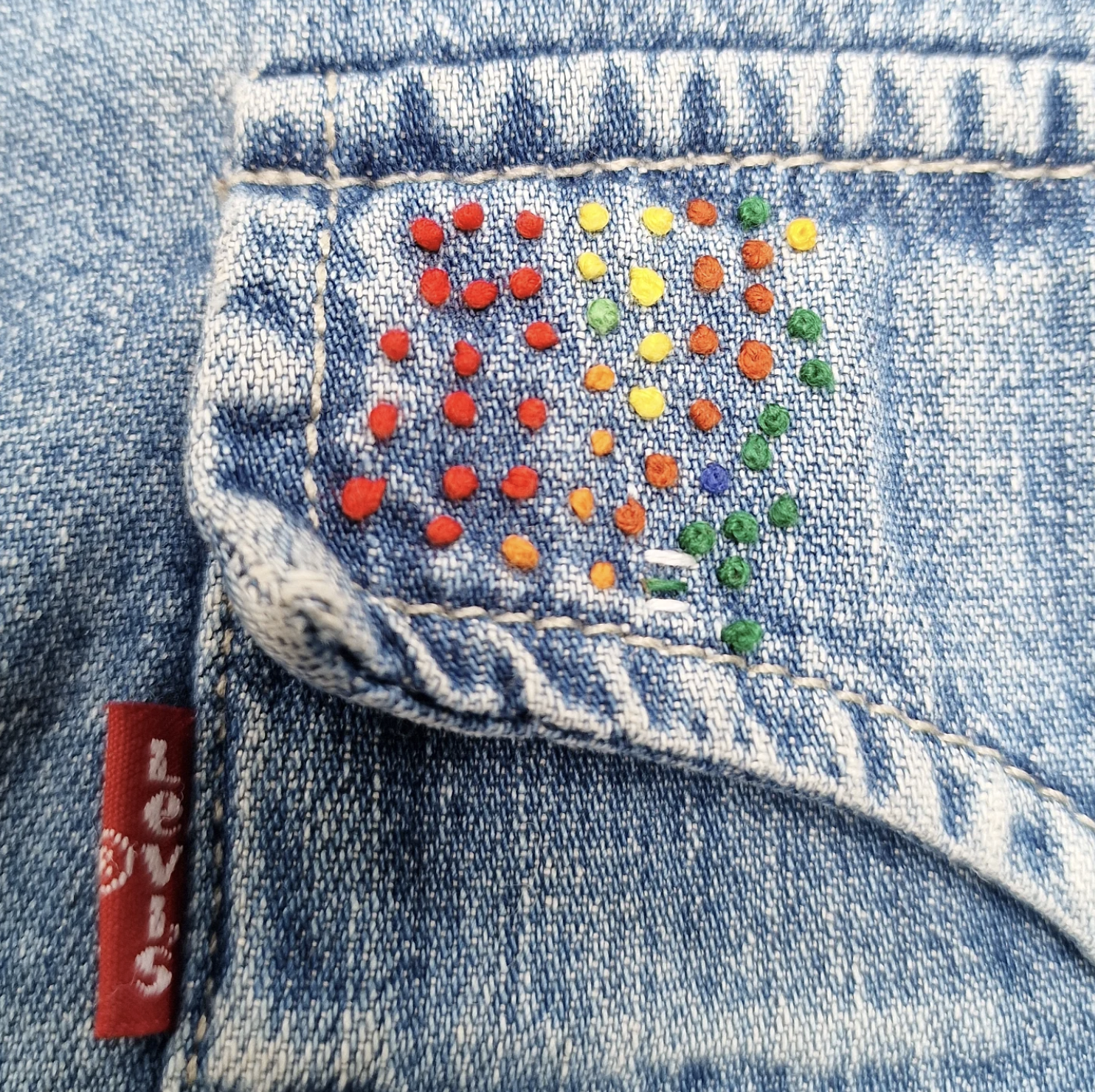
So every morning I gather together the clothes that I was wearing the previous day. So it's just clothes, it's not things like underwear or socks. And I sew a French knot either directly into the garment, or for garments where it might damage the fabric, like say waterproof outerwear or stuff that's got a really deep pile, or things like leather, I attach separate labels, just a piece of cotton tape on the inside of the garment, and I make my stitches on that. And sometimes they're cross stitches, sometimes they're just a little five bar gate.
Alex [50:56]
Like a little tally, yeah. Lovely.
Wendy [50:59]
But the ones I do directly into the garment tend to be French knots. And then as I did that for that first month and thought, and thought, hmm, there's something in this and I really enjoy doing it, I then started thinking, how can I connect this in some way to maybe some bigger pictures of things, or the world, nature, small ambitions [laughter]
I came up with a simple method inspired by, have you seen the practice of knitters and crocheters making temperature blankets?
Alex [51:42]
No.
Wendy [51:43]
It's a really lovely activity. I think it's connected to daily or weekly temperatures in the place where the person is, and they choose their yarn colour based on the temperature. So you see kind of almost like the climate stripes, you see those as evolving.
Alex [51:59]
Oh my goodness, that sounds amazing. I need to look this up.
Wendy [52:04]
Yeah, and some of them are really beautiful. I thought, right, okay, I could do something like that. So mine's not related to temperature, but what I do is I change colour every season. So obviously we've got a four-season climate in the UK, we've got spring, summer, autumn, winter, so each one I change the thread colour. And then I mark things like the solstice with a different sort of stitch in a different colour.
Alex [52:39]
So then, when you're looking back over it, you can orientate yourself in relation to when. Yeah.
Wendy [52:43]
Yeah. So they're starting to tell a story of when I've worn things, and noticeable things like maybe garments that perhaps were very hot weather oriented and, you know, based in the North of the UK, I wouldn't wear them very much. But then particularly this year, because we had quite a hot spring, I found that I was stitching spring-coloured stitches into garments that only had summer stitches. And that's quite significant. Like, oh, I'm already wearing this garment and it's only still spring, and normally it would be the middle of summer, the only time when I would be able to wear this garment.
Alex [53:34]
We just don't reflect on these things, do we? We're just so busy, we just go about our daily lives and we completely lose any sense of orientation, whether it be in time or place. You know, what time of year it is, what day of the week it is. And I think just the act of recording that and then being able to reflect on and notice...
And I can see it absolutely does perform the function of actually connecting yourself to the broader conversations about climate and ecosystem. We all live and survive within huge, larger systems which we have no control over. And I just think it is fascinating to have an opportunity, just in that really small way, to be able to connect with that and situate ourselves. I would be fascinated to see what mine would look like, for example, here in Australia, in Melbourne, in contrast to living in the UK. And I used to live in Sheffield as well, but also different places in the UK.
So then what you've got is this just beautifully emerging pattern that you know the significance of, and is emerging to, I guess, the uninitiated as perhaps just a nice design. But then that holds a deeper meaning, doesn't it? So yeah, what happens there then?
Wendy [55:00]
So yeah, I'm not sure that anyone completely unfamiliar with my work has ever commented on them. Hopefully eventually people will. But people that are maybe a bit familiar with my work and what I'm doing have started noticing them, because on some garments there are a lot of them.
And yeah, like you said, they are creating this sort of abstract surface decoration. I kind of like the fact that it feels like a bit of a secret between me and that garment. I know what it is, what its meaning is and what it represents. But maybe to anyone just passing me in the street might think, oh look, she's embroidered her dungarees.
Alex [55:56]
But then to someone who knows the secret, and I've read this on one of your posts, they'll come up to you and say, you've worn that a lot, or whatever. And I find that in itself fascinating, in that wearing that a lot is something to be really proud of, because you've evidenced it and you've taken the time to record it.
Whereas I think in our consumer culture, sort of traditionally, well, I say traditionally, I don't mean traditionally, I mean, in the recent past, the idea of wearing something repeatedly has been very much frowned upon, hasn't it? It's that, gosh, you can't wear the same thing two days in a row. But then it's like, well actually this kind of motivates you to want to wear it two days in a row, because then you're building up the dots which then build up the pattern and create even more of a connection, and it becomes something to feel truly proud of.
Wendy [56:46]
Yeah, I love that aspect of it, that it's almost like the complete antithesis of what fashion is all about. This practice celebrates extended use. And also the practice of doing it and seeing these patterns develop motivates me to want to wear stuff more as well.
Slowing Down: Attention, Drawing and Keeping-While-Giving [57:13]
Alex [57:13]
Yeah, so tell me then about, because obviously, going back to the wardrobe tracking apps, I think some of them do track numbers of wears to see if you're getting price per wear, or those kinds of things, to see if you're getting value out of your wardrobe. But this is different in some ways, isn't it, in terms of actually getting people to take a moment to stop and actually make a stitch?
I mean, I've got a five-year-old and an eight-year-old, and I think there'd be a lot of people out there that are just like, my god, I wouldn't have any time to stop for a second and make a stitch. But what is the value of doing that? I'm kind of sensing there's probably a mental health aspect to this as well, and a slowing down aspect to this too.
Wendy [58:03]
Yeah, definitely for me personally. And I totally appreciate that it really isn't for everybody, and it's not something I would have ever tried to incorporate in my work with participants. I think if I had presented it to my participants and said, hey, this is what I want you to do for a year, I don't know, I might have been surprised, I don't know, but yeah, it feels like a big ask.
When I first started, I thought, well, I'll just try it for a month or so and see what happens. I'll probably just not do it for any longer, it'll just be a little experiment. But I enjoy it so much that I can't imagine stopping really. I mean, for a start, I love hand sewing, that helps. And I've got a busy life as well, I haven’t got kids taking up my time and things, but we all try and cram a lot in, don't we? So to find time to do some hand sewing every day, I couldn't find a way to do it previously. So that is a lovely bonus for me, I just know that every morning I get to spend some time doing some hand sewing, which is lovely in itself.
And then I'm reflecting on what garments I've worn, what I've done in that garment, whether I enjoyed wearing it or not. If I didn't, maybe there's something I can do to it, to change it, to make it a bit more enjoyable to wear. I'm paying a lot more attention materially to these clothes, because when we wear clothes, we're not really looking at them in any great detail, are we? We're just putting that on our bodies, we might look down and notice things, we'll look at ourselves in the mirror, but it's never looking in really great detail at a garment.
Alex [1:00:08]
No, and we often only just notice things when they go wrong or break as well, don't we? We don't really appreciate them as we're living in them.
Wendy [1:00:17]
Totally. So I'm noticing more about how garments have been constructed, maybe where they've been made, little details in their material, how they've come together, and also how they're wearing.
So through this practice, I have noticed garments where they might have been wearing a bit thin somewhere, and I thought, I need to do something about that, otherwise that is going to suddenly tear. But I can intervene a bit early and do something about it to stop that happening. So yeah, it's just a way of being a lot more aware materially, as well as reflecting on, well, I seem to enjoy wearing this garment a lot, and yet it's pretty unimpressive, but I seem to wear it a lot.
Alex [1:01:24]
And I just think the mindfulness as well. I mean, I am ridiculously busy at the moment, and I can sense, I get particular symptoms when I'm stressed, like physical symptoms, and I have really felt the need to do stitching at the moment. It's really funny, it's like I haven't got the time to do it, but I feel like I have to do it.
And so this morning, actually, when I got up after the kids had gone to school, I sat down and repaired a couple of holes in the top that I wanted to wear today, because I thought, I want to wear it today. And this top now has become a project that I've been repairing for the last five years. And I've started to become quite proud, actually, of the fact of how long it's lasting, and the little scars on it that, if you really look, you can see. They're acts of care, I suppose, aren't they?
And just that stopping with a needle and thread for two seconds, I just think it is that value of, just the act of slowing down and stopping for a second and taking a moment, I think is extremely important. So that's why I just wanted you to reflect on the value of that for listeners, because I think it is that kind of, I don't have the time to do it, and it's that value of actually making the time and prioritising that kind of stopping and taking a moment.
Wendy [1:02:55]
And the value of a long project. I mean, I have noticed it has made me think about the connections between that and the bigger thing, doing a PhD, and just these small repeated acts that are not a huge overwhelming task. But if they're repeated over time, they can build up into something much more meaningful.
Alex [1:03:26]
And actually, when you consider that we live in digital culture where there's so many shortcuts in life and there's so many cheats and hacks, and you're thinking about social media and the number of characters that you can have in social media posts and there's no long form, I think people really are craving at the moment sustained connection with things, with projects. Long-termism as opposed to short-termism, investment as opposed to the quick fix.
Wendy [1:04:01]
Yeah. And it's much less stressful. That constant renewal and being bombarded with, here's the next thing and the next thing and the next thing, is exhausting. And I found, in how my habits have changed through the PhD, it just feels like it's better for me. It's much less distraction constantly all the time.
Alex [1:04:34]
Yeah, absolutely. So I'm going to ask you about another... I mean, I know we're sort of going over time, but I just think this is so valuable and it's so fascinating. And I might have to edit a few things out, but I'm going to bring it back to shoes in a minute, because hopefully listeners can already recognise a lot of the things that you're talking about can be done with shoes quite easily in lots of ways.
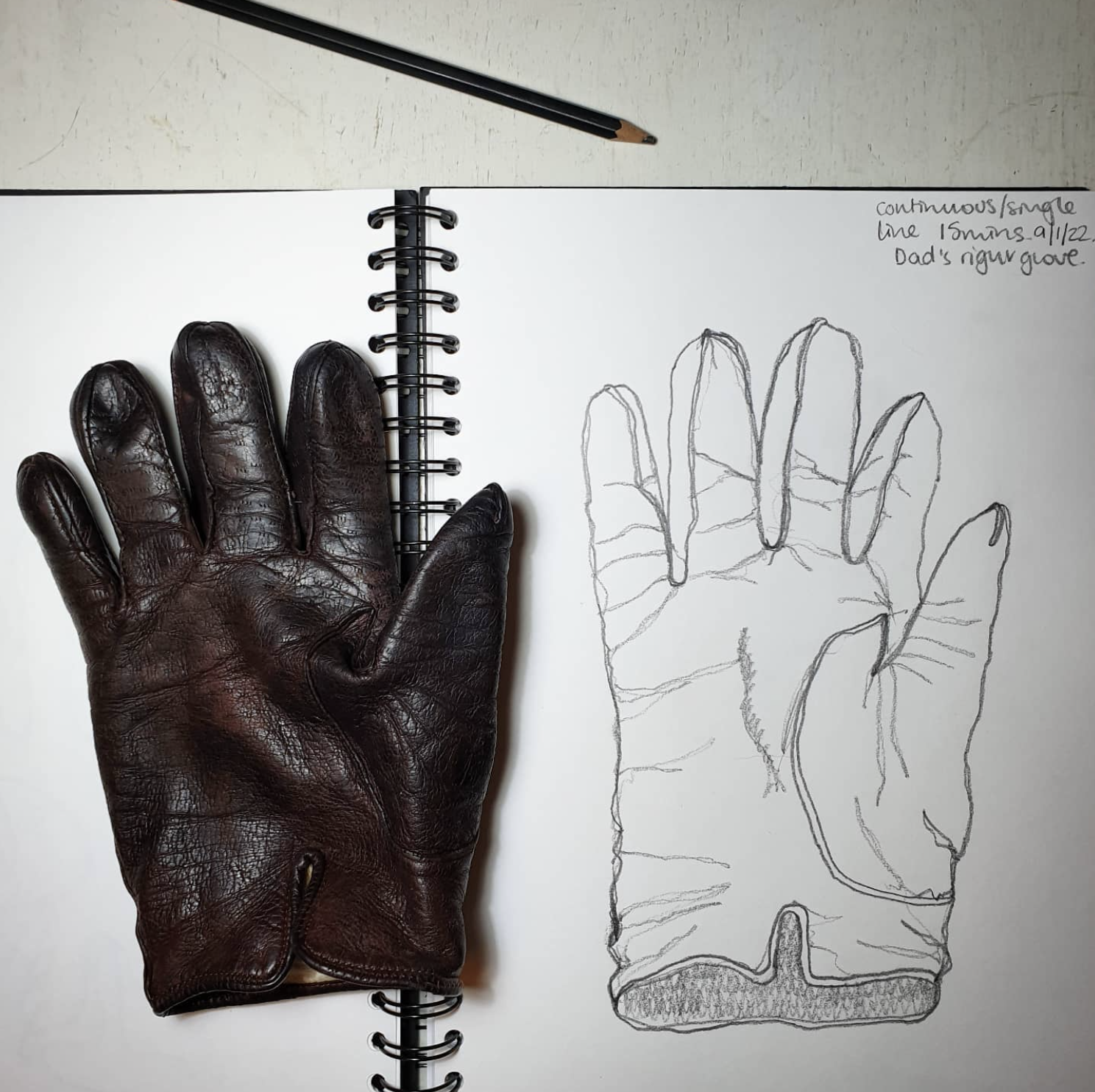
But also I wanted to talk about the drawing. So this idea of drawing as well, because I think I mentioned in the episode with Ellen that I encountered someone who had said that they, well, I've encountered several people actually that say that they either take pictures of, or draw, particular items of clothing or shoes, as what Ellen and I were describing as sort of divestment strategies. You know, that I'm going to have to let go of it but I need to keep something of it.
And actually really paying attention to something and spending time looking at something before it goes is an interesting idea, isn't it? So you've actually really engaged with that, haven't you? What have you observed? What did you do?
Wendy [1:05:40]
Yeah, I mean, I've just done a bit of that in my own practice. It's not become a huge part of my practice, but whenever I do it, I really, really enjoy it. And I think the daily stitching and the practice of making the rubbings and the printmaking with participants has kind of fulfilled that same feeling, that same connection, enabled that same kind of deep looking. It's all about spending time with things, isn't it?
I mean, when you make a drawing, it takes time. You have to pay attention. You have to filter out all the other stuff that's going on in your head and you're really focused on that thing. And I think I sort of saw the same things happening in my workshops, where participants were making rubbings of garments or printing garments.
I mean, originally, very early on in my PhD, my initial idea was making drawings of garments with participants. I just think, as soon as you start talking about art and drawing with people that perhaps had a bad experience of that at school, maybe don't think of themselves as creative, and there's that classic phrase that people often will use: I can't draw. Which I think most people can. Again, it's just that practice of doing it repeatedly and spending time and making time to do it repeatedly.
But I think I saw the same thing happening with the rubbings and the prints. It's paying attention, noticing details, spending time, just giving some time to that object that normally would have been given no time at all, really.
Alex [1:07:50]
Giving time to the object. And this is what happens when people deconstruct their shoes as well. Noticing exactly where the stitches are occurring, noticing the design details, noticing the construction, spending time with it and appreciating the value of it, and the little secrets that these things hold that you just would not spot or see or notice if you weren't actually spending the time.
Wendy [1:08:18]
I think it's also a nice idea. Again, I saw this with the prints of the clothes, going back to what you said about a way of preserving memories and keeping records of things that then you feel a bit more able to part with. That definitely seems to be part of the function that these prints are performing. It's kind of like capturing a moment in time, capturing a memory, capturing an experience. And then does it feel easier to let that original thing leave your life?
Alex [1:08:58]
Yeah. And I'm not sure I actually mentioned this in the episode with Ellen previously, but in anthropological terms it's called, Annette Weiner wrote the book about inalienable possessions and the practice of keeping-while-giving. So you're giving something away, but through ritual and through practices you're keeping something. And it's the keeping the something, whether it be the picture or the memory of the drawing it or the experience of that, you're keeping that as a way to allow yourself to give. And also the object itself is keeping part of you, even though you're giving it. So it's the fact that you are inalienable, you are inseparable. The object, if you spend time with it and you have a ritual that goes with the divestment of it, stays with you and you stay with it.
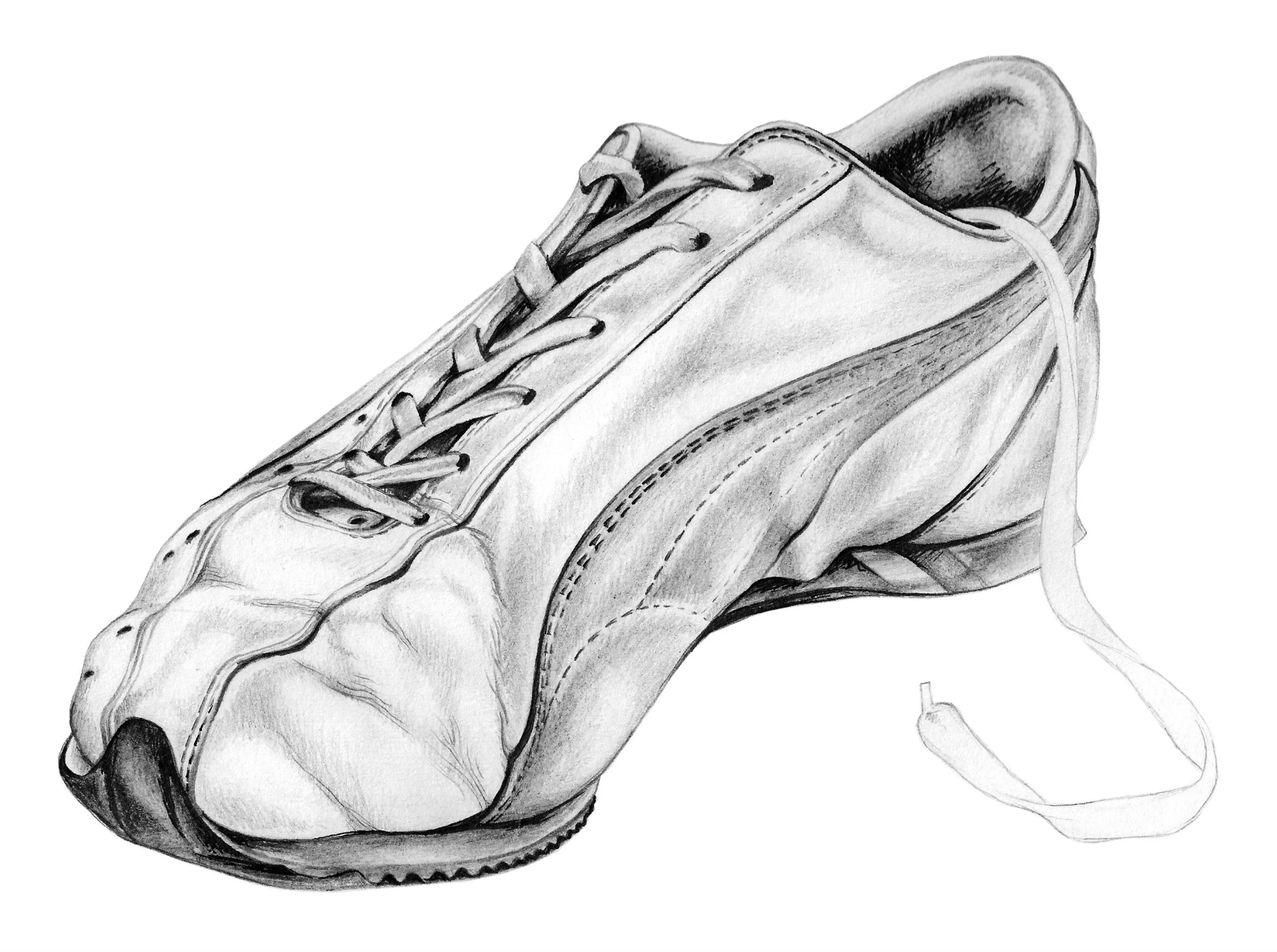
So I did this drawing of a trainer, a sneaker, that I was wearing whilst I was backpacking, that I had to throw out. I think I have mentioned this before, probably several times. I'll get it off the wall, hang on. Here you go. So this is it.
Wendy [1:10:17]
And yeah, I was listening to you talking about that with Ellen, and I was thinking I would love to see that drawing.
Alex [1:10:27]
2002. And I've actually got it on my blog, I wrote an article about it when I first started the PhD. One of five pairs of shoes that I brought with me to Australia when I went backpacking. Unbeknown to me, during that backpacking adventure I met my future husband, who I was to marry in 2016. And so this has gained significance as time has gone on. But yeah, I just couldn't part with them. I needed to give them the time. They had connected me with so many people and they'd been with me in so many places. I needed to do something.
Wendy [1:11:04]
And there are things like, I know some people do take photographs of significant things, and maybe they have a different ritual of taking the photograph. Perhaps they spend more time and perhaps photograph it from lots of different angles. But there's something particular about creating an image with your hands, that I feel is very particular. And I mean, there's a reason why drawing is also used by historians and archaeologists to record things and study things, because they learn so much more than they would have by taking photographs. They've got to spend more time, they've got to pay a lot more attention.
Alex [1:11:58]
So, okay, why do we lose this practice? I mean, it's obviously really rewarding and engaging to be able to do these things with the things that we wear. Are these things done in schools? I've noticed that my fashion students at university, the ones that are really creative and really innovative and are able to engage with the materials, are the ones that have probably maintained that practice all the way through their lives. But I think for a lot of people, at some point in their lives, they just stop doing this. How can we encourage people to do it more? I don't know, what's the problem there? Why have people become so detached from it?
Wendy [1:12:41]
I think it is just that kind of bombardment, isn't it, of constant new stuff. And I personally think that when things become so cheap, they are really devalued in people's eyes and they're seen as really disposable, replaceable, and therefore lose any meaning that they have. Even though a fast fashion garment can become a loved and precious item. It's all to do with how we interact with them, the memories and experiences that they capture.
But yeah, I think just that connection to materiality is getting more and more lost in modern life. Not to end on a bit of a down note, but even with the use of AI, we're just getting more and more, there's just this growing barrier that seems to be going up between humans and material things and the world that we're surrounded by and that we're part of. Yeah, it's like, I don't know, we're kind of being trapped in this digital cage.
Alex [1:14:12]
It's funny though, because I am detecting, I think I've mentioned before with my fashion students, this absolute desire to not want to use AI and to return to connection, particularly after COVID having lost. And a lot of those kids have never really learned how to connect socially with other people, how to strike up a conversation. And I just love the fact that some of these activities are a licence to connect. They give you the ability to connect with other people.
Over in Australia, and in First Nations cultures all around the world, in Australia this idea of sitting around and paying attention to things or doing some kind of craft or making comes with the practice of yarning, which is where you're sharing stories and you're connecting and you're building empathy and you're building community and a sense of belonging. And it's really invaluable. So I think all of these activities, whether you consider yourself creative or not, the social and cultural connection that can come from that.
What Could Industry Do Differently? [1:15:17]
Alex [1:15:17]
Now, as we're talking, I'm aware of the fact that a lot of our listeners are industry. And you said something earlier, that you actually can't buy new clothes anymore because of your engagement, because of your knowledge about this, and also just because it gives you no sense of fulfilment, because it's not doing any of the things that you've discovered are possible through engaging with the clothes that you already wear.
Obviously for industry that's terrifying, because it's like, if nobody's buying new clothes we're not making any money, and what do we do about that? Now my feeling is that industry is also suffering the problem of consumers that are feeling a lack of engagement and a lack of sense of belonging and connection, on the high street and with digital culture, and this whole idea of retail is dead and all of those things as well.
I can see with a lot of your research, potentially it could be commercialised in some way. It's a different business model potentially, isn't it? How do you feel about this idea of business models that are an alternative to this idea of, it's not even replacement, is it? Because a lot of the things that people buy, they're not replacing something else, they're just adding to the things that they already have.
Wendy [1:16:33]
It's additional, yeah.
Alex [1:16:38]
But yeah, how do you feel about the idea of industry engaging with some of these ideas?
Wendy [1:16:44]
I think it's perhaps like a lot of retail and high streets, particularly in the UK, that it's starting to think a bit more about experience, and maybe including some kind of experiential value to the brand, and ways to feel part of a community.
So I think it would be easier for smaller, more innovative brands to try and do these kinds of things, be it through repair or shared storytelling, or more creative ways of taking back garments and that kind of thing, or celebrating really special garments that were from a particular brand.
But I think it almost highlights the systemic problems within the industry that have enabled this situation that we find ourselves in now to arise. Because it is that offshoring of production, and no sense of place and skill and locality in bigger brands, that it's a big homogenous thing that has become, for me anyway, really quite disconnected from the human aspect of fashion, which is individuality and belonging and finding your tribe and connecting with other people. It's almost like the model of big fashion that we've got now has erased that.
And I just think the things that we could do to maybe reinvent fashion a bit, or to do fashion differently, also highlight how it's gone so wrong, if that makes sense.
Alex [1:18:56]
It does. And look, I think a lot of the things that we're talking about can be framed in this kind of anti-capitalist, anti-big fashion kind of way, and I think that is a lot of the work that these practices do. But I don't necessarily think that it means that brands can't engage with these things.
The slight concern is that sometimes it becomes a bit of a trend and it's sort of co-opted, and you get this flourish of Instagram posts where people are suddenly doing rubbings of their clothes and whatever, and then the next one is something else. And I guess you might call it culture washing, or whether it's greenwashing or whatever.
Wendy [1:19:43]
Yeah, I think the key is authenticity, isn't it? And I think people are much more attuned to and able to spot and call out inauthentic behaviour.
Alex [1:20:01]
I think they are. But also the other thing is that it almost doesn't matter, because if brands are encouraging these kinds of practices, you can't undo the connection that is then made between the wearer and the garment and their community.
So I think, in terms of the authenticity and the cultural and social value of these activities, however or wherever they're occurring, whether a brand is using them to their advantage or not, the outcome of materially connecting with our things and building those relationships can't but be a good thing, I think. Can it? I don't know.
Wendy [1:20:36]
No, I think you're right, yeah.
Shoes, Mending and Future Collaboration [1:20:42]
Alex [1:20:42]
Yeah, I don't know, it's interesting. Well, I mean, I will just show you as well what I have done to my shoes.
Wendy [1:20:55]
Oh, nice, is that stitch? That's beautiful.
Alex [1:20:59]
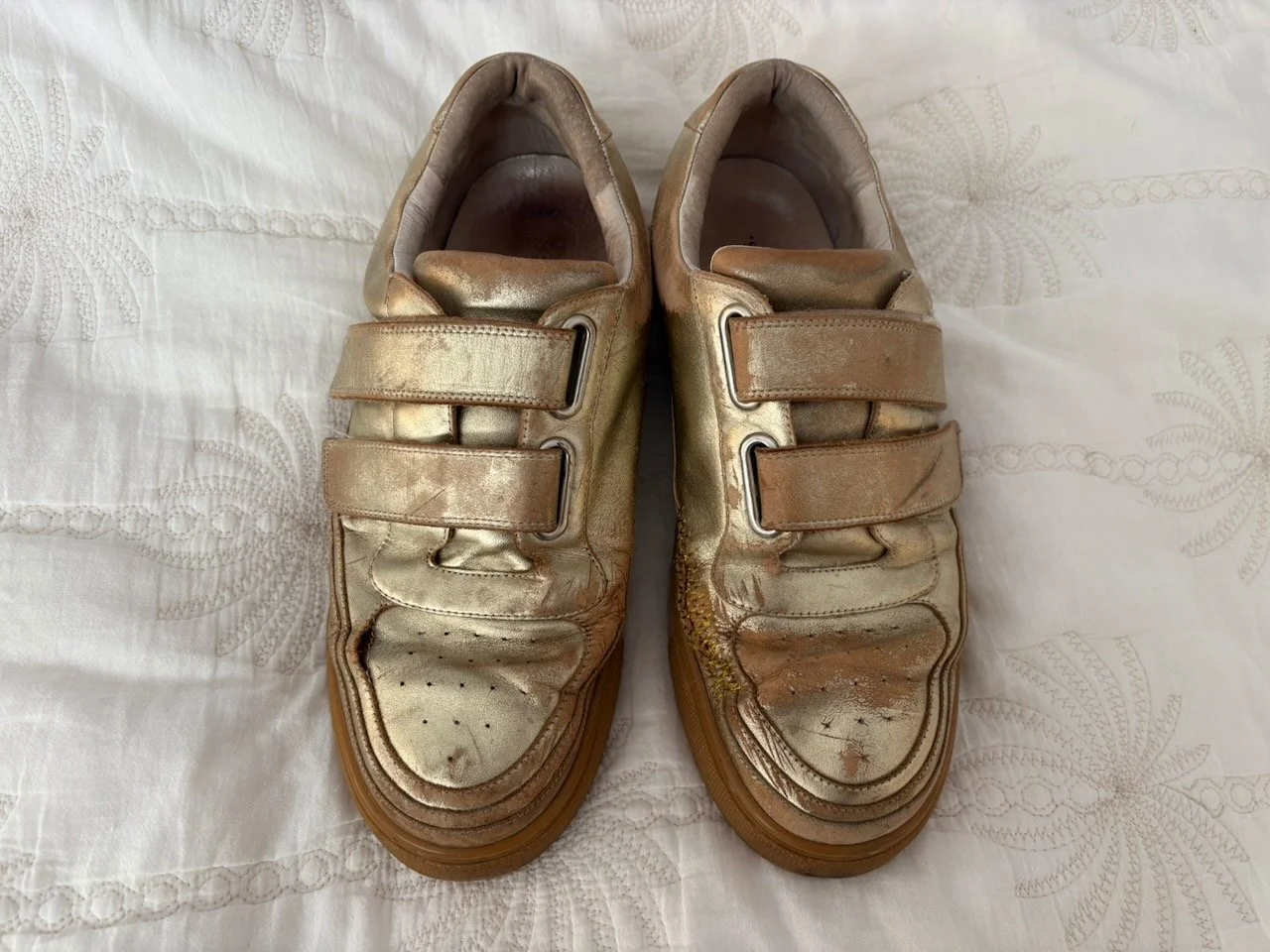
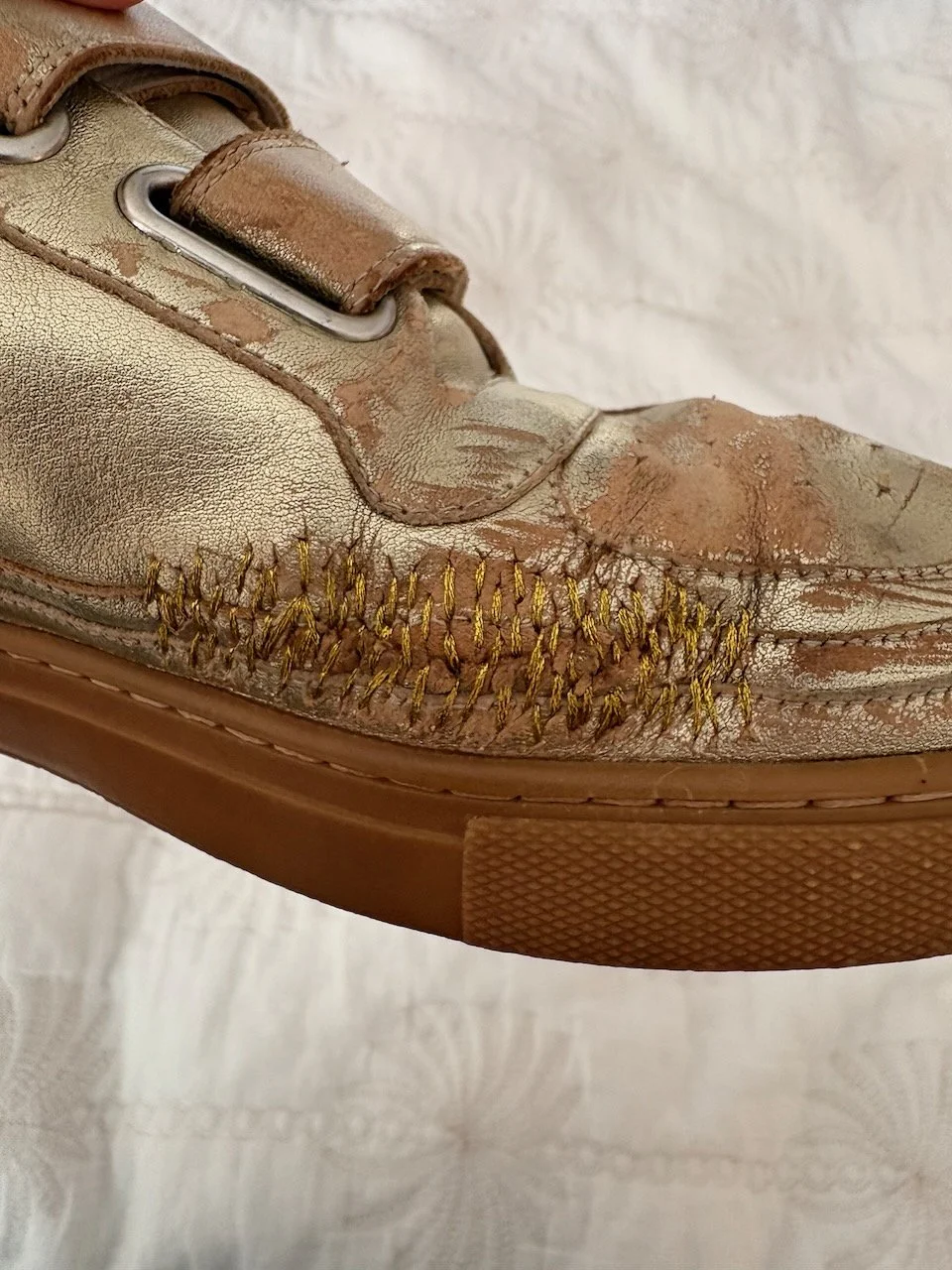
Yeah, so these are a pair of Radical Yes shoes, and I need to share these with the Radical Yes people because it's a Melbourne brand. This is a beautiful leather and gradually the gold is wearing off to reveal the lovely leather underneath, but it did have some holes and I've done a sort of Boro stitch over it. And yeah, I really enjoyed spending time with these shoes and stitching, and I've used a thread and it's a visible mend.
Wendy [1:21:30]
That's lovely.
Alex [1:21:32]
So, you absolutely can do these little practices with shoes. And I think it'd be lovely to see more people doing these things and spending time with their shoes and thinking about how they're going to build those connections back with their shoes, but also with each other through their shoes.
Wendy [1:21:50]
I need to be braver with my shoes, obviously, Alex. [laughs]
Alex [1:21:54]
What about your shoes?
Wendy [1:21:56]
Yeah, this is where I deviate probably from everything else. I mean, I don't over-consume shoes, but I don't particularly like buying pre-worn shoes. I have bought pre-worn shoes, but it's only when they've been described by the seller as hardly worn.
If I'm thinking about buying a new pair of shoes, I mean, it's something that happens really rarely. I very rarely buy new shoes, and I do look after shoes as well. I try to clean them, I try to wear weather-appropriate footwear so that I'm not getting stuff ruined.
If I think they're truly unwearable, I mean they will go in one of them skips that accepts footwear, which doesn't feel good. It doesn't feel like a good thing to do with them. But I do try to at least make sure that they're very securely paired, because what little I do know about footwear is that that is one of the huge problems, that they immediately become separated. And then there really is no chance of anything useful being done with them.
Alex [1:23:21]
Yeah, I just think it's interesting hearing your reflections on that, because I think shoes are overlooked and sort of neglected, and they do present quite a problem for a lot of people that have these values and want to practice in ethical and sustainable ways and slow things down, but still enjoy fashion, still enjoy clothes, still enjoy expressing your identity, and don't want to do it in a way that becomes problematic.
Well Wendy, I'm going to let you go. I knew this was going to be a good conversation. I've taken up so much of your time.
Wendy [1:24:02]
That's alright. It's really nice to finally have such a nice meaty conversation with you, Alex, because we've got so many shared interests. And you do sort of prompt me to think about things that I perhaps don't easily think about, which is around shoes and footwear.
Alex [1:24:28]
Maybe there's a collaborative project there somewhere in the works, of us working together to think about how some of those techniques could be extended to footwear.
Wendy [1:24:37]
That's almost like you just read my mind, Alex, because I was just going to say exactly the same thing.
Alex [1:24:43]
And also, I don't know, maybe there's an industry collaborator out there who might like to benefit from our expertise. I mean, you're nearly finished your PhD, aren't you? So I'm sure you'll be thinking about what's next.
Wendy [1:24:56]
Yeah, it would be interesting to do some of these activities maybe with designers from brands. That could be an interesting activity, I think.
Alex [1:25:07]
Yeah, and actually I have found that I have sort of framed our footwear deconstruction workshops as professional development as well, because a lot of designers actually aren't involved in the making and production of the shoes. And I imagine it would be the same actually for clothes as well. And when a designer deconstructs a pair of shoes, and when they then make it into something else, it activates the notion of designing for end of life.
Wendy [1:25:34]
Yeah, absolutely.
Alex [1:25:35]
Okay: professional development activities for designers, designing for end of life and designing for emotional durability, as we were talking about before. We are available.
Wendy [1:25:46]
We are, we are. This is the working title of our new collaborative industry workshop.
Alex [1:25:56]
This is it. Research for impact, real world impact. Anyway, that's shameless promotion done. I will let you go. Thank you so much, Wendy, for all your time. It's been absolutely wonderful and we'll catch up with you again soon hopefully.
Wendy [1:26:11]
Thanks for having me on, Alex. It's been really great to talk.
Debrief: Repair, Sole Prints and Conspicuous Waste [1:26:15]
Emily [1:26:15]
So Alex, thank you so much. What a rich episode with Wendy. It was just lovely to hear her passion and to get thinking about how we can apply some of those, I guess, techniques and ideas to footwear.
Alex [1:26:32]
Yeah, it was. I couldn't stop thinking about footwear all the way through. So as I said in the episode, it's so transferable. Funnily enough, actually, the day that we recorded was when the UK was having that, I think it was like 38 or 39 degrees, and because they don't have air conditioning, when she got on the camera she had a wet cold towel round the back of her neck. And I mean, it really sort of brought into focus the relevance of the conversation in terms of climate change and everything that's associated with all of this waste that we're producing.
But yeah, lots of good stuff in there. What did you think, Emily? What were the main takeaways for you?
Emily [1:27:15]
So there are kind of two things really. One of them, I got very excited when Wendy was talking about repair. And obviously, as you both mentioned, shoes are quite different, there are very different techniques involved in repairing shoes. But something that I have noticed on social media, there's quite a trend for boot repairers making reels, showing how they repair their shoes. But also people making reels about how to polish your shoes, condition the leather, to look after them. And that's really quite satisfying to watch. But also, spending that time, giving your time to those shoes, to polish them, to get to know them, to prolong their life, if you will, is a really powerful way that you can do that, even if you're not perhaps literally stitching onto them. That's really quite a powerful thing.
Alex [1:28:16]
Yeah. And I think when you do maintain your shoes, as she was saying in the episode there, you notice when they might need a bit of repairing. Now the ones that I stitched, they've probably got a little bit too far in terms of the damage, and if I'd got involved with them a little bit earlier, if I'd been paying attention to them a little bit sooner, then I could have minimised that damage. So yeah, I think definitely spending time and paying attention is really important. That's such a great point.
Emily [1:28:46]
Yeah, I guess if we're going down adages, the old stitch in time saves nine. And so checking out your shoes before they go too far down the hole, that's a great thing.
Another thing too is around end of life. So I know you've got your wonderful This Is Not a Shoe workshops. Obviously not everybody can always get along to a workshop, and sometimes also we have too many pairs of shoes as well. But I was just looking at Wendy's Instagram and seeing the beautiful ink prints from the garments, and it got me thinking, there's no reason you can't do that with the soles of your shoes, right? Because they've all got beautiful patterns quite often, the tread, so many interesting and different and varied patterns. Why not make like an ink transfer of that, perhaps onto some fabric, and that could be like a transfer or a patch for a t-shirt or a jacket? So in some sense you can continue to wear those shoes. You can keep “wearing” your shoes, in inverted commas, and it would be visually striking too.
Alex [1:30:01]
Yeah, that's such a lovely idea. And it's funny, isn't it, because the soles often are quite secret. You don't really notice them. I always think as a footwear designer you could have so much fun, and I'm sure they do, with the sole units and the prints that they leave behind. And thinking about what those prints would do, in terms of designing for end of life again, what those prints do at the end of their life, what they could be, could be really lovely. That's such a lovely idea.
I think one of the main things for me as well is this idea of feeling proud of wearing things repeatedly. It's such a huge shift away from tradition, sort of more recently. We just started the new semester over here at RMIT, and we start our fashion and dress course with a lecture on what is fashion, what is dress. And my colleague Jon Hewitt takes the students through all of the old fashion theorists, Georg Simmel and Thorstein Veblen and Karl Marx and all of those. And Thorstein Veblen specifically was conspicuous consumption, and this idea of conspicuous waste, that actually you could really distinguish yourself by the waste that you produce. So only wearing something once, and it never being seen again, was a sign that you had a lot of money and didn't have to wear things twice. Did that resonate with you at all?
Emily [1:31:31]
It did, it did. And it's quite interesting too, because Thorstein Veblen's talking about the leisure class, and in a lot of ways they were kind of a bit nouveau riche. Whereas we talked today about old money aesthetics. And if you look at someone like King Charles, he's been wearing the same pair of shoes for 50 years. They're incredibly well made. And obviously he's got the money to afford bespoke shoes, and he's also got the people to take care of them for him. But the fact that he is quite proud of wearing and rewearing these shoes. It's a very upper class English thing to rewear tweeds and wear the tweeds that have been handed down from grandfather, and they're your country tweeds.
And even Catherine, Princess of Wales, on a different note, she famously rewears her clothes and shoes to various royal and red carpet occasions. And it is giving fashionistas permission to shop in their own wardrobes, I think.
Alex [1:32:43]
Love that.
Emily [1:32:44]
It's no longer a mark of distinction. It's actually quite distasteful to be seen to be flashing your money and flashing your cash.
Alex [1:32:55]
Yeah, in certain circles. It is interesting, isn't it? I'm always intrigued by whether this concept of class is still relevant in today's day and age or not. But I think this kind of conspicuous waste, I think that concept is interestingly shifting at the moment.
Emily [1:33:13]
Yeah, I think also people like the royal family, even though they're absolutely minted, they are still aware of social inequalities. Prince William's got his charities with homelessness, for example. And it's quite different from the conspicuous consumption that someone like Jeff Bezos and Lauren Sánchez engage with, when they just rent out Venice. People, particularly in today's environment, people are really not happy with these vulgar displays of wealth. And I think that's something that we can kind of get behind as well.
Debrief: Wardrobe Studies and What's Next [1:33:58]
Alex [1:33:58]
Yeah, that's really interesting. The other thing that I wanted to just mention as well is this idea of wardrobe audits. Have you ever done a wardrobe audit, Emily?
Emily [1:34:07]
Yes, I have. And a really great way to do it, and this is what I was talking about, shopping in your own wardrobe: I did it for a girlfriend, she helped me out in return, and it's fantastic to have a new set of eyes. So get a friend over, get a bottle of wine, try things on. What I noticed with the audit is that we tend to wear our clothes in the same combinations. Whereas getting a friend in, they can say to you, hey, absolutely, you can wear that red skirt with a tweed jacket. And you might be like, I'd never thought of that combo before. And so suddenly you've got new ways to wear old clothes, which can be just as powerful and just as good a feeling as getting something brand new.
Alex [1:35:03]
Yeah. And I was just remarking to my husband earlier today when I was getting my clothes out of our chest of drawers. Our chest of drawers is groaning with the weight of all of the clothes, and I swear I only use about the top five percent of each of those drawers. I have no idea what's lurking at the bottom. I know I need to do a wardrobe audit and I'm dreading it in a sense, but also slightly excited. So I think watch this space, and we might see whether that wardrobe audit comes to fruition.
But yeah, I just wanted to mention that it does also link to this idea of wardrobe studies, which has become a really legitimate method in fashion studies and fashion theory. There's a book that's actually freely available that people might like to go and have a look at, that I would say has probably got all the key academics that have been responsible for bringing this idea of wardrobe studies into focus, which is Opening Up the Wardrobe: A Methods Book, with all sorts of methods for studying people's behaviour and practices in relation to clothes. And so that is edited by Kate Fletcher and Ingun Grimstad Klepp. And so we'll put a link to that in the show notes as well, for any academics out there who are interested in thinking about how to diversify their methods.
And yeah, one other thing that I just wanted to mention, Emily: I've got some exciting news for the This Is Not a Shoe project. So you mentioned before that there may be people that can't access our workshops. Now, This Is Not a Shoe is actually going on the road, because I'm taking some long service leave towards the end of this year to go back and spend time with friends and family in the UK. And I'm taking the This Is Not a Shoe workshop and some exhibits with me. So details on that to be announced in due course, but we will absolutely advertise where those workshops might be taking place, and that will be sort of towards the end of the year.
As we close, this is the penultimate episode of the current series of The Social Lives of Shoes, and we're going to have a bit of a break while we double down on our fundraising efforts and do lots of other bits and pieces that we both have to do at the moment. So just reminding listeners again about our GoFundMe page. We are raising money to be able to continue with The Social Lives of Shoes podcast in a way that is financially viable for us and for the Footwear Research Network. So do please go and have a look at that and donate whatever you can.
Emily [1:37:47]
Great funding means that we can make great episodes.
Alex [1:37:51]
Yeah. So thanks so much, Emily, and see you soon.
Emily [1:37:57]
My pleasure. Look forward to it. Bye.
Alex [1:38:01]
We hope you've enjoyed this episode of The Social Lives of Shoes from the Footwear Research Network. Please go to our website for the show notes, including a full transcript, links and images. You can follow us on LinkedIn and Instagram. That's footwearresearchnetwork.org.