Footwear Research Network Editorial Policy
Last updated 12th November 2026
Purpose and principles
The Footwear Research Network (FRN) publishes contributed writing from researchers, educators, makers, and industry practitioners, on the condition that every piece is published on the FRN's editorial terms, not the contributor's. The FRN is a not-for-profit, academic-led knowledge exchange organisation, with knowledge exchange running in both directions. People who design, make, sell, repair and dispose of footwear hold knowledge that research often cannot reach on its own, and the FRN wants to support a process where knowledge happens in conversation with scholarship.
The FRN's credibility rests on its independence, so this policy sets out how it accepts contributions without lending academic authority to commercial claims. Four principles guide every editorial decision: transparency about who is speaking and what interests they hold; independence of editorial judgement from funding, sponsorship or commercial relationships; rigour, meaning that claims are supported or clearly framed as opinion; and plurality, meaning that the FRN actively seeks voices from across the footwear system and not only from those with the largest communications budgets.
Content strands
Contributed work is published in one of two clearly labelled strands, so that readers always know what kind of knowledge they are reading. The FRN decides which strand a piece belongs in. A practitioner who draws on systematic evidence may be published under Research and Scholarship, and an academic piece based on personal opinion may be published under Practitioner Perspectives or as a clearly marked opinion piece. Where it serves the conversation, the FRN may pair a Practitioner Perspectives piece with a short invited response from a researcher, or publish it as part of a dialogue between the two.
Who can contribute
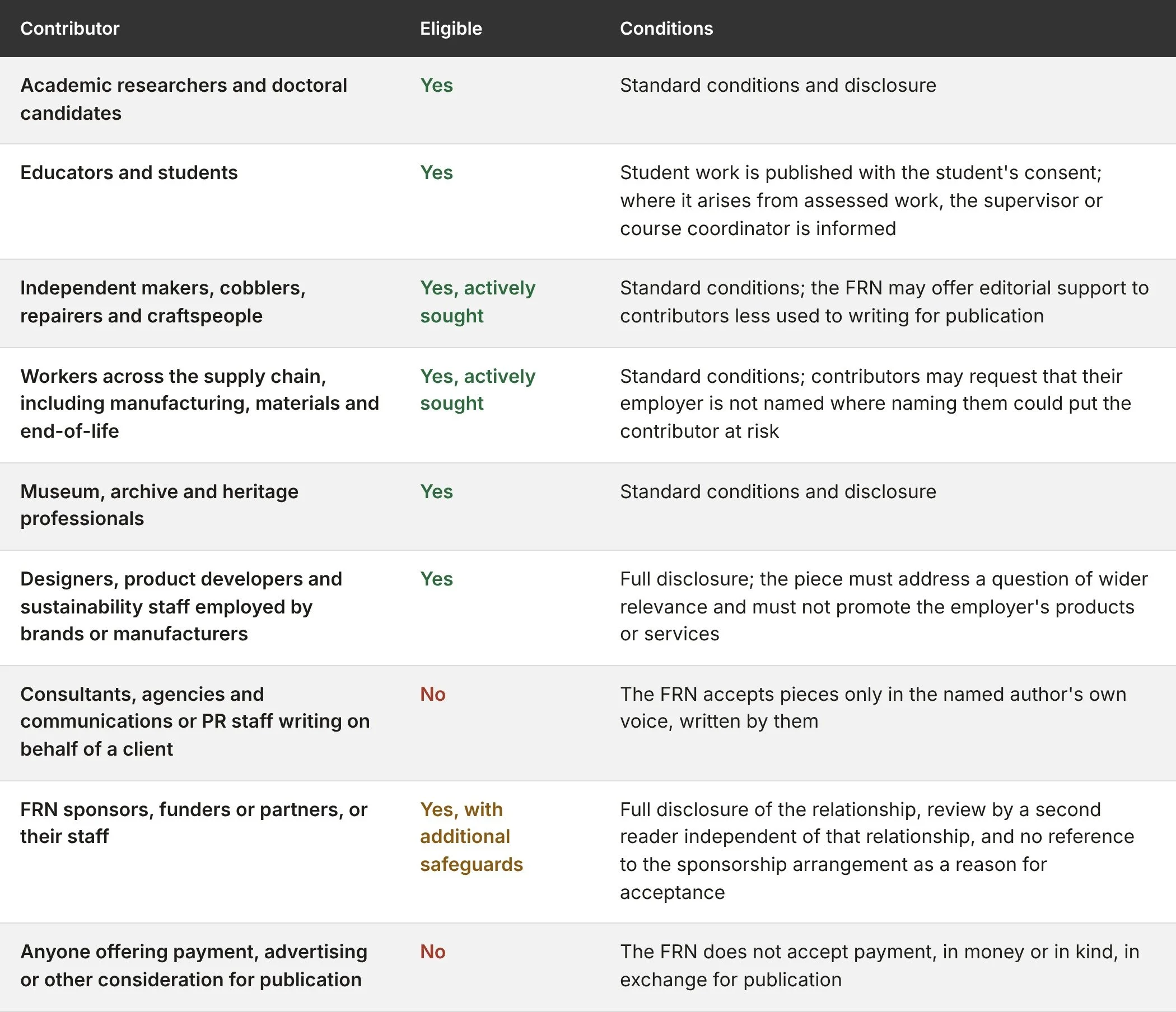
The FRN welcomes submissions from anyone with substantive knowledge of footwear and its social, cultural, material or environmental dimensions. Eligibility depends on the conditions in the next section, not on job title. The FRN aims to keep the balance of Practitioner Perspectives pieces broad. It will not publish pieces from the same organisation more than once in any six-month period, and it will prioritise voices that are under-represented in footwear discourse.
Conditions for acceptance
A piece is accepted when it advances understanding of footwear for a reader who has no stake in the author's organisation. A useful test is whether the piece would still be worth reading if the author's organisation were never named. Every submission, in either strand, must meet the following conditions.
It addresses a question, problem or debate of wider relevance to the footwear sector, to research or to education, rather than describing a single product, collection or campaign.
It is argument-led. Contributors may draw on their own organisation's work as an example, but the example must serve the argument and not the other way round.
Factual claims are supported. Claims about materials, environmental impact, labour conditions or performance are referenced to evidence the FRN can check, or are clearly framed as the author's view or experience.
Sustainability claims meet a higher bar. Statements such as "sustainable", "circular", "biodegradable" or "carbon neutral" must be specific, qualified and evidenced, or they will be removed.
It contains no promotional material: no calls to action, discount codes, product links, launch announcements or pricing.
It is the author's original work, not previously published elsewhere in substantially the same form, and any use of generative AI in drafting is declared.
It treats people, communities and cultures with respect, including appropriate acknowledgement of Indigenous and cultural knowledge.
Pieces that are primarily marketing, reputation management, responses to criticism of the author's organisation, or attempts to position a product against competitors will not be accepted in either strand.
Disclosure and conflicts of interest
Every published piece carries a statement of interest, and this applies equally to academic and practitioner contributors. Contributors complete a short declaration at submission covering their employer and role, any financial or commercial interest in the subject of the piece (including shares, consultancy, product development or sales), any funding received for the work discussed, and any relationship with the FRN, its sponsors or partners. Where there is nothing to declare, the statement says so.
The FRN publishes the statement with the piece. Failure to disclose a relevant interest, discovered before or after publication, is grounds for rejection, correction or withdrawal.
FRN directors, editors and reviewers also declare interests. Anyone with a personal, professional or financial connection to a submission, or to the author's organisation, steps aside from decisions about it.
Editorial independence, payment and sponsorship
The FRN does not accept payment, in money or in kind, in exchange for publication. Publication cannot be bought, guaranteed, or offered as a benefit of funding. The FRN does not publish advertorials or sponsored content within either editorial strand.
This policy operates alongside the FRN's sponsorship policy framework. Sponsors and funders gain no influence over what the FRN publishes, no right to review content before publication, and no right to request that content be changed or removed except to correct a factual error. A sponsor's support may be acknowledged elsewhere on the FRN's platforms, but never as part of an editorial piece.
The FRN retains full discretion over whether to publish, when to publish, which strand a piece appears in, its title and any images used. Contributors are not paid for their pieces, and the FRN does not charge contributors any fee.
Review process, editing and corrections
Every submission is read by the FRN editors and, for Practitioner Perspectives and any piece connected to a sponsor or partner, by a second reader drawn from the FRN's advisory group. Decisions rest with the FRN
and are not made by any one person where a commercial interest is involved.
The contributor sends a short pitch (around 200 words) describing the argument, their role and any interests.
The editor responds within three weeks, either inviting a full draft or declining.
The full draft is submitted with the completed declaration of interest.
The editor and, where required, a second reader assess it against the conditions for acceptance.
The FRN accepts, requests revisions, or declines. Declined pieces receive a brief reason, but decisions are not open to negotiation.
The FRN edits for clarity, length, house style and compliance with this policy, and shares the edited version with the contributor for approval of factual accuracy before publication.
If a published piece is found to contain a significant error or an undisclosed interest, the FRN will publish a dated correction or, in serious cases, withdraw the piece with a note explaining why. Contributors and readers can raise concerns by emailing the FRN.
Rights, licensing and policy review
Contributors keep copyright in their work and grant the FRN a non-exclusive licence to publish, archive and share it across FRN platforms, including social media and podcast promotion. Contributors may republish their piece elsewhere after publication with acknowledgement of the FRN as the original venue. Contributors are responsible for securing permission for any images or third-party material they supply.
Contributors may not use FRN publication in advertising or marketing materials in a way that implies endorsement of their organisation, products or services by the FRN. Linking to or sharing the published piece is welcome.
This policy is reviewed annually by the FRN board, and sooner if the FRN changes its publishing activities or sponsorship arrangements. Next review: November 2027.
Submission EOI:
Please use the form below to suggest a written contribution for consideration. Please wait 3 weeks for a response before following up.
Enquiries to Contact@footwearresearchnetwork.org
Strand 1: Research and Scholarship
What it holds:
Writing grounded in research, including summaries of published or in-progress studies, reviews of literature, methodological reflections and critical essays
How it is labelled:
Author name, institutional affiliation and any declared interests
Strand 2: Practitioner Perspectives
What it holds:
Informed viewpoints from people working in or around the footwear industry, drawing on professional experience rather than formal research
How it is labelled:
A strand banner stating that the piece reflects the author's professional perspective, plus author name, organisation, role and a statement of interest