How Footwear Archives Shape Brand Identity, Culture, and Design with Tim Crumplin
Available on Spotify and Apple Podcasts:

Episode 4 Overview
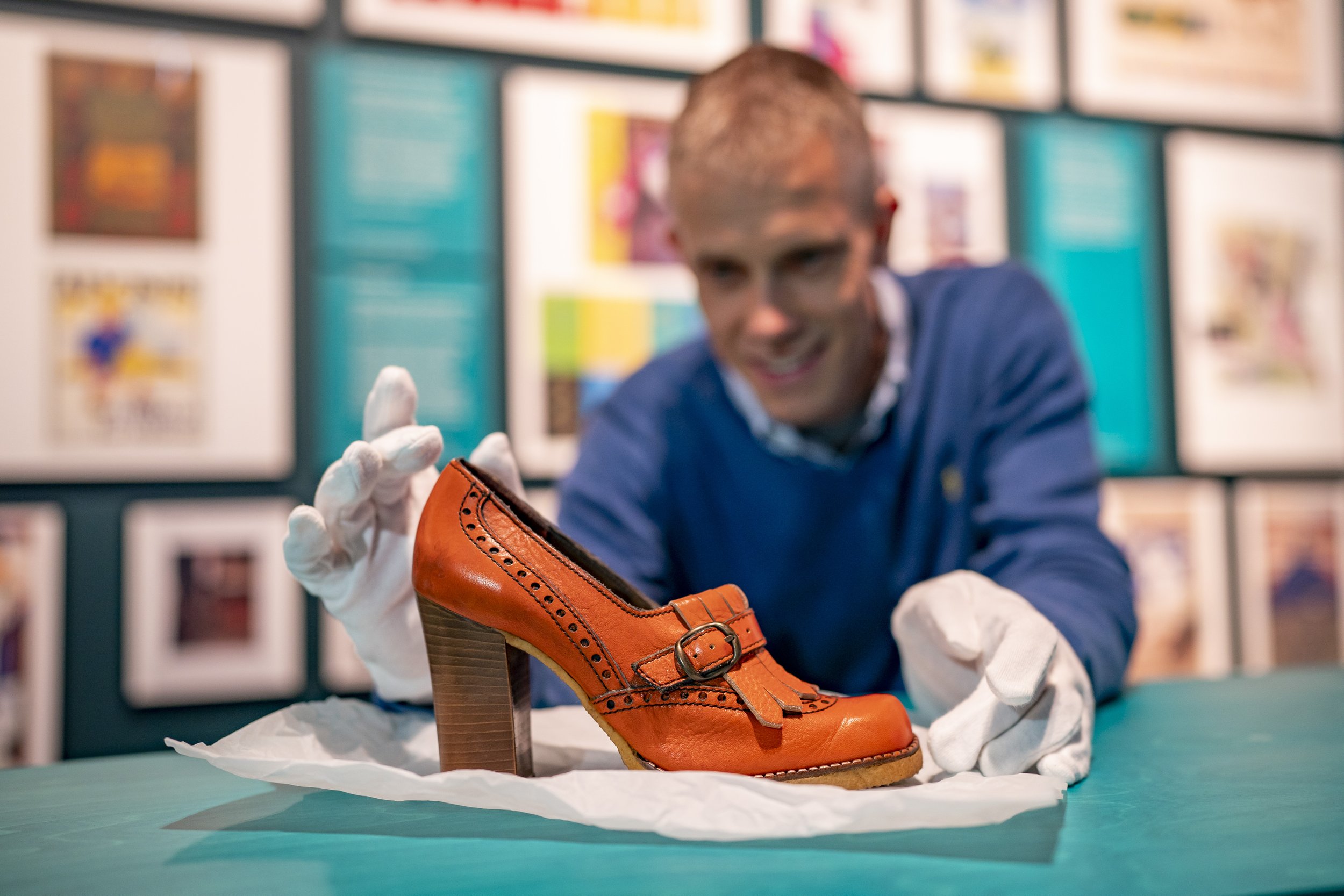
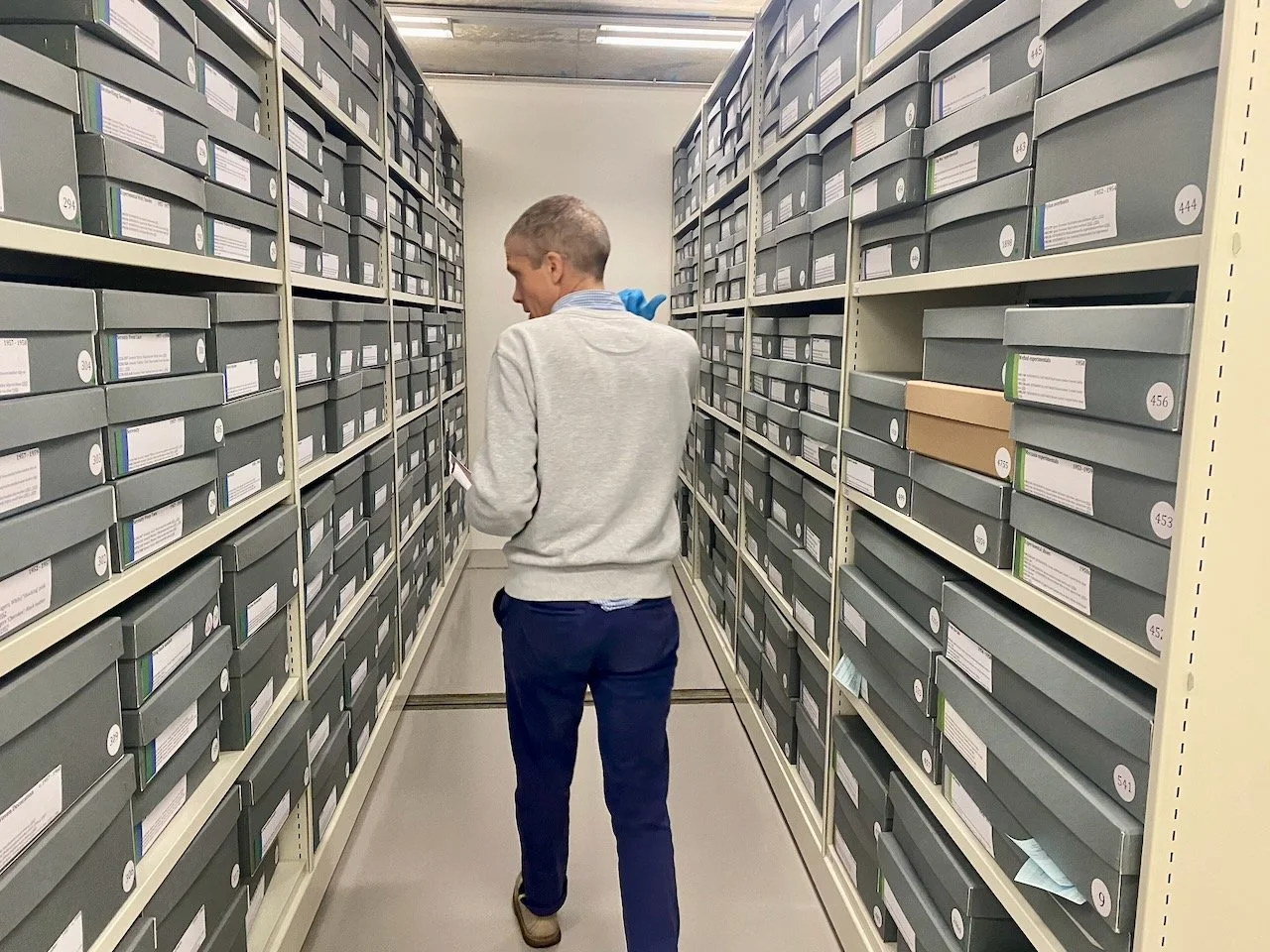
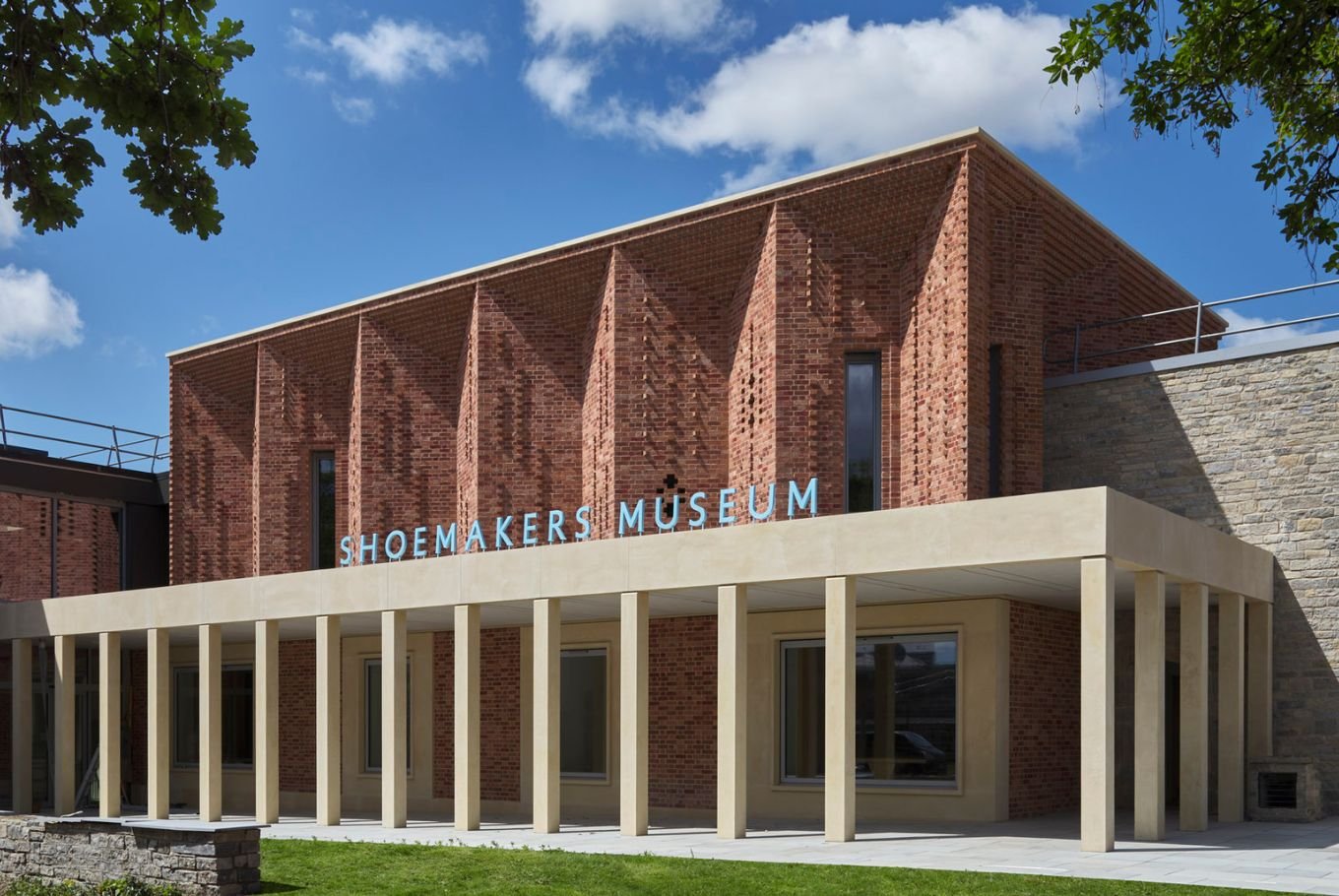
What is the value of the footwear archive and museum? Why are so many brands now establishing their own archives, and how and why do footwear professionals engage with archival materials? In the first of three episodes on footwear histories, Dr Alexandra Sherlock chats with Tim Crumplin, business archivist at the Shoemakers Museum and Alfred Gillet Trust (Clarks Archive), to discuss the significance of public and private archives and the vital role of their custodianship for culture and industry.
Credits
Interviewee: Tim Crumplin, Business Archivist at the Alfred Gillett Trust, home of Shoemakers Museum.
Interviewer: Dr. Alexandra Sherlock
Presenters: Dr. Alexandra Sherlock and Dr. Emily Brayshaw
Editor: Dr. Alexandra Sherlock
Photographs: Credits in photograph captions
Links
Shoemakers Museum website: https://www.shoemakersmuseum.org.uk
Clarks Village, Street, Somerset (for visitors planning a trip): https://www.clarksvillage.co.uk/en
Footwear Research Network Museums and Archives directory https://footwearresearchnetwork.org/museums-archives
Northampton Museums and Gallery (shoe collection): https://www.northamptonmuseums.com/collection/collections-home/shoe/
The Wedgwood Collection at the V&A (the cautionary tale Tim tells about what happens without trust protection): https://www.vam.ac.uk/collections/wedgwood
The Archives and Records Association (ARA), the professional body for archivists in the UK https://www.archives.org.uk/
Clarks brand website https://www.clarks.com/en-gb
Alex’s list of research publications https://alexandrasherlock.com/publications
UTS (University of Technology Sydney), Opening Up the Fashion Archive Symposium, 11-12 March, 2026: https://www.uts.edu.au/events/research-symposium-opening-up-the-fashion-archive
Chapters
00:00 - Show Intro
00:58 - Episode Overview - Emily and Alex
07:26 - Tim’s background and route into Clarks and the Alfred Gillet Trust
11:09 - How the archive has changed
14:15 - Recognising the value of the archive as a creative resource
18:28 - Street, Somerset and the Quaker influence on Clarks
24:40 - Vertical integration and traceability
27:50 - How to build an archive
37:23 - The vulnerability of shoe museums and archives
39:03 - The case for the charitable trust model
45:20 - Collection policy: what gets kept and why
49:40 - How designers use the archive in practice
55:30 - Archives, corporate culture and healthy approaches to risk-taking
01:06:47 - External access and community engagement
01:09:03 - Digitisation
01:16:52 - How to become a business archivist
01:19:04 - Finding and visiting the Shoemakers Museum
Transcript
Show Intro [00:00]
Emily [00:10] What if shoes could speak? What might their stories, and the stories of those who make and wear them, tell us about the ways we live, our values and our impact on the world?
Alex [00:22] Welcome to the Social Lives of Shoes, a podcast brought to you by the Footwear Research Network that brings to life one of the most underestimated and humble aspects of consumer culture.
Emily [00:32] Whether you design, produce, make, market, sell, or just wear shoes. These conversations will transform how you think about them and reveal new possibilities for a more sustainable future.
Alex [00:46] This episode was recorded and produced in Australia on the unceded lands of the Wurundjeri Woi Wurrung people of the Eastern Kulin Nation. We pay our respects to their ancestors, elders and custodians.
Episode Overview - Emily and Alex [00:58]
Alex [00:58] Hello Emily, we're sitting next to each other today.
Emily We're in the same place. We are on — Is it Wurundjeri Country here in Melbourne?
Alex We are, yes. So yes, we are introducing this next episode of Social Lives of Shoes with Tim Crumplin, the business archivist at the Alfred Gillett Trust and Shoemaker's Museum.
Emily And gold miner.
Alex [01.21] And gold miner, we'll find out in a minute. So Tim I first met when I was doing my PhD which was an organisational ethnography at Clarks headquarters and I quickly realised that he was hugely respected within the organisation for his work there as business historian and archivist. Emily and I just wanted to start by sort of highlighting some of the things that will come out of this episode and I guess what their relevance are for listeners. It follows on quite neatly from our episode on iconic shoes as cultural objects.
Emily [01:57] Absolutely,
Alex [01:58] Tim really beautifully highlights in this episode the importance of kind of being custodians, I suppose, of these cultural objects that so many of us hold so preciously in our lives. And Clarks is one of those brands — and there are numerous others — that are part of our lives and are part of our memories. And I think what I found really lovely about talking to him is to know that those memories and that material culture is looked after. And I guess that leads on to the importance of — I think one of the main outcomes of this episode is actually thinking about the structure of brand archives and whether they are public or private. What did you like about this episode?
Emily [02:45] I like that point, I really think it's great. Whether they are public or private and what that can mean for researchers, for makers, for other footwear companies — I love this idea of custodianship. A very dear friend of mine is an amazing antique restorer. And he always says, you never own this stuff, you just get to hang out with it. And I think that idea as well will dovetail really nicely into our next episodes with Elizabeth Semmelhack at the Bata Museum and Hilary Davidson at the Fashion Institute of Technology. I think it also speaks into this real turn towards companies and researchers alike understanding the value of their corporate history and their corporate archives. We're seeing, for example, there’s been this fantastic symposium held at the University of Technology in Sydney called Opening Up the Fashion Archive, which is thinking about ideas around archival engagement, around remaking, rethinking, reimagining archives and archival practice. So a lot of the stuff Tim's talking about is really great for that because it's essentially his how-to guide. It's also tying in really nicely with nascent research organisations in the UK — for example, there's the Ready to Wear Research Network, which is really just starting to kick off, headed by Alice Janssens and Liz Tregenza, both really well-respected fashion historians. And that also is about looking at fashion archives in the ready-to-wear space. And so it's this real turn, I think, that we're seeing at a time when archives and museums and cultural output is underfunded globally. We're starting to understand just why this is so important. What do you think Alex?
Alex [04:51] Yeah, absolutely and I think often — I speak to brands quite regularly and many brands have their own collections. I think there has tended to be this tradition of wanting to keep it to yourself. But actually, I think they're increasingly understanding the value, the credibility and the respect that can come from opening up those resources to ultimately the consumers who actually have been central to those brands becoming so meaningful.
Emily [05:20] And I think that by holding these archives — and these memories essentially —
Alex [05:25] …Making them public.
Emily [05:26] …Making them public, yeah, brands can also, in a way, reassure customers that they feel seen. It's like: we see you, we see the value that as a consumer you are bringing to our product. It's like a reciprocal relationship.
Alex [05:44] And I think making those archives, those collections available, acknowledges the part that everyone plays in how important these products have become. Yeah, as you say, the consumer feels seen, manufacturers feel seen, the workforce feels seen. And ultimately being, Acknowledged then presents quite a compelling motivation to want to buy from that brand, to maintain consumer loyalty and not just buy the cheap knockoff from the — no names mentioned — mass fast fashion manufacturer that is producing the copy. So yeah, I think the dividends to be gained from opening, as you say with the UTS event, opening up these archives for brands is huge. And I think Tim's work and the rest of the team at the Shoemakers Museum and the Alfred Gillett Trust — which is from the Clarks family, orginally a Quaker family — you see some of those values coming through in terms of being custodians of these things for future generations, and sharing and education. I think, yeah, one main takeaway from this episode is the structure as a charitable trust that Tim really does determine is a really good thing.
I think, it's a wonderful episode, it's a very generous episode. Thank you so much, Tim, for sharing all of your knowledge with us and the rest of the footwear community. And I certainly encourage everyone to go and visit the Shoemakers Museum, reach out to Tim and the rest of the team to find out what you can learn. Yeah, and we hope you enjoy it.
Emily [07:23] Absolutely.
Tim's background and route into Clarks and the Alfred Gillett Trust [07:26]
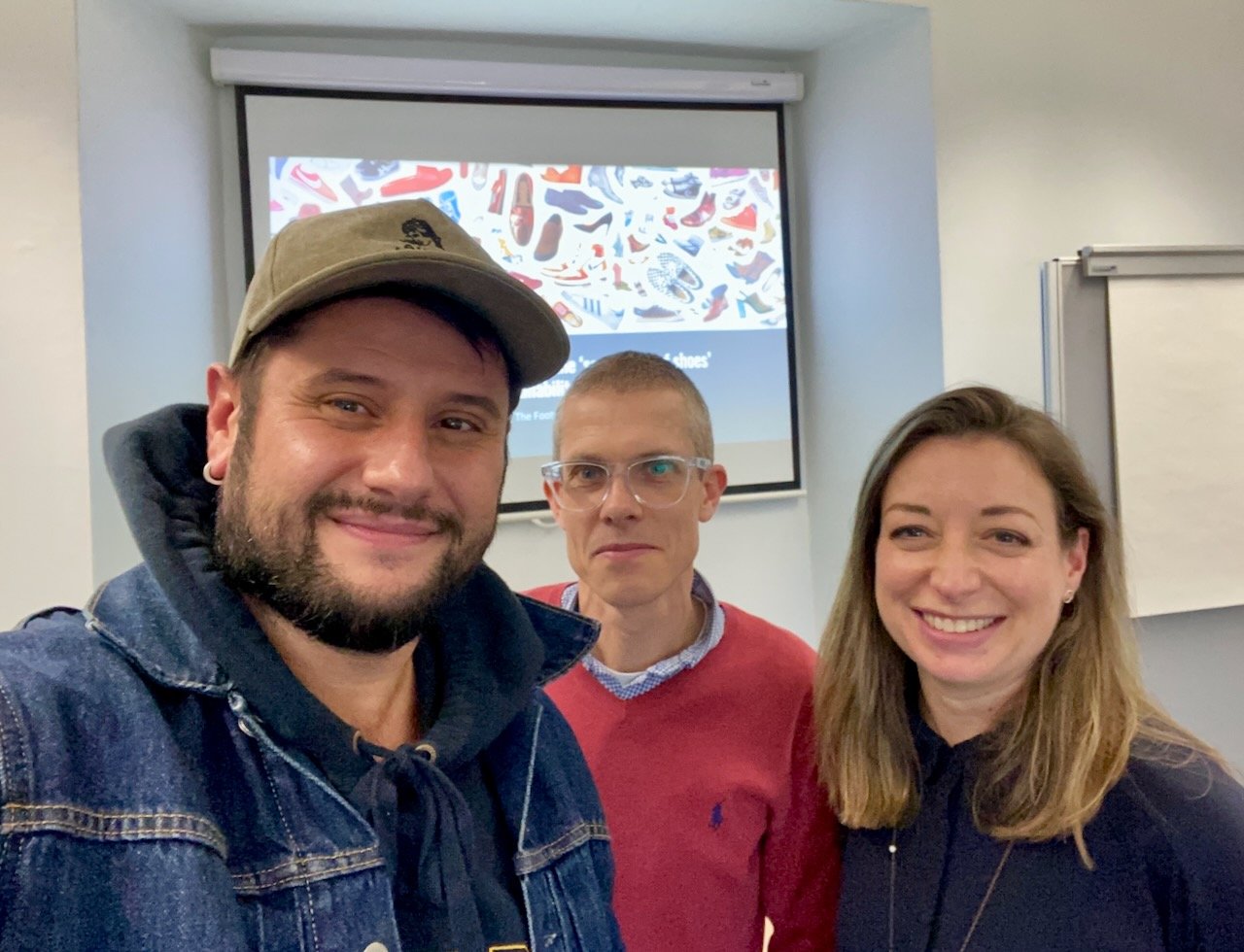
Alex [07:26] Hello, Tim Crumplin. Welcome to the Social Lives of Shoes podcast. Thank you so much for joining me on this very early morning, it is for you, and early evening for me. So I think we're probably both tired in different ways. We've known each other for a few years since I did my research at Clarks. I wonder if you can basically give us a bit of an introduction into who you are and what you do.
Tim [07:49] Yeah, certainly. Well it's more than a few years, it's decades I think. So yeah, I mean I'm a business historian — first and foremost I suppose, that's kind of how I cut my teeth. But I became an archivist and I'm now a business archivist at the Alfred Gillett Trust or the Shoemakers Museum. And Shoemakers basically holds the collections that relate to C&J Clark or Clarks Shoes, and owns those collections and makes them available to everybody. And, kind of as part of that, I came 22 years ago, having completed a PhD in economic and business history, which was commercially funded on the Isle of Man. I completed that in 2003, and I'd written a commissioned history prior to that. So I came here that long ago to write a business history using the collections that we have here.
I mean I quickly discovered that the cooperation that I'd enjoyed with the Commissioned History didn't necessarily translate elsewhere — and that was one of the reasons why, having come here, I sort of contrived to stay. I think where corporate archives existed they quite frequently were usually closed. Access depended very much on personal relationships. But as an academic researcher I quickly came to understand that companies perceived archives as reputational risks or sources of legal and regulatory anxiety. I remember one firm very candidly saying to me there was just nothing in it for them — they weren't going to benefit in any way, shape or form by allowing me access to the collections. I mean, ironically, it was those closed collections that really appealed to me, especially the ones within consumer brands — like apparel, footwear, the automotive businesses, football clubs, drinks brands — the ones where I think heritage stories could influence buyer behaviour. So you know, as I say I was desperate to stay here. As soon as I kind of got a foot in the door. I mean, the archive here kind of originates from the 1940s; but at the time of its creation it very much followed that kind of format — closed, very much kind of run for the benefit of a business rather than for the wider kind of research environment. I mean the archivist and business historian recruited to gather the archive together was a chap called Lawrence Barber and he was quite explicit in his intention to create a resource for the company. When he opened the museum in 1951, that was opened along very similar lines. I suspect following his death in 1966, the place was staffed by a series — I use the term and it might be a bit disparaging — old retainers. They were people that were qualified to manage the collection by their long service records. The museum was then redeveloped in 1974 to coincide with the 150th anniversary and as a consequence of that it kind of acquired this broader public remit — but the explicit kind of commercial purpose of the collection kind of continued. I mean, to some degree it was diluted from Barber's day. But it kind of continued because it was the wish of the family. It didn't need a commercial justification at that point. They were happy to sustain it because they thought it was a good thing to do.
How the archive has changed [11:09]
Alex [11:09] Yeah, so when I came to visit you in 2012 when I was doing my research, the Shoemaker's Museum didn't exist yet. I think even the Grange didn't really exist yet. You were working out of, I think, a small office on the High Street in Street — which is where Clarks has been based for, what, 200 years, in Somerset — and a big, slightly leaky warehouse with lots of stuff in Castle Cary, and also there was the museum on the High Street as well, that sort of slightly pokey, very, yeah, just lovely characterful museum. But yeah, so just tell me how have things changed since then, and why have they changed? I guess many people can probably say that there might be a lack of investment in archives but that has changed over the years at Clarks, hasn't it?
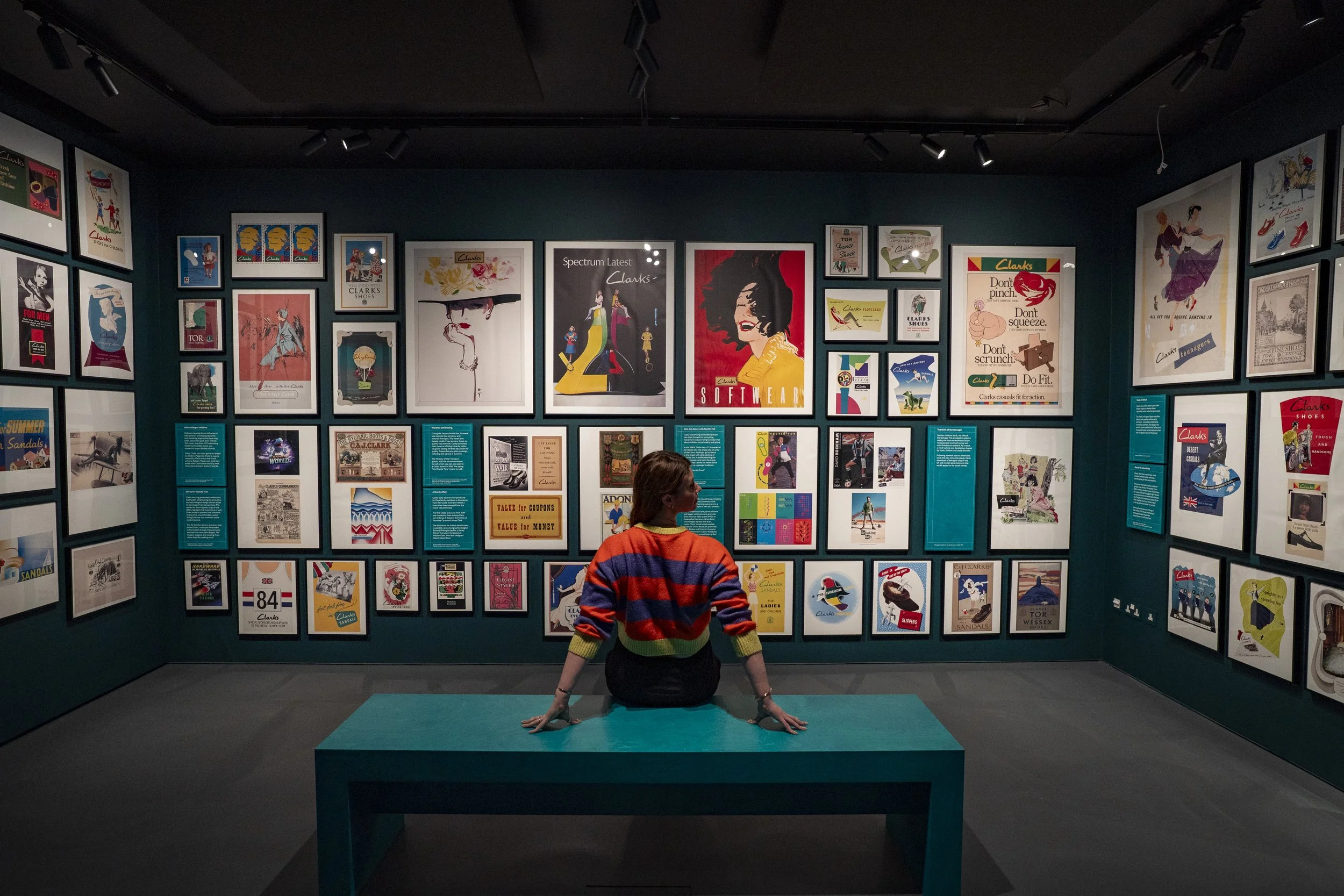
Tim [12:03] Yeah, I mean I would say universally that's changed. I think business archives, from my experience, quite often reflect the commercial health of their hosts, and collecting and commitment fluctuates largely as a consequence of how well the brand's doing or how well the company's doing. So like for example, what you sampled in that two up, two down overlooking the swimming pool — that very much reflected the difficulties of the business in the 1990s. The archive was run proactively until probably the 1990s and then it was just effectively mothballed. I'd kind of come in in the early noughties — I mean, Richard Clark, he's a family member, he was instrumental in reviving it at the time I think when nobody else really cared. So I'd say it was very much a family initiative rather than a business initiative. But he recruited another old retainer called Derek — Derek Patch — who worked as the insurance manager for about 40 years. And he painstakingly box-listed the collection. Derek was a beautiful man. He taught me pretty much everything that I know. And I couldn't have done what I did as an academic researcher in 2004 without him. He died in service in 2009. And then I think I'd kind of got sort of five years of research under my belt by that point. I mean I think I'd probably been encouraged to pursue a traditional academic career I think — that was certainly the advice I was being given — but I think I'd steadily become seduced by the idea of research having kind of commercial outputs, and I think that's kind of where archives have really started to gather momentum now. I think in the early 2000s, most creative companies placed very little importance on brand history or collecting. I think few credited heritage collections with any sort of creative ability or commercial impact, and I think even fewer believed they could affect or contribute to businesses financially. People were using the collection but we weren't really encouraging it.
Recognising the value of the archive as a creative resource [14:15]
So you know Marijka? I met Marijka when she was heading up Originals — and she did so with Rosie McKissock and the pair of them were like a dream team. So Marijka was the designer for Originals and she was the one that really started to engage with Derek in the first instance and me in the second. She was always very, she was the sort of person that wouldn't take something at face value and she would always kind of probe, so I was kind of sat up upstairs and she dealt with Derek downstairs — and it wasn't long before she found a way to my desk and started to discuss stories and history about Clarks with me, and about sort of brand history. And Derek was very much the conduit to the product, to the objects in the collection, so she would use him to provide footwear for her that would inspire her to create new product but also to authenticate old. And then she started to encourage me to give her stories to be able to give those products that sort of gravitas. So we had designers like Marijka or Anna Garberi that started to access the collection as a creative resource at about that time. But that wasn't happening out of encouragement, as I say, from us or the company — it was more from their perseverance. And Marijka was kind of intoxicatingly interesting and very lovely and sort of hugely persistent. And she kind of worked with us, I think, to show us how heritage could influence contemporary product. I think when Derek died, conversations started to be had with her that led to the digitisation and a more structured commercial service. But I think with the support of Clarks staff who were using the service at that time — and we had a couple of archive shoes that were actually really, really impactful, they sold large pairages — I think we started to attract attention off the back of that. And it was at that point that the company really started to talk about digitising the collection, and the family kind of continued to underwrite it. I trained as an archivist. And what began as research evolved into, I don’t know, like — I think basically Marijka and I were in a position to be able to integrate the archive into the business at that point. But at that time corporate archives as an inspiration for company design were still fairly unusual. And that was probably about the time that I met you, so yeah 2012.
But I think all business archives are probably quite different. Commercially owned archives have tended to be constructed for company use, as we've kind of said, and they're very much operated for that purpose — the archive is operated as a department within the business, be that marketing, legal, public relations, or something like that. But I think now, increasingly you see business archives being operated as charitable trusts or CIOs with an outward focus. And I think that's where we're finding now that the collections that pertain to a particular brand can be used for community and outreach objectives. So the Shoemaker's Museum and Archive as it now stands holds the Clarks collections, but it's very much a trust and it’s run on a similar kind of basis to places like the Sainsbury's archive or the Marks and Spencer's archive. And in tho se instances, services can be supplied to the brand, but at the same time we can encourage access to bona fide external researchers such as yourself from all disciplines. And that commercial sensitivity that was previously something that really kind of closed collections can kind of be balanced with openness. And I think when I first started out as a business historian it was quite demoralising because the default was, well yeah, we don't really want you to come in because you're more trouble than you're worth. But I think one of the big things with business archives is the fact that they've started to recruit archival practitioners. So it's part of the training and the professional framework that we adhere to — to make collections open and accessible and for them to be used effectively and responsibly. And that's what we endeavour to work towards, so consequently those collections are a lot more open than they probably ever tended to be.
Street, Somerset and the Quaker influence on Clarks [18:28]
Alex [18:28] Yeah, so would you say then that Clarks and the Alfred Gillett Trust were pioneers then in terms of making collections open and shareable? Because I'm just thinking about the context of Clarks — Clarks is based in Somerset in a town called Street. And over the last 200 years, Clarks really has kind of established that area, hasn't it? When I was doing my research there and I stayed in a little B&B, it became quickly evident to me that there wasn't anyone in the Street that didn't have something to do with Clarks, or know someone that had had something to do with Clarks. So the company was obviously really an important factor in the establishment of the area. And obviously the family themselves were Quakers as well. I wonder if you can speak a little bit as to how that might have influenced the way that the trust and the archive has been set up.
Tim [19:30] Yeah, Street is a model industrial village, effectively, and it's very much community, family, company — the three kind of coexist, and if you were to take any one of those elements out of the equation, you probably wouldn't have what we have here now. So that kind of Quaker ethos transcends, again, pretty much everything. To some degree, Shoemakers is a corporate museum — it's a bit of a brand mecca. But from the trust's perspective, it's very much more about having education at its core. And the remit kind of reflects family initiatives that have characterised the locality over that 200 years. So you look at precursors like the British School in 1858, or the Crispin Hall that was opened in the 1880s — which was very much a club and institute — or Strode Theatre in the 1960s, or the Shoe Museum as it was opened in 1974. Shoemaker's is very much in that vein. These are facilities for the community. So Shoemaker's Museum very much lends itself to a sense of place — it very much celebrates Street. It's a place of nonconformity and of commerce. It's a place that obviously produced footwear, but that footwear was shaped very much by the local landscape — Somerset, the people that populated it, their connection with their surroundings. Inspiration in design was very much drawn from those local references, in colours, materials, in textures. And even when you look at trademarks, a lot of the product was trademarked with St. Michael's Tor or Glastonbury Tor — that was always omnipresent, I think, in the company's visual identity. I suppose the Quaker virtues of things like simplicity, peace, integrity, community, equality — all of those things, have kind of been used to run the business, have been used to influence the locality, and to some degree have influenced the product that's come off the back of it. So all of these things are kind of intertwined. And I think the isolation has also made it pretty special. YOu’ve come to Street, Street's not an easy place to get to. But having said that, there was a thirst for international travel and I think a search for knowledge, and that kind of created a receptiveness to new ideas, innovation and experimentation — and that very much impacts the business again, the product and the people that visited. So the family were drivers in getting individuals to come to the locality.
Alex [22:05] Yeah, I think when I was there, I sensed, this kind of — in one sense, a frustration about the lack of proximity to, say, London where a lot of business is done — but also an appreciation for being located in Somerset. And actually, that that was really important for continually reminding staff about that kind of DNA and all the values that you're talking about. I mean, I remember one participant at the time saying, you know, it's very difficult to be a brutal, hard-nosed business person when you're driving down country lanes to work every day. So I think that character of the place — I can see how it would go into the practices, the business practices, the product, and the way that the staff operate. And I think it was so interesting as well, what you were saying about being detached — meant that people couldn't be lazy, they needed to get out and look. And I think just in the context of globalisation and digital commerce and how homogenous things have become and this lack of authenticity, this placelessness of products — I think it's really interesting to see a turn now towards understanding the cultures from which products come from, understanding their location in place, to reinstate some of those values and personality and identity to products and brands. Is that a function of the archive — to ground the brand and the product and…
Tim [23:51] Yeah, definitely. People come here frequently and they're basically looking at references. They're coming to look at old stuff — the really old stuff — but they're coming to look at it because it gives them that kind of groundedness. As I say, the locality very much dictated what was produced, to a point. What was good was — we talk about isolation — but I think where isolation might have been a weakness, it was actually a strength, in that by traveling internationally and then coming back to this locality, you were kind of left, to some degree, to your own devices. They kind of vertically integrated by being geographically isolated, which added an additional strength. Yeah, there's a definite kind of DNA.
Vertical integration and traceability [24:40]
Alex [24:40] So when you say vertically integrated — for anyone that doesn't know what that means…
Tim [24:45] Basically it's an attempt to kind of invent self-sufficiency. So if you're a shoemaker, you make shoes, but you also want to be able to control all the processes that go into shoemaking. So you want to be able to become a maker of knives, you want to become a tanner, you might even want to become a farmer. So you basically have all the processes of production — you want to become a last maker. So you're basically self-sufficient, you rely upon nobody. That's not really an issue if you're based in Northamptonshire or Leicestershire because you've got all those services around you. But if you're going to try and build an international business manufacturing footwear in the southwest of England in Street, and you're as isolated as you are — bearing in mind that the nearest train station wasn't even in Street, and at the time it was probably three or four miles away but now it's kind of 15 to 20 miles away and it has been since the 1960s — you had to become very self-sufficient, very kind of vertically integrated. And that was a strength, that was something that they set out to do and it gave them an expertise that enabled them to challenge the big hitters.
Alex [25:59] Yeah. I mean , I'm just thinking — vertical integration in the current day and age would be a huge advantage with incoming legislation around traceability, wouldn't it? Because the fact that more and more brands aren't vertically integrated, because of outsourcing, is actually causing quite a lot of problems, now this traceability and digital product passports and so on are coming in. So I can see how valuable that archive and those records would be now. I know a lot of brands are talking about reshoring some aspects of their production or investing in their own means of production, which is really interesting. It's fascinating to think about when that might have been done previously.
Tim [26:41] I mean, you talk about vertical integration and its effect upon the collection. The way that the archive has been put together means that it's been taken from quite a lot of the subsidiaries of Clarks. So you've subse quently got this very broad collection of material that you're able to draw upon. It's not just about shoemaking. It's about all the ancillary elements of shoemaking. And I think from a brand perspective you’ve either got heritage or you’ve not, you know, it’s not something you can invent. You can’t create it, you can’t really buy it. I mean heritage is competitive advantage, but you can kind of weaponise it. And I very much see the archive, to some degree as my armoury. It gives the place legitimacy, and it’s allowed the brand to enter new markets, to justify higher price points, you know it fosters loyalty. And you can cultivate a degree of desire, and I think that was what I was alluding to early on when I started to look into business histories. It was the consumer brands, I think, that interested me the most because of the power that you could cultivate from heritage, and the way you could use it to influence the consumer.
How to build an archive [27:50]
Alex [27:50] And the credibility as well, isn't it? Of that history. So now more and more brands obviously are recognising that an archive, whether it be private or public, is an asset in terms of establishing one's credibility and authenticity to the consumer — and also upon which to develop innovations. And in my research as well, I really identified the Alfred Gillett Trust and the Clarks Archive as a wonderful way for staff to continually remind themselves of those values and that DNA. So you've mentioned to me previously that a lot of brands come to you to ask for advice about how they might establish their own business archives. What are those conversations like? What do people tend to want to know? What are the challenges for them, do you think?
Tim [28:48] Yeah, I think it's an astute observation — that there are a lot of footwear brands that have started to realise that they can harness their archive. I think some might have informal archival arrangements institutionally — they've been engaged in collecting, they've got collections — but they want to be able to utilise them in the first instance, professionalise them in the second, and probably safeguard them in the third. And I think that's what a lot of them are coming to do. I mean, there are other brands that have come to us and they don't have anything, and they're either having to painstakingly reconstruct their histories by acquiring objects on the open market, or they're new brands that have been astute enough to realise that they need to begin collecting from the outset. The other part of that is, conversely, I've seen some newcomers that have been in touch to discuss archive policy, and I suppose they're failing to document it. And if they don’t document their uniqueness now, early on, reconstructing that uniqueness retrospectively becomes harder, it becomes more expensive, and ultimately becomes a lot more impossible.
Alex [30:00] Despite Clarks maintaining good archives as they went, I know that you did also have to do some work in terms of retrospectively documenting things, didn't you?
Tim [30:12] Oh yeah, we still are.
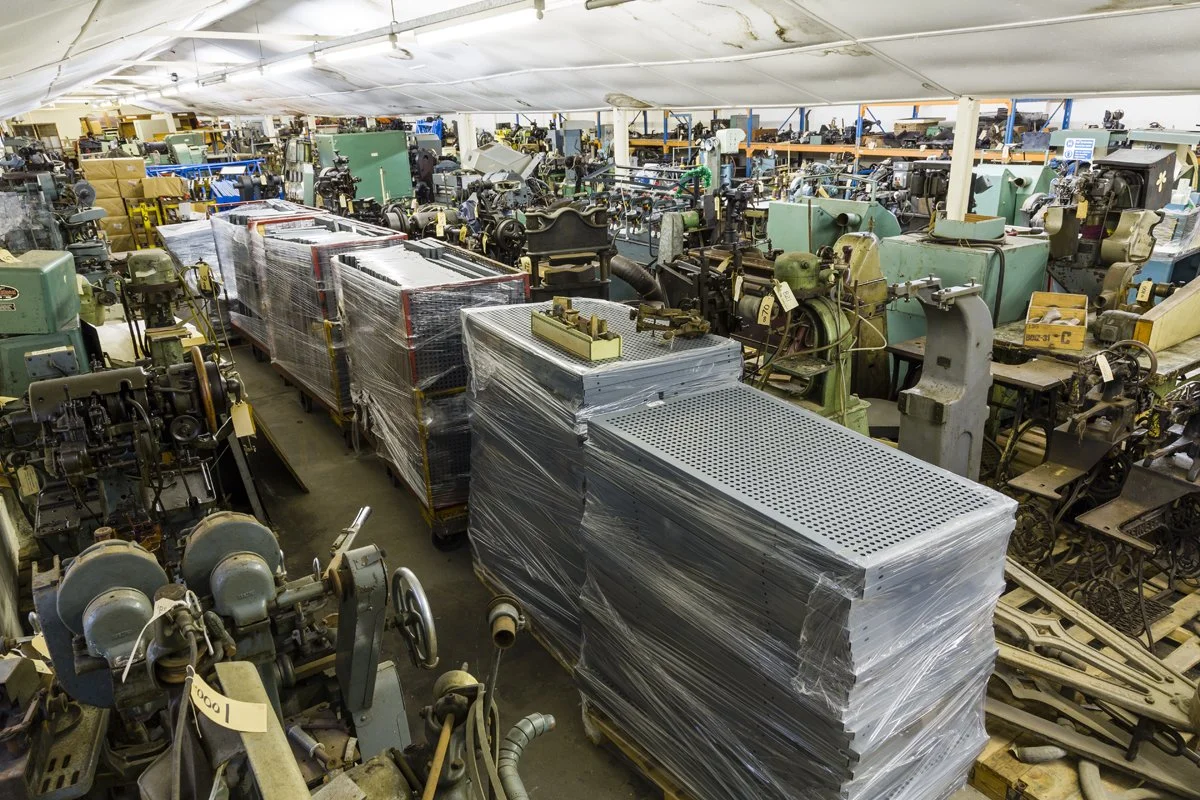
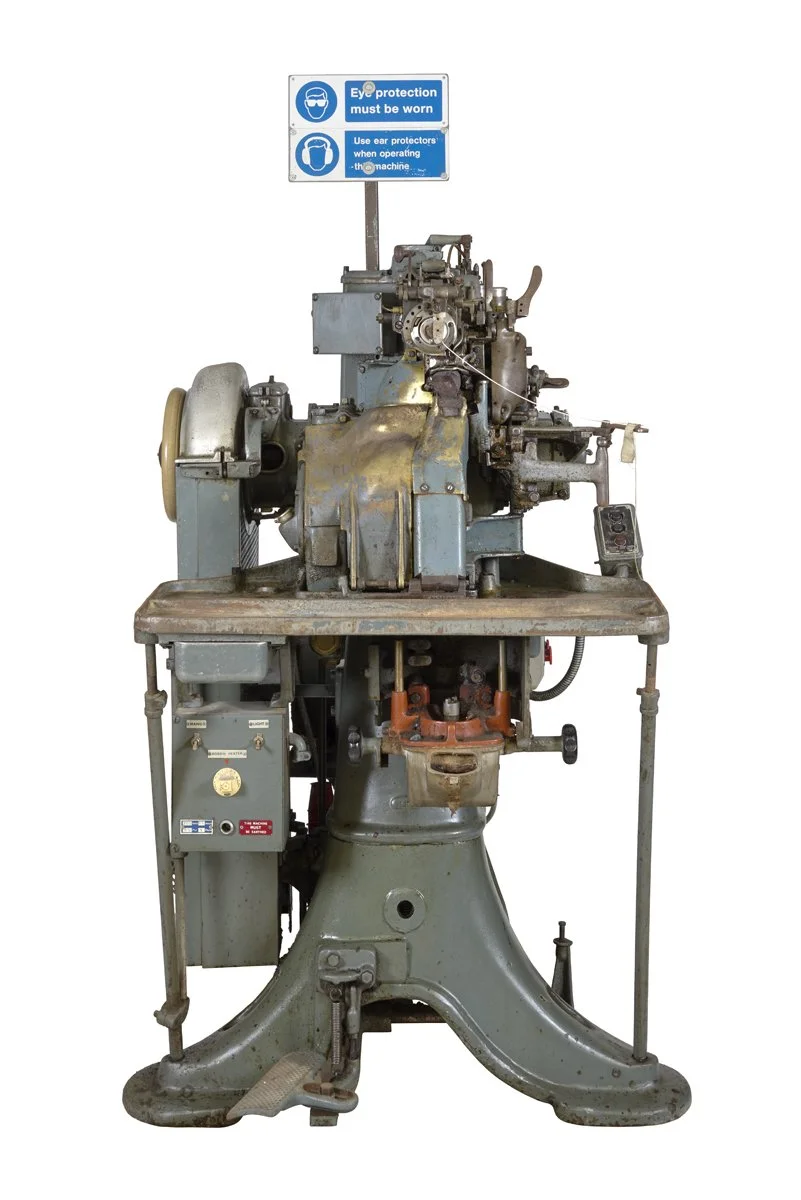
Alex [30:11] Like I remember you had lots of really amazing machinery in the warehouse — like the Bushacre machines for the Desert Boots, and so on — and actually the people that had operated those machines were becoming quite old and actually dying, and with them that knowledge was going. And I do remember you talking about getting oral histories. You say you're still doing that — what does that look like?
Tim [30:43] We do have oral histories and we're continuing to contribute to them. If you look at the archive for example, it's strong, I would think, from the 1820s all the way through to the 1970s and then it starts to tail off. And we see that happening, largely because, I suppose, the family probably become more distanced from the business, although they're still managerially involved until the 1990s. But they very much dictated collecting policy and encouraged… although they deposited their own papers, they also encouraged those around them to do the same. But also, archives very much reflect the fortunes of the business. So for example, trade was difficult in the 1990s — we have huge gaps in that time period within the collection. And where it's tailed off from the 1970s, with sporadic improvements in the 1980s and then dropping off again in the 1990s, we're having to use those oral histories to get people in to fill the gaps and make sense of some of the collections we've got. So they make contributions in that sense but they also interpret objects in the second. So oral histories are just an absolute boon for interpreting those primary sources but also giving you some sense of the object that you've got. Because it is just scrap metal — those 500 machines that we have — without input from people that know how they worked, where they were used, when they were used, you know, they’re not much use to us. We do have information on those machines, but not as much information as we’d like. We don’t have that personal insight. You know, those machines earnt wages for individuals that they used to raise their families and pay mortgages. And the life of the machine and the life of the individual that worked that machine — that's what gives it added significance, because it is just a lump of metal. But if you can speak to the man that worked it for 30 years and he can show you what it's done to his body, and he can tell you what it meant to him to work that machine and the product that he produced off of that machine — or the sewing machine that was used by a collective of women and the way that they talk about the friendships they developed around those machines, and how their life-long, and how they were pursued outside of factory life, and how the factory kind of supported communities — you've got a lot more than just a lump of metal all of a sudden. But it's the oral histories that give that flavour and give that sense of importance.
Alex [33:23] Yeah. And just the incredible stories — and the understanding of how it's not just a brand, and how integrated it is in people's lives and the history of the area. I mean, I remember when I was looking at them with you, you pointed out some stickers on one of them — because someone had stuck some stickers on one of them — and it gave a bit of an insight into what they were interested in. I can't even remember what the stickers were but it was just this trace of a human on the machine, part of the history, and it just brings that history to life, doesn't it? And I think for those then working within the company, and I guess also for the archivists and the business historians, it really emphasises, I guess, a responsibility as a custodian to continue that legacy — for the sake of all of the people that have come before and the knowledge and the practices that have been developed.
Tim [34:14] Oh custodianship is a big theme here and that kind of stems from the whole Quaker ethos. I think they perceived themselves very much as guardians of these collections and the materials within them — even though they kind of own some of them. They don't perceive themselves as owners, they perceive themselves as guardians, and there's a responsibility that comes with that — and that responsibility is that you're trying to pass it on in as good, if not better, a condition than the one that you received it in. And I think that's backed up very much in the last 15, 20 years with the work of Richard and other trustees — family trustees — and the fact that money has been put into the archive in the first instance. As you say, you've been into the archive, and you've seen we've got a state-of-the-art facility that's probably just over 10 years old. And then in addition to that, you've now got Shoemaker's Museum, which is an educational hub that allows us to have a platform to share the material that we've got in the collection with the community and use it for education and outreach purposes. Yeah, there’s a huge commitment, it's a big responsibility. I remember when I first wandered around here with Richard on my first day and I walked out and I said to him as we were walking down the road: “that's quite a lot of responsibility, isn't it?” I mean, he looked very sombre — you wouldn't blame him for feeling a bit pained, you know, because it's a fantastic thing to have. The family, particularly Richard, have been very acquisitive. I mean, as Quakers, I think they've seen the need to collect and to retain and to keep. And I think unlike other business archives, we've kind of got the space here to be able to indulge that. So whereas my contemporaries — you know, business archivists in London — have got to make some fairly hard and fast decisions on how they manage their collections because they don't have the space, so having to deaccession or be very strict about acquisition of material — here it's been exactly the opposite. Where they've wanted to take things, they've taken them. Historically it's been fairly indiscriminate; we've taken absolutely everything. Which is a good problem to have in many respects because you know 100, 150 years down the line you've suddenly got a very comprehensive and fantastic collection. Myself and contemporaries — like Jude and Julie and Nikki and Jordan — have now got quite difficult jobs in having to appraise those collections, catalogue them, make sense of them, make them more accessible and stabilise them to a point. But you know, it's a good problem to have. And when we kind of talk about the other companies that are either starting to build business collections now or have collections that they're working with — most of them haven't got collections on anything like the scale that we have, and that's competitive advantage for the brand, to be able to draw upon that. I don't think there are many companies that can talk about brand authenticity in the same way.
The vulnerability of shoe museums and archives [37:23]
Alex [37:23] No, look I don't want to add to the anxiety around the sense of responsibility that you hold at the Shoemakers Museum and the Alfred Gillett Trust, but there isn't another museum like it in the UK, is there? And on the Footwear Research Network, in collaboration with some academics in Switzerland who had done a study of shoe museums and archives around the world, we've got a Museums and Archives directory — and I was really surprised by, first of all, how few there are, and also just that they are so vulnerable. Because I mean, I want to talk a little bit about the structure as a charitable trust — because obviously we've got the Northampton Museums and Galleries, which I think has got one of the largest collections of shoes in the world, but obviously that is slightly vulnerable to public funding because it's part of the council, and we know what's happening around public funding for culture and the arts in the UK if not elsewhere in the world. And then as you say, you've often got archives that are private and brand-owned, which again are vulnerable to the financial and commercial imperatives of the brand — and particularly if those brands are shareholder-owned as well. So I wonder if you can talk a little bit about the advantages of the structure that you have in terms of maintaining that custodianship and protecting those histories.
The case for the charitable trust model [39:03]
Tim [39:03] Yeah, yeah, yeah. I think within the context of business archives, the whole idea of structure is a really, really important question. What's been interesting here historically is that as it evolved, as it started, this was very much explicitly a commercial collection — you know, as I said earlier, it was run as a commercial collection, it was created as a commercial collection and it was used as a commercial collection. But as I say, the Clarks archive has always kind of been, and sort of museum, um the museum was run by the business. And I suppose the archive was too, even though Richard took on responsibility for it and ran it more as a trust thing. I mean, he set up the Trust framework, and in so doing, you know, it's taken time, but obviously now it's legally separate. The historic collections are legally separate from the core business. I suppose that separation does a number of things. So it protects the history. So you know, if the parent company - which you’ve already referred to - if it ever experiences any kind of financial difficulty — whether it's a merger or an acquisition or strategic change or anything like that — then the archive isn't immediately treated as a disposable asset. Which is something that happened with the Wedgwood archive, where it was sold off and disposed of when the assets were disposed of, and the money that accrued as a consequence of the sale was used to plug — I think in that case it was the pension deficit. So you know, if the Wedgwood collection had been held in a charitable trust, that wouldn't have held. But because it wasn't, it was regarded very much as a commercial asset. So that's one of the great things about the trust structure. But I think it also changes the governance as well, in that our collection now is very much overseen by trustees, and they have responsibility for its preservation and for ensuring there's proper stewardship of the collections. They're able to plan long-term in a way that I think companies probably aren't. Business archives and business collections, certainly traditionally, have come a long way down the pecking order in terms of priority — both in terms of planning and in terms of funding. There's that kind of benefit as well. There's also, as I say, that benefit of balance that we talked about before. Where, you know, we acknowledge that there are commercial sensitivities within our collections, but we can manage our collections to accommodate those. And we wouldn't refuse any reasonable requests — there's no point-blank refusal to come and look at collections. We would always look to adhere to our ethos, which is to share the collections and make them accessible. So you as an academic — we would wholeheartedly encourage you to come and look at them, and that stands for any academic discipline or school, or anything. And they're also kind of practical considerations with charitable trusts. So for example, external funding streams. If you're associated with a business and you're bankrolled by that business exclusively, then if you go out to a funding body, their first question quite understandably is: well, why would we fund you if the business won't? If you're a branded archive, a corporate archive, the company should be funding this research. It shouldn't be something you're coming to a third party or a publicly funded body to look for money. So for cataloging collections, or for conducting research. So there are other kinds of financial incentives, you know, such as business rates, which I know know a huge amount about, but I think the government will give concessions to trusts in the way they operate to be able to benefit the collections. So there were quite a few considerations when moving into the trust framework, and that's why I think quite a lot of business collections have gone that way. So, as I say, Rothschild's is one. I think the Royal Mail — the Post Office Museum and the Royal Mail element — I think that's a charitable trust now. But yeah, Sainsbury's. But there are loads. We operate now as a charitable trust that owns our collection, and that obviously gives us power — it empowers us, it empowers the collection. That's why we built the museum when we did, because prior to that we didn't own the collection. We actually owned the collection from 2021. And once that was squared away and possible, it took an element of risk out of the situation, because it was only on loan to us before that. But by having that collection in our ownership, we were then able to invest in a building to host the collection and build Shoemaker's Museum. So, Trust ownership is a good thing for access and for empowerment.
Alex [44:23] Yeah, it sounds like a fantastic model. Again, it comes back to that more long-term thinking that you need to be a custodian within a culture that is a little bit more immune to commerce and the commercial agenda, I suppose.
Tim [44:41] Yeah, well there are a lot of responsible companies that are doing community work with their archives. So, I look at some of the bank archives, I look at Boots for example. Boots have done some really, really good projects. I know they did one for Alzheimer's, working with a lot of the care homes — and they did that through a sense of smell and using a lot of the things that were sold through Boots shops throughout the ages that would kind of provoke people to be able to talk about memories. I mean, shoes are the same — we use shoes in a very similar kind of sense.
Collection policy: what gets kept and why [45:20]
Alex [45:21] Yeah, absolutely. So just talking then about the collection policies around what is kept and how it's kept. I wonder if you can talk a little bit about that. So, how is it decided what's kept? Who makes those decisions? And according to what kind of principles or strategies would you say?
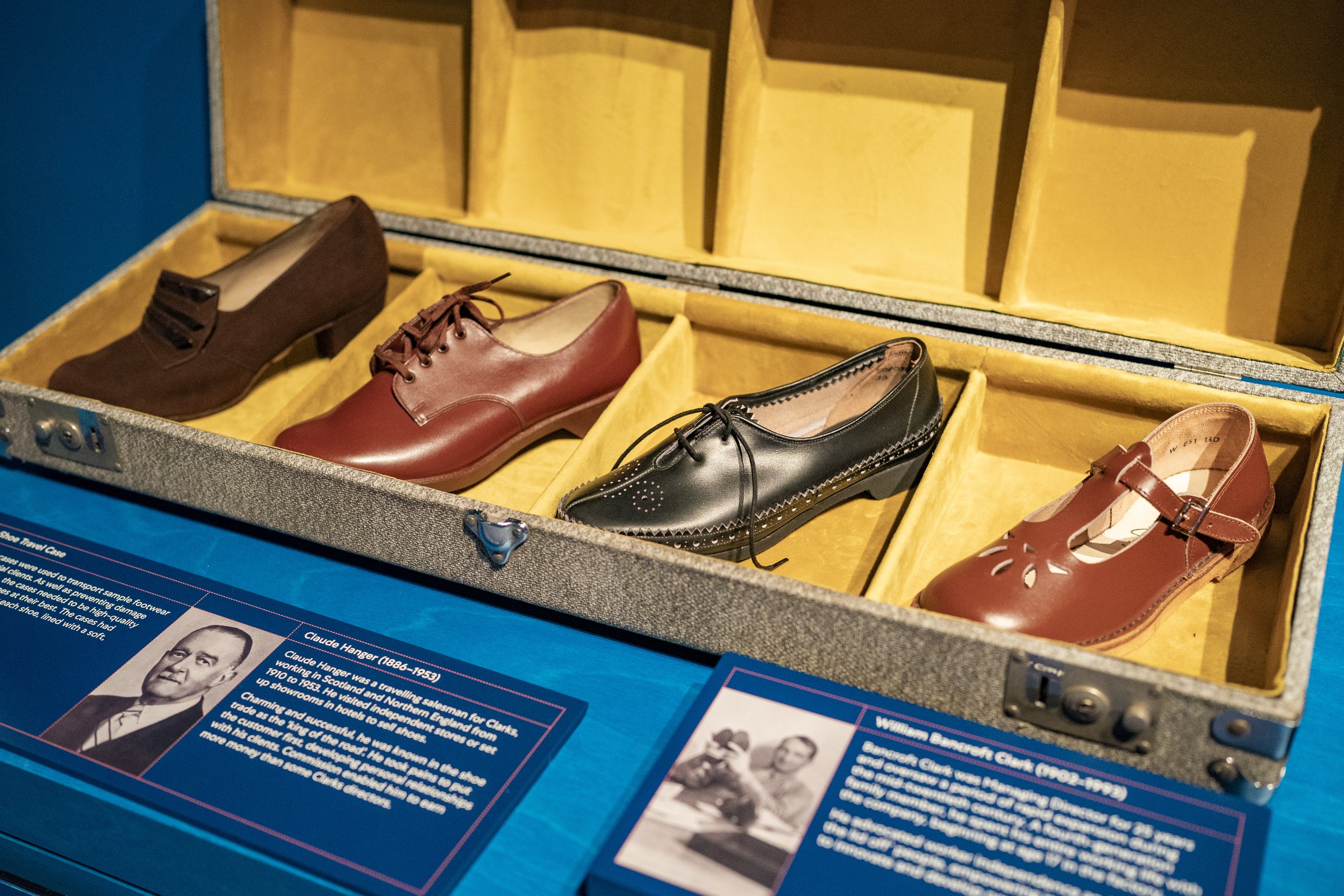
Tim [45:47] So historically, as I say, we've collected quite indiscriminately, and that very much reflects the fact that the collection probably wasn't managed professionally. So it was only, I would think, after my arrival — probably around 2012 when you arrived — that we started to recruit professional curatorial and archival staff, and that made a big difference in the way that we conducted ourselves. So for a start, it led to the drafting of a collections development policy. So we publish that on our website and it very much outlines the kinds of things we're interested in, why we're collecting them, how it contributes to our collecting agenda and the way that it will be used to inform what we do. So when we get offered material we tend to appraise the things that were offered — you know, potential acquisitions — against that and against the rest of the collection to see whether it's relevant, how it might be used, whether it's stable, the provenance, you know who it belongs to, and making sure that it's a legitimate acquisition. So we make decisions on all those bases. But we’re also, we’re taking collections from the general public, taking them across the counter from the museum, and we would apply that framework. But we would also apply it to corporate acquisitions. So historically the collection has been supplied with footwear from the business, with point of sale material and marketing, with internal memoranda, minute books, those sorts of things — and they would be applied to a similar framework in terms of collecting. But we very much work with the business, and we do with any donor to some degree, to inform us and to guide us as to why we might want to take these things. So with footwear, for example, we would go to the different genders seasonally and we will take a strict amount now — usually something like 25 a season across each gender. And we'll talk to the individuals that have worked on those collections so that we can try and understand what it is they've produced, why they've produced it — bestsellers, materials, constructions, significance on that basis — Um commercial failures.
Alex [48:05] Yeah, I was going to say! So it's not just the bestsellers that you pick — it could be the commercial failures, because I guess there's as much to be learnt from the failures as from the successes, isn’t there, so that’s really interesting.
Tim [48:13] Yeah, yeah, there’s as much to be learned from failure as success, yeah without a doubt. And sometimes it's nice to then have a discussion with them as to why it failed. And sometimes you'll accept on that basis. The reason why it failed might have been because the market wasn't ready for it. The reason why it failed might have been because technology just isn’t advanced enough to do what that shoe attempted to achieve. But you know, if you tuck it away and put it on a shelf for a couple of years, all of a sudden it becomes relevant again. So it can be brought out, it can be learnt from, and those lessons can be reapplied.
Alex [48:46] Wow. So you're looking after them, aren't you? And I think sometimes you do hear this — I don't know whether there might be a bit of an assumption sometimes, that brand archives, particularly with heritage brands, you know just plunder the archive and keep bringing things back from the past and there's a lack of innovation. But actually, my experience of observing how the designers and so on were using the archive — it was actually quite different. It was about what you were learning from the past to inform the future. It wasn't just a case of necessarily copying something from 50 years ago; as you say, it may be something from just a few years ago that didn't work because the time wasn't right. But there is quite a lot of innovation that is inspired by the archive, I suppose, as well. I wonder if you can talk a little bit about how the archive is actually used by the staff at Clarks. How does the conversation start? You’ve developed quite a good relationship with various people in the teams there, haven’t you.
Tim [49:42] Yeah. And it's kind of based, I suppose, very much on personal relationships to a point. I think archives — some people get them and some people don't, you know, in terms of using them for corporate benefit. Some people can interpret them, can work with them and put that into collections. And other people — it either just doesn't float their boat, or they just look at you as if… you know, they just can't grasp how they would incorporate it into collections. I mean, to some degree it would be good if it was on a foundation course or part of a designer's development. Yeah, I mean, Matteo is another one. I think Italians in particular — it's probably that whole made-in-Italy thing — they kind of intrinsically understand heritage brands, archives, how those things work. But yeah, Marijke was another one. I mean, Marijke, I think, came into the business and came into Originals at a time when Originals was very peripheral, it was very small. It wasn't particularly commercial, I don't think. And her and Rosie McKissock were just given the freedom to do what they wanted with it, which was just a fabulous time to be here. I mean, they would just kind of pull me into meetings and you'd just sit and talk to them about stuff. And they were able to incorporate that, but have the freedom to do what they wanted really, because to some degree — and I suppose, it sounds bad — but it didn't matter hugely. But in not mattering, it meant that they could take the risks that we've talked about to some degree, to be able to establish something quite significant. It was only when it gained traction and became something quite big that everybody I think started to jump on the bandwagon with it. As you say, Matteo is like the modern manifestation of Marijke now, and it's just brilliant. He's an advocate for the collection, but he also knows how to use it, and he encourages those that work around him to do the same. And Marijke did exactly that. I mean, she was the one that really developed the interest in it, and we started to get a good footfall of people using the collection. And I remember her saying: I would love to not share this stuff, I'd love to keep it to myself and just use it as my own special little place — but you know, that's not good for you and it's not really good for me either really, in the grander scheme of things. Yeah, I think I've been lucky in life in that certain people have come along at just the right time. And I think she's one of those. Yeah, very much so.
Alex [52:34] Yeah. No, it's wonderful — those collaborative relationships that result in such successful initiatives and a deep understanding of the brand and the product, that the archive can facilitate, I suppose, yeah.
Tim [52:53] I remember when I was working with Marijke, I barely had a job. I mean, you know, Richard would ask me what I was doing and would sort of say “I need to have a meeting to talk about your future” — or lack of it, I think was probably the... And I'd say, “I'm just so busy Richard, there's just so much going on”. And he'd be a bit bemused and say, “like what? What are you doing?” And I'd say, “oh, I'm working with all these people in the business and we're doing some really great things.” And he was kind of intrigued to the point of giving me the freedom to do it. You know, and I'm sort of indebted to him in a way. Richard was a brilliant boss, really really good boss in the early days, because he did give you those freedoms. And I suppose to a degree, trust — you know, he would let you just get on and do stuff. And I don’t suppose without him, the collection would really have had the platform to have got to that point. I mean, as I say, it was mothballed in the mid-90s.
Alex [53:58] But I think the thing that you're touching on was a finding of my research, actually, the importance of giving staff within brands some freedom to explore and discover, whether that be in the archive or getting out and about and looking, or getting into culture and connecting with people, and understanding how things are used and their meanings and their value — to make more relevant decisions in terms of designs and strategy. So I think, not keeping too tight a hold on what people are doing, so giving them a little bit of latitude to innovate and build that knowledge that is so important.
Tim [54:41] Yeah, I'd say it's a consumer drive that’s causing this. I think it's international markets as well — and the ability to set yourself apart from other brands in international markets. I'd say it's brand saturation. It's the fact that you've got a lot of people, you know, now, that are going into a lot of these fashion sectors, and knowing that you've got something unique, that you’ve got a history that can't be reinvented or can’t be created or contrived — you know, you've either got it or you've not. It is competitive advantage. And to me, that's why businesses have started to invest in archives, started to employ professionals to run them, and have started to give them quite a lot of credence.
Archives, corporate culture and healthy approaches to risk-taking [55:30]
Tim [55:30] I think one of the things that I find really interesting is that your archive can influence corporate culture. So risk-taking, for example. I've used the archive recently to illustrate — certainly to newcomers, more junior members of staff — I think even culturally, an aversion to risk. And I don't think that's just in this business, it's probably more collective. You know, businesses increasingly, I think — I don't want to say they're beige, but they're not pushing boundaries in the same way that perhaps predecessors did. And to talk to people through some of the oral histories that I've been able to develop — you know, you talk to individuals that talk about, I don’t know, advertising campaigns that used Helmut Newton, you know the erotic photographer, on a Clarks advertisement, in a fairly conventional publication, and realising that that is pushing boundaries, and that might lose them their jobs, but actually thinking that the risk is worth taking to push the brand on to the next level. Or the same with products — you know having the ability, or the foresight or the strength of character to be able to do something a bit different. When you talk to some of the people that worked in marketing or range management here, they said some of the iconic products they produced were the ones that nobody liked. And it was only when nobody liked them that they actually thought they were worth launching — you know, rather than chasing trends, you wanted to influence trends, you wanted to drive trends. So if you had a peripheral take-up, so you know the people on the edge of focus groups — you know, three quarters of the people in the focus group disliked it — you only needed a couple - or even more than three quarters dislike it - you only needed a couple to pick up on it and say, yeah, I think it's quite good, for you to say, yeah we’ll run with it. And a lot of the big products, the ones that have actually sold really considerable volume in the collection, are the ones that nobody actually really wanted. And I think the thing is that a lot of people don't know they want product until it's kind of put before them. And when you look at the way that people have actually come to those decisions… So again, people travelled, they would go to college campuses, or they would go to America, and they would look at sort of the West and East coast and they would look on the beaches, and they would see what people were wearing, and then bring it back here and interpret it in a Clarks way and push it out to what would have been a fairly conventional consumer. But if your kids are wearing it, then there's every possibility that you'll be wearing it yourself in another 5, 10, 15 years' time. I think the archive can teach people that risk isn't necessarily a bad thing — it's the way it's managed, both in terms of access but also in terms of interpretation and how you use your archive. So more recently, it’s risk, a healthy attitude to risk has been one of the things that has encouraged me to get people to use an archive.
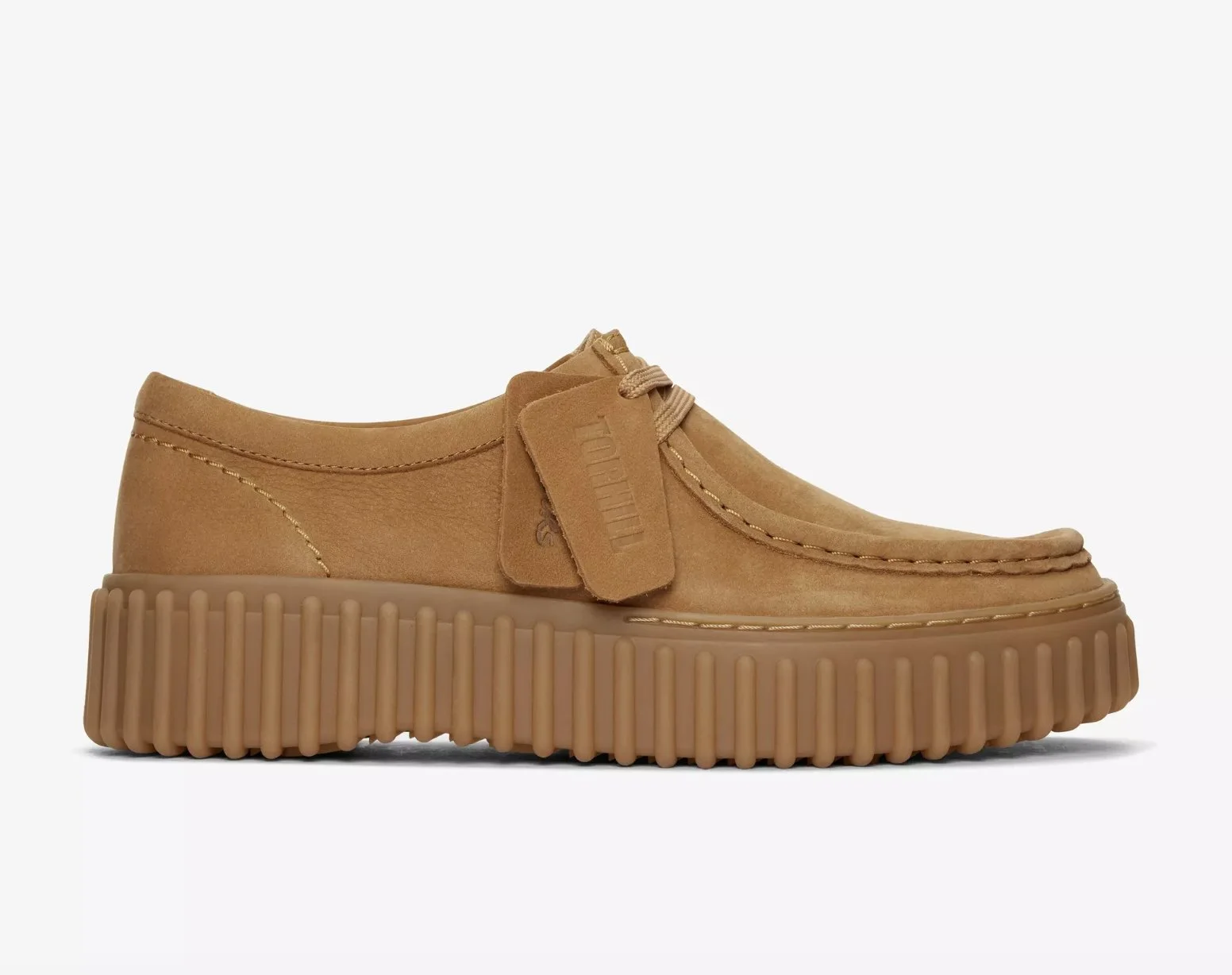
Alex [58:48] Yeah, because there are quite a few styles actually that have got quite a lot of publicity — I'm thinking about the Tor Hill, which is quite unusual. What was it you were going to say about that?
Tim [59:00] Yeah, so that's an archival silhouette. It's got like three archive references in it in one shoe. I mean, that's one of the reasons why I do this job.
Alex [59:09] Yeah, I mean what a wonderful success, because that shoe has got character hasn't it. And I think this is what I guess is the response to — I mean what you were saying about so many brands being risk-averse. I can understand why that happens, because with mass manufacture in large quantities a small mistake can be hugely costly. But I guess what you're talking about is that the archive is actually an opportunity to take calculated risks and learn from the successes that came from previous risks — to understand what risk-taking looks like in a healthy and calculated way, to come out with innovative outcomes, rather than just taking a chance. But yeah, I think it informs calculated risk-taking. And I do remember when I was researching there as well, these wonderful success stories — I remeber, sometimes the briefs that designers would get would be to repeat what sold well last season in various new colours, tried and tested. But then some of the designers would then sneak in an additional style that wasn't included in the brief, and I remember one designer telling me that style was then chosen and became a bestseller. And it was just so lovely seeing the impact of that on her. And you know that it was a bit of a risk to go with that style, but the risk absolutely paid off, and I do think she was one of the people who was a regular user of the archive — I'll mention her because I don't think she will mind at all — it was Philippa, who has since gone on to do a master's degree at the V&A and the Royal College of Art. Because she was just always fascinated by the stories of shoes and I think she was just in her element. So again, I think, the importance of archives particularly for designers is to develop that cultural capital — that embodied knowledge about what the shoes are all about, why they're successful, all of that knowledge that’s stored in the archive — so they can make better-informed decisions about what they're designing. So it's such so wonderful for the staff there to be able to have those resources at their fingertips and also to have you to be able to access those as well because I I'm sure lots of the archive is being digitised and can be searched but there's nothing quite like having people that sort of have been through it materially and know it inside and out and know all of those stories.
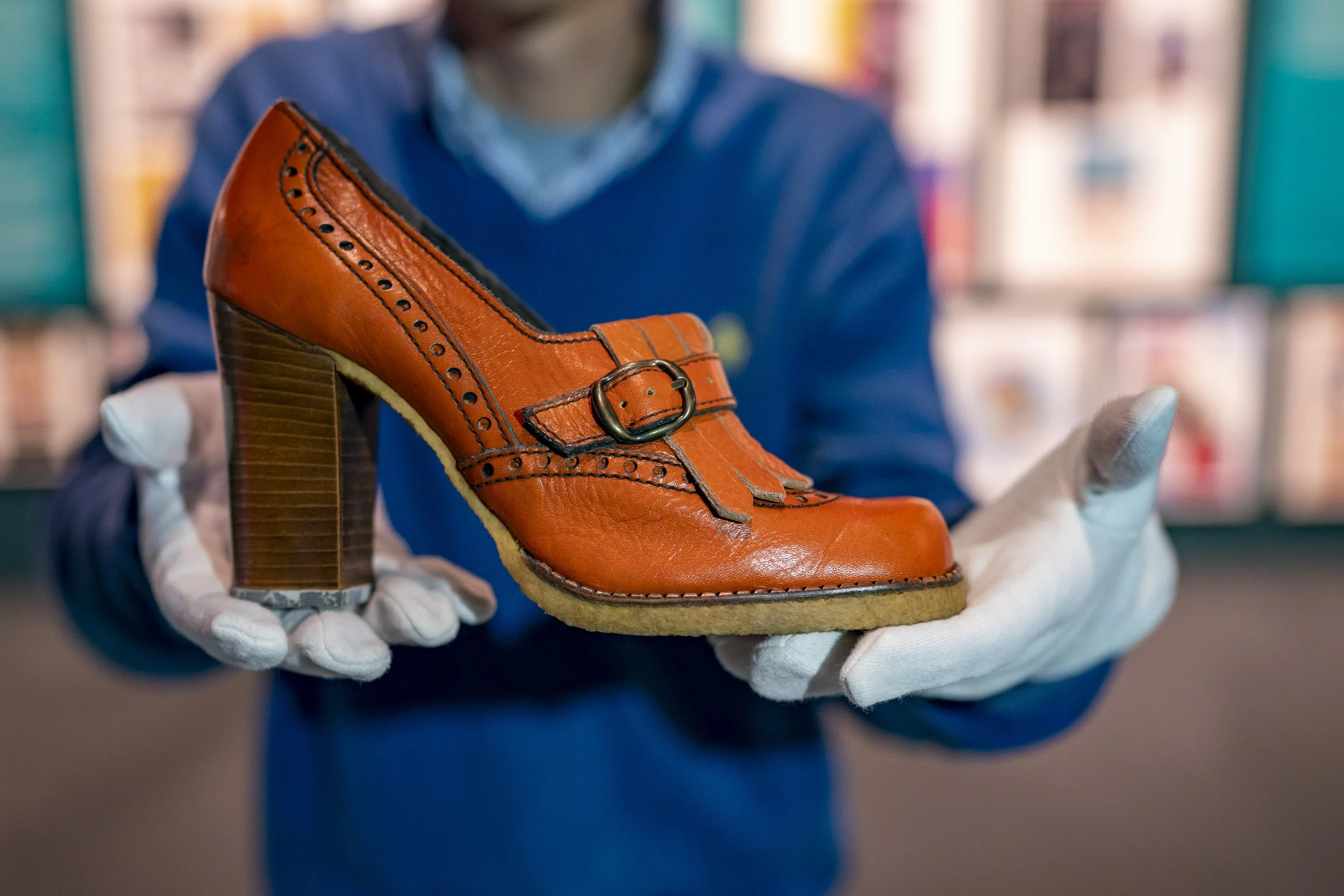
Tim [01:02:21] Yeah, I mean it's lovely to be able to influence. You talked about Tor Hill — I walked out of a hotel room in London the other day and the cleaner was in the corridor and I looked at her feet and she was wearing a pair of Tor Hills and I was so excited. you know and I had to hold it all in because I didn't want to blurt out, you know, “I was there when your shoes were conceived” — because that would have just been plain weird, would it not? And I said hello to her, but I had to get round her as quick as I could because I couldn't contain it. And I got into the lift and I told my son and I could just see that he looked at me in a very pitying sort of way. But it's just nice. I think that's probably the reason why I've desperately wanted to stay — because it's like working with creative people, working in an archive with them, being able to introduce them to concepts or elements, and dig around a little and find things, and then to actually see that interpreted commercially and sold in a shop or just worn, you know, like in a corridor. It’s just mad. I think that's what I delight in. You find yourself walking around with your eyes on the ground looking at feet rather than where you should be going. I mean, designers they come in here seasonally. They're always using catalogues to identify all kinds of things like materials and last numbers and colours — you know, they’re comparing original shoes to lasts and patterns and swing tags and promotional material so that you can integrate all of these things to do something quiteTim compelling with it. And it's because the resource here is so rich and there’s so much like Scope, that you have the capacity to be able to kind of do that I suppose. And whilst you're looking for accuracy and brand authenticity to a point and you’re looking to be able to produce a Wallaby as a Wallaby has always been produced, and you've got the reference points to do that, or with the Desert Boot or the Desert Trek — you know, the excitement is in then being able to take elements of Clarks DNA and mix them all up to produce a new product. Yeah, like Tor Hill — it's got a Wallaby silhouette, it's got a kind of buffer on it from a Big Gripper from the 1990s, and then it's got a tread detail from a 1980s shoe. I don't suppose many people know that, but I know that, and that just warms my heart. But it’s those kind of things and It was the same with Marijke and Anna Garberi when they first started using the collection — to sit and watch them work through the collection and then say, “I think I've got a reference here and a detail there” — it might be a punching or a stitch detail — and to say, “I think I can use that in a modern sense to actually give it a Clarks look”. You don't need to necessarily mark the product, it doesn’t need have Clarks written all over it. It's identifiably Clarks by the way it looks, and therefore people know exactly what it is as it walks down the street without needing to ask you or needing to look for the brand on the outside of it. So that's kind of what I like about that heritage referencing. It's just good fun.
Alex [01:05:43] And I think the other thing is — you're taking inspiration from the archives and you're putting things together, and in doing that you're bringing different stories together, different eras together. And although people might not be able to articulate that, I think there is a resonance often for people that they can almost sense, can’t they. And the designers' job is that they are reimagining these things for a new context, for the current context — you know, what do these styles mean now and what are the stories that they tell in relation to the way that the world has changed? So it's wonderful to be able to reference those things to tell new stories that are relevant to present times.
External access and community engagement [01:06:47]
Alex [01:06:47] So how is the collection used externally by external people? What is the normal protocol? What normally happens? What kinds of inquiries do you get?
Tim [01:06:47] We get a lot of academic inquiries. The business collection is something that hasn't been researched massively currently. That was one of the attractions for me to come in in the early noughties — it was just an untapped gold mine, there's gold in those hills, you know. And it hadn’t actually been accessed… I think it had only been accessed by one other academic since about the 1980s, and that was a family connection that enabled that. Yeah, so academic interest is a big one, but that's largely I would think driven by the family connections, by that educational and social reform angle — nonconformity, religion, suffrage, temperance, abolition of slavery, free trade. Those sorts of things. So we get real academic buy-in and we're keen to cultivate that and to get more of it.
Alex [01:07:42] Because there's a really interesting history of women in industry through Clarks, isn't there?
Tim [01:07:50] I mean, Sandra Holton was one. And the good thing is that when academic researchers start to cite the collection in their sources, that's when we start to get some momentum. And yeah, that's what we're aiming for again now, because the archive has actually been closed off and on for the last few years — because obviously we had Covid and then we've had a major redevelopment with the site, so we've had to close the reading room, and that's the point of access really. So people tend to come to us through the reading room by appointment, Monday to Friday. But the collection is used in a whole host of other ways. Obviously now we've got the Shoemaker's Museum, we've got that public platform. We're engaging with schools and using the collections from that perspective. We're engaging with the community and we're able to use the collection very powerfully for all kinds of things — U3A groups, WIs, care homes. You know, and now that we have that platform and are visibly apparent, I'm kind of hoping that the collections will be utilised more and more.
Digitisation [01:09:03]
Alex [01:09:03] Absolutely. And what about the digitisation of the collections now as well? Because I know you've been going through a process of digitisation — how does that work?
Tim [01:09:12] So digitisation was — After I suppose we got that initial kind of success with styles that were inspired by the collection. So things like Bombay Light in 2008, 2009, those kind of big sellers. That's when the business was happy to start looking at digitising the collection and putting funding into the digitisation of the collection. So they were keen to digitise the shoe catalogues, the Couriers - so the factory magazines. They've also started to digitise the point of sale collection. I mean, those three collectively can be used to interpret one another. So the catalogues are probably the strongest initial point of contact for individuals to look at, because from a commercial perspective they give you details of specifications — shoe, colour, material, last number — so you can then start to explore the collection more broadly for those elements to draw them all together. But yeah, things like the Couriers, and the comments and the news sheets — those factory publications — are just really, really strong. Clarks invested considerable amounts of money in inter-company communication from the 1920s, 1930s onwards. So you get an insight into the people that worked here, what they produced, the factories they worked in, the communities that they served — be that in Street or further afield. And I'm talking about the Southwest as well as Australia, New Zealand, South Africa, America — where people worked in offices, be that wholesaling or manufacturing. So that is just such a rich resource, and we can use that again to engage with people that worked here, so ex-employees, but also students, school children. We've also got things like family papers — things like visitor books for Millfield House, for example, which we've done projects with schools so they can start to understand their place in the world. This whole idea of internationalisation and the internationalisation of Street and significant people like Booker T. Washington or Ida B. Wells or Frederick Douglass visiting Street. And the impact that activities and initiatives that were conceived in Street had upon both the locality and the wider world, andthose kind of very broad and sort of significant subjects. The Village albums — we're about to start digitising those. So that was a literary society. Quakers are known for their literary societies. They're a very contemporary commentary that were written from the 1850s and are still written to this day — and that’s part of that Quaker tradition of gathering to write and create things and read collectively. That's again something that we'd like to share with the community. So the digitisation initiatives are starting to take shape, but ideally what we need to do is to catalogue a lot of those collections before we start to digitise them. And that's the spade work — that's the hard work.
Alex [01:12:31] And you're probably still discovering things all the time, aren't you — like when you're doing that cataloguing.
Tim [01:12:36] We've catalogued so little — but the things we have catalogued are the things we use, because we have started to discover gold amongst them. And it's that gold that people have been able to utilise.
Alex [01:13:10] Gold mining — you're a gold miner!
Tim [01:12:27] Yeah, I mean, I kind of joke — this is an armoury as far as I'm concerned and you have to protect your armoury. Yeah, there's gold in these hills. It's one of the reasons why I've not left, because I've been panning for it for 20 odd years. There's always new stuff.
Alex [01:13:17] Yeah, so you're a gold miner, but you're also worth your weight in gold.
Tim [01:13:14] Do you think?
Alex [01:13:15] I’d day so, and I'm sure there'd be lots of other people that would agree with me as well, and I know that you’re a very modest person. But yeah, an archive of the scale that you have there involves quite a team with complementary skills and tendencies, I suppose.
Tim [01:13:36] Yeah, yeah. I mean Julie Mather is our archivist — she's our professional, she's the best in the West, probably further afield as well. Yeah. I'm probably not a typical archivist. I don't think I'm wired up right for an archivist. Derek, I mean, I look at Derek and the collection that Derek left behind. Derek was never a trained archivist, but he was wired up to be an archivist. Very methodical. Collected in a really conscious way. He knew what he wanted to collect and knew why he was collecting it and organised it in the right way and boxed it in the right way and documented it correctly — very fastidious. I suppose, as I say, he'd spent 40 years in insurance, so consequently that was quite a routine-driven process I'm assuming. But yeah, he was really good.
You kind of look institutionally at the way places are run now. People are in the up-and-up game — there's no benefit to staying anywhere for very long. And I think that's one of the strengths of the archive, and it is becoming more of a strength as time goes on. Because people have such short service tenures, and just as you start to get to know people and you love them, they leave. And it's your job really now to indoctrinate them in the Clarks way in a very quick and accessible way so they can start to interpret stuff. And to some degree brands don't really know where they're going if they haven't got a very good appreciation of where they've come from. So the archive has the capacity to do that. I think one of the things about being a business archivist is it's a job that people are proud of having long tenure — it goes against this whole idea of needing to change your job every two or three years to get promotions or experience. Because, to some degree, what you want is such an innate understanding of what it is that you're working with that it kind of makes you exploitable in the best way. Is it Helmut Fischer at Puma — Mr. Puma? I mean he's been at the archive there for something crazy like 45 years. I've only done 22 but by comparison that's a drop in the ocean. But if you look at it institutionally, that's a long service record. There are very few people that I know now with service records of more than 10 years — but when I started, I was raised by people that had service records of 20, 30, 40 years. That was quite normal 20 years ago. And I think that's another purpose of the business archivist and of the archive — it takes somebody with some kind of institutional memory, some kind of corporate memory, to be able to anchor all the people that are flying through, who don't really have the ability to be able to take on a great deal but need to be given as much understanding and knowledge as you can in a short amount of time to empower them to do their jobs. So yeah, it's a weird scenario.
How to become a business archivist [01:16:52]
Alex [01:16:52] So given that there is a kind of emerging appreciation of the value of archives and business histories, how does one become one? If somebody was interested in following this line of work, what qualifications can you get and how would you go down that road?
Tim [01:17:05] How do you become a business archivist? Or an archivist generally? There are a number of routes. In terms of becoming an archivist there's a fairly formal process — so there's a postgraduate qualification, but you can certainly get experience or placements within archives as part of that. A lot of people that seem to go into fashion archives like footwear archives have fashion backgrounds first and foremost, and almost seem to train as archivists almost as a secondary application. I think as well, a lot of corporate archives haven't historically necessarily insisted upon an archivist having a professional qualification. Almost, knowledge of the brand or of fashion more generically has often been the bigger requirement. I mean, to all intents and purposes, that's how I've come to infiltrate the industry — I was a business historian with an intimate knowledge of Clarks firstly, and was basically told: if you want to stay, you're going to have to become an archivist. And I did that in a secondary sense. As I say, a lot of the archivists I know — the older ones at least — have come into it because they knew the discipline or they knew the business or they knew the sector. And for most of us it's because we've become wedded, I suppose committed to the collections, by working in close proximity with them — usually as researchers — and we want to kind of take it up another level. And that's kind of what it was for me.
Finding and visiting the Shoemakers Museum [01:19:04]
Alex [01:19:04] Well look, I should probably let you go because we've gone over the hour now and you've probably got a day of work to do and I probably need to get home and have some dinner. So just before I say goodbye, where can people find you and what can they expect when they come and visit?
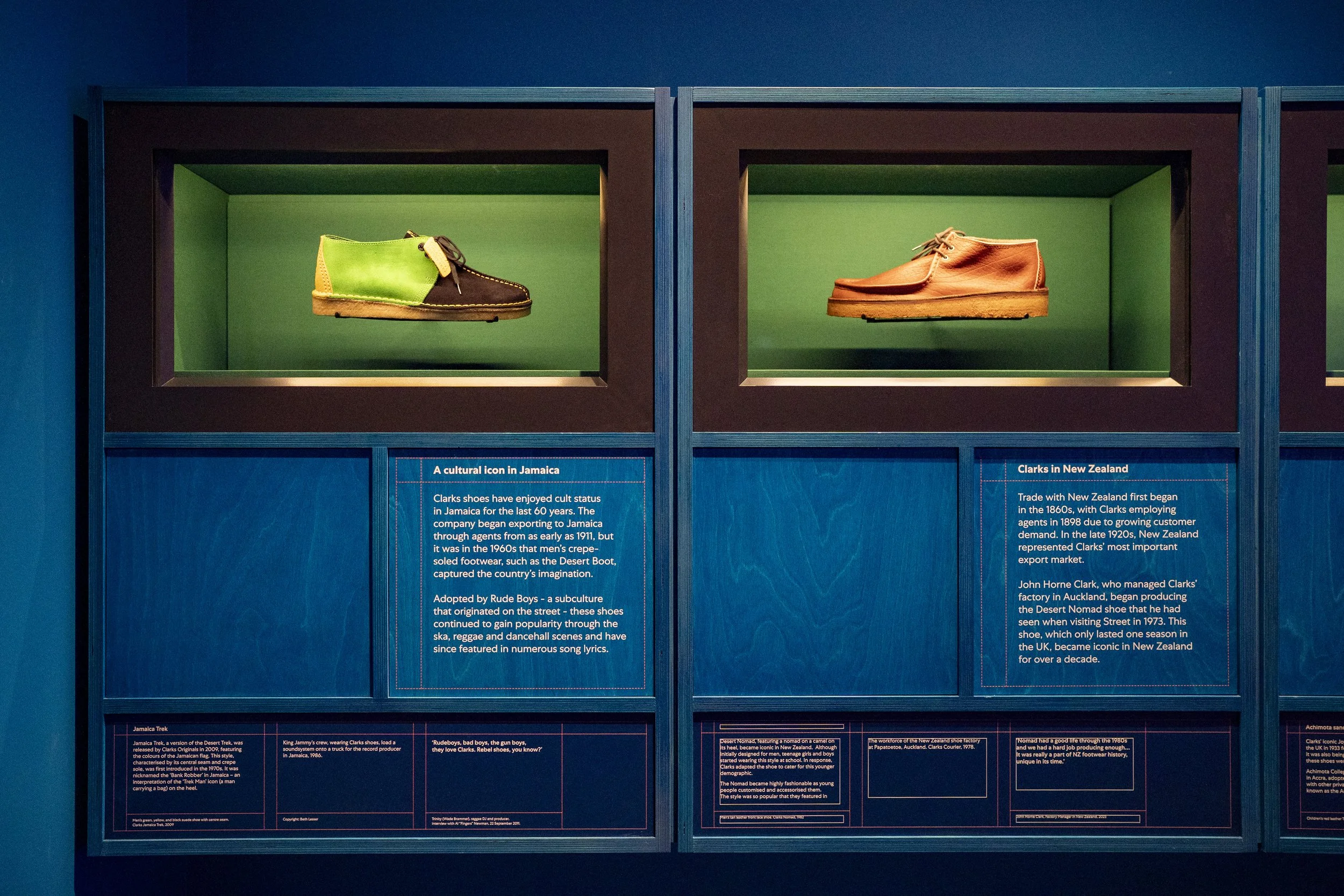
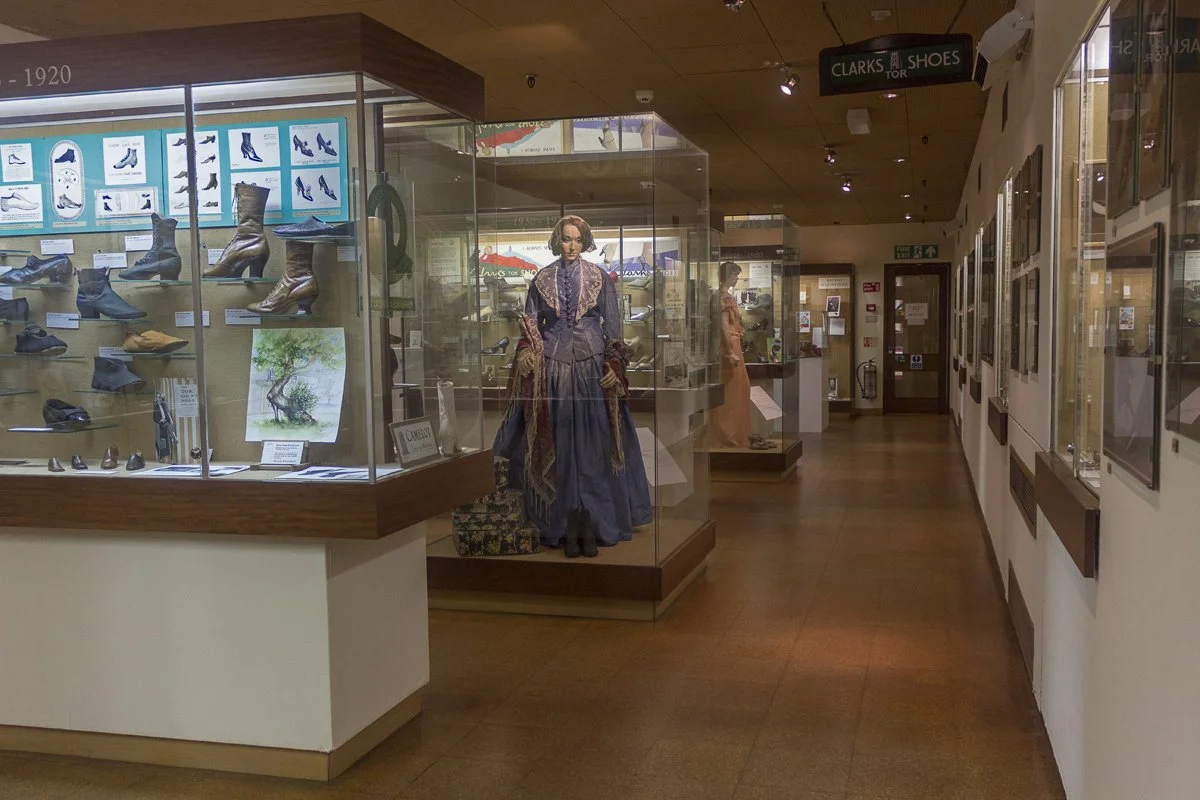
Tim [01:19:25] Where can they find us? Well they can find us online. So we're shoemakersmuseum.org.uk. I think we're across pretty much all social media platforms — we can be found in all the usual places in that respect. We're obviously in Street in Somerset, right by Clarks Village. We've got ample parking should you wish to come in person. We're basically four galleries and we document the history of shoemaking, of Street, and of the family, and of selling and buying of footwear and of Clarks. And the museum's effectively been opened to celebrate the 200th anniversary of the company of Clarks. But yeah, there are a lot of shoes on display — we've got our first shoes, we've got school shoes, we've got shoes that have been worn by your nearest and dearest. I mean, I came across a shoe the other day — a K-Rapide — that took me back to a conservatory on a warm day in Melton-Mowbray, a striped deck chair and my gran. You know it was one of those leisure shoes worn by mature ladies that used to take me down to the badminton club. But you know, your shoes just have resonance, don't they?
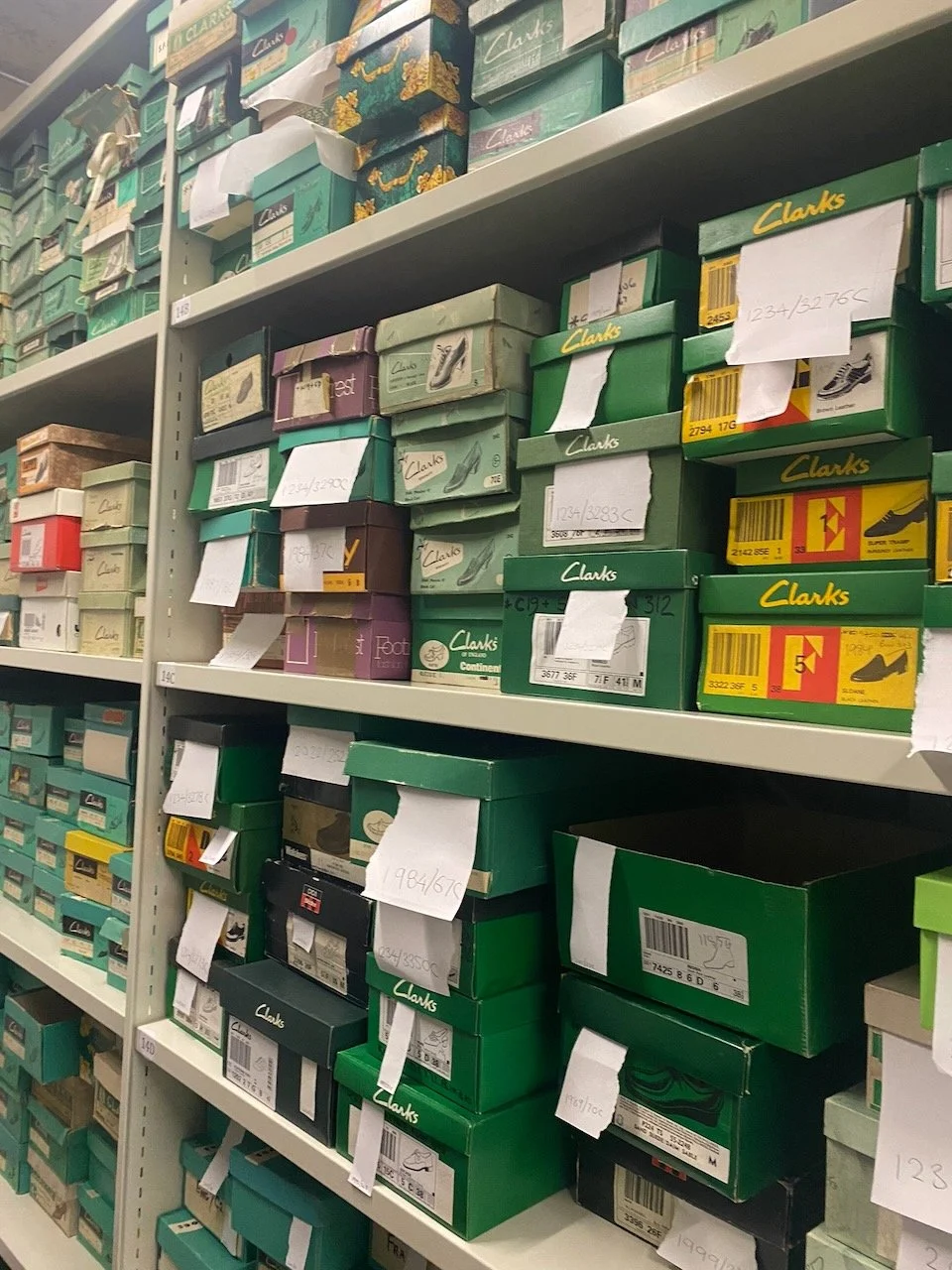
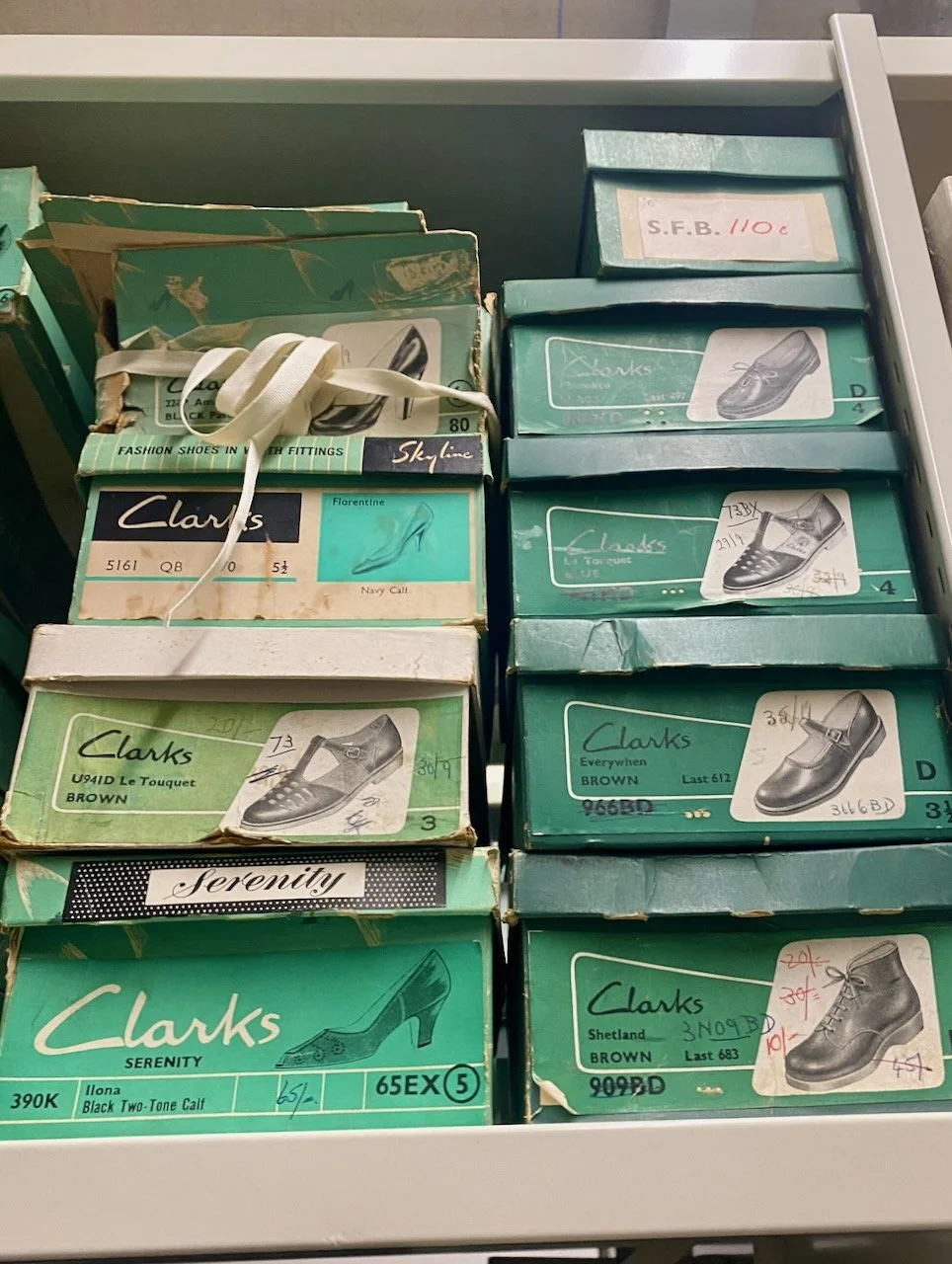
Alex [01:20:42] well, I remember walking down a row of boxes with you at the archive and seeing the Clarks Magic Steps box, which I always aspired to own as a child in the 1980s at primary school, would it have been the late 1980s? But I was never allowed to have.
Tim [01:21:11] Yeah, the Magic Glade, the Princess. Now they're on display and you'll be reassured to know that you weren't the only person that was denied a pair of those shoes. We have countless people that come in and say, do you have the Magic Steps shoe? And you're able to show them that almost almond-shaped shoe that was quite sort of delicate wasn’t it. But when you look at it now, it was just a plastic plug in a heel — and it was the marketing that kind of gave it the magic.
Alex [01:21:37] Yeah, that was quite a new thing at the time, wasn’t it. I don't think a lot of brands had really caught on to that idea of the storytelling and the marketing campaign that went alongside that. Which, you know, we see so much of it now, don't we? So thank you so much Tim for your time.
Tim [01:21:53] No, you're welcome. You know, we'd do anything for you. You know, these sorts of institutions have favourites; there are people that you'll do stuff for, you know.
Alex [01:22:06] We hope you've enjoyed this episode of the Social Lives of Shoes from the Footwear Research Network. Please go to our website for the show notes, including a full transcript, links and images. You can follow us on LinkedIn and Instagram. That's footwearresearchnetwork.org.