These shoes were made for talkin’: footwear in performance costume
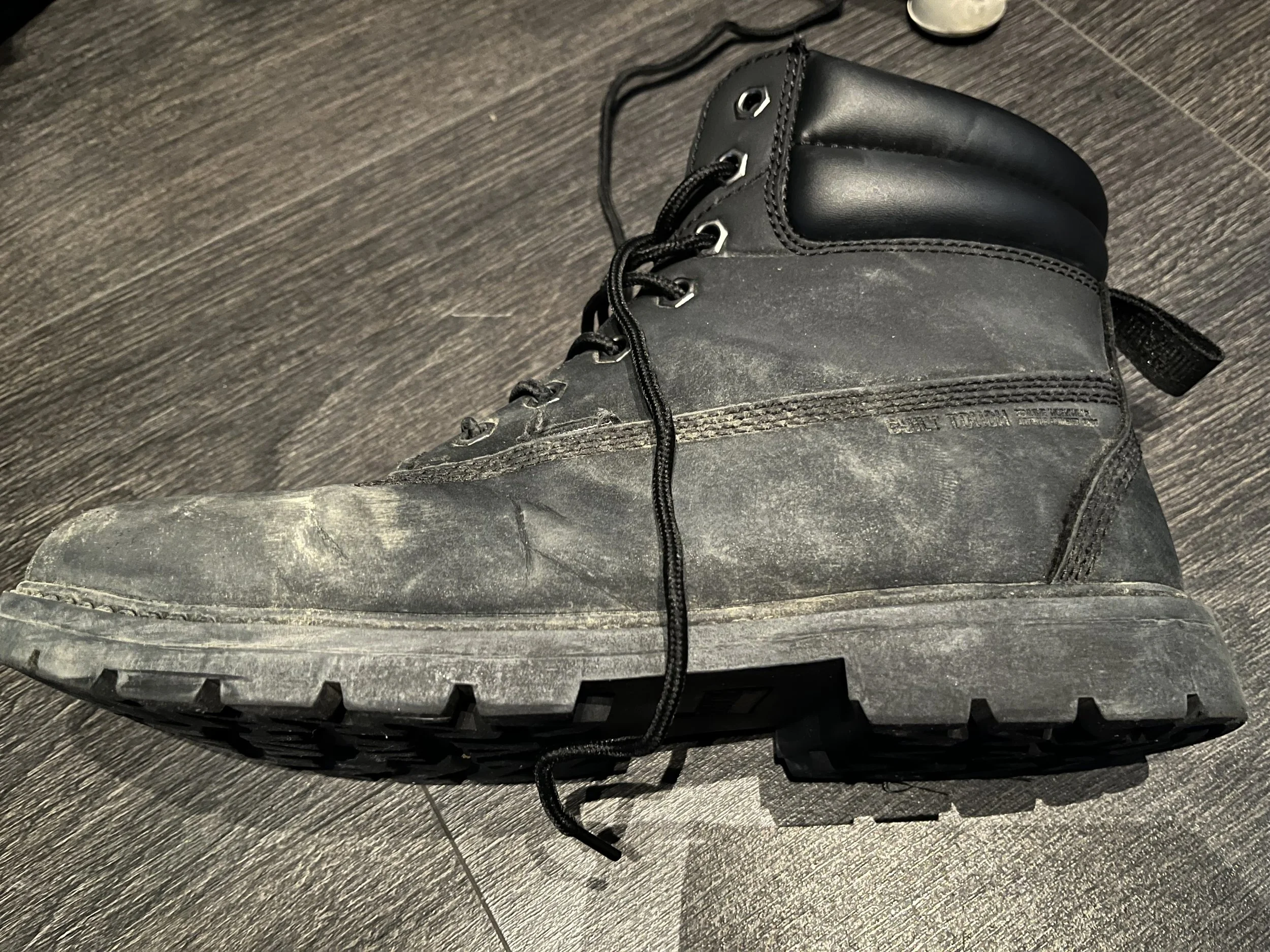
Boot, customised for the 2026 production of Equus, dir. BROCKMAN at KXT on Broadway. Photo: Emily Brayshaw
Our podcast, The Social Lives of Shoes, asks ‘What if shoes could speak?’, but shoes in performance costumes tell an additional story to their own: the story of the character who wears them. In this post, Dr Emily Brayshaw muses on some boots she customised for a recent theatrical production and how footwear in performance costume tells multiple stories simultaneously.
The play
In August 2026, I designed the costumes for a Sydney-based production of the 1973 Peter Schaffer play, Equus, directed by BROCKMAN for Daniel Cottier Productions. Equus tells the story of Alan Strang (Ryan Yeates), a 17-year-old psychopath who blinds six horses with a hoof pick. Alan is institutionalised after the gruesome event, and the play is largely an exchange between Alan and his psychiatrist, Martin Dysart (Jay James Moody), who analyses Alan’s childhood and psyche, revealing the events that led up to the blinding.
Within Equus, the audience comes to know the people who have shaped Alan’s life, including his father Frank and mother Dora, and a mysterious ‘horseman’ who takes six-year-old Alan riding at the beach, much to his father’s chagrin.
Frank (Gus Murray) is working-class, a socialist and an atheist, who works as a printer. He is the antithesis of Dora (Sophie Gregg), an upper-middle-class primary school teacher and devout Christian. Their conflicting views on religion and class are central to the reasons for Alan’s twisted sexual equine obsession and worship.
Costuming Frank
Costume design requires research into the historical, social, cultural, economic, and material aspects of what a character might wear. Each item of clothing must then be made or customised to tell the story of the character’s life and their actions in each scene. Frank’s costume, created in the production’s largely greyscale colour palette, comprised a dark grey flat cap; a dirty, light grey singlet; faded black jeans; a grey flannel shirt; a black bomber jacket; and black socks. These fabrics and garments have a long history of being associated with working-class masculinity both on and off the stage. Frank’s costume included a pair of worn, black work boots, which also signalled his status as a tradesman.
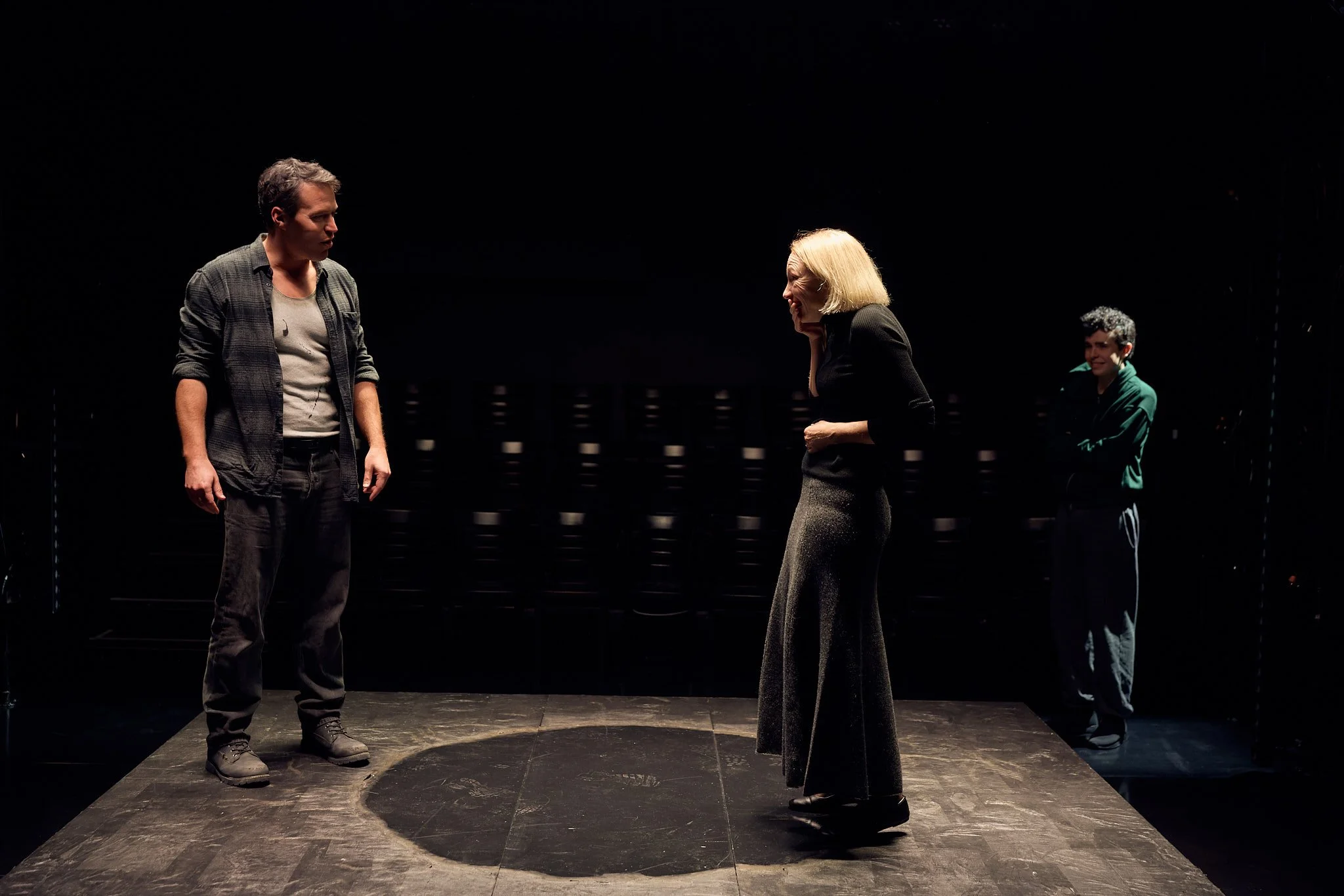
Frank Strang (Gus Murray), pictured with Dora (Sophie Gregg) and their son Alan (Ryan Yeates). Photo: Equus, BROCKMAN (dir.) at KXT on Broadway (2026). Photo credit: Daniel Boud.
The boots
Footwear is a crucial to costume because it allows the character “to be distinctive” in the context of the production (Stutesman 2021, 28). This is because footwear gives ‘hints about a person’s character, social and cultural place, even sexual preference’ (Bilger in Riello and McNeil 2011, 3). Beyond understanding the meanings footwear communicates, a costume designer must also consider how footwear and its meanings can be adapted to tell the character’s story.
Aoife Monks (2011) notes that costume allows actors to shape theatrical identities and form bodies, making it central to both an actor’s and spectator’s experience at the theatre, and this includes footwear. Murray himself also believes footwear is ‘such a helpful detail into character’; it is central to how an actor embodies a role. Murray was also passionate that Frank’s boots looked lived in, telling me that one of the first things he looks at is a character’s shoes. If footwear looks too new, Murray told me, it breaks the illusion of the world created on the stage, unless the production specifically calls for a character to have new shoes.
I bought Frank’s boots new so Murray would have boots that fit, because this, along with different types of footwear, greatly affects how an actor moves, how a body is formed on stage, and how the audience receives it. But I agreed with Murray: a tradesman’s boots, which are worn almost daily, rarely look new. I had to break them down to look lived in.
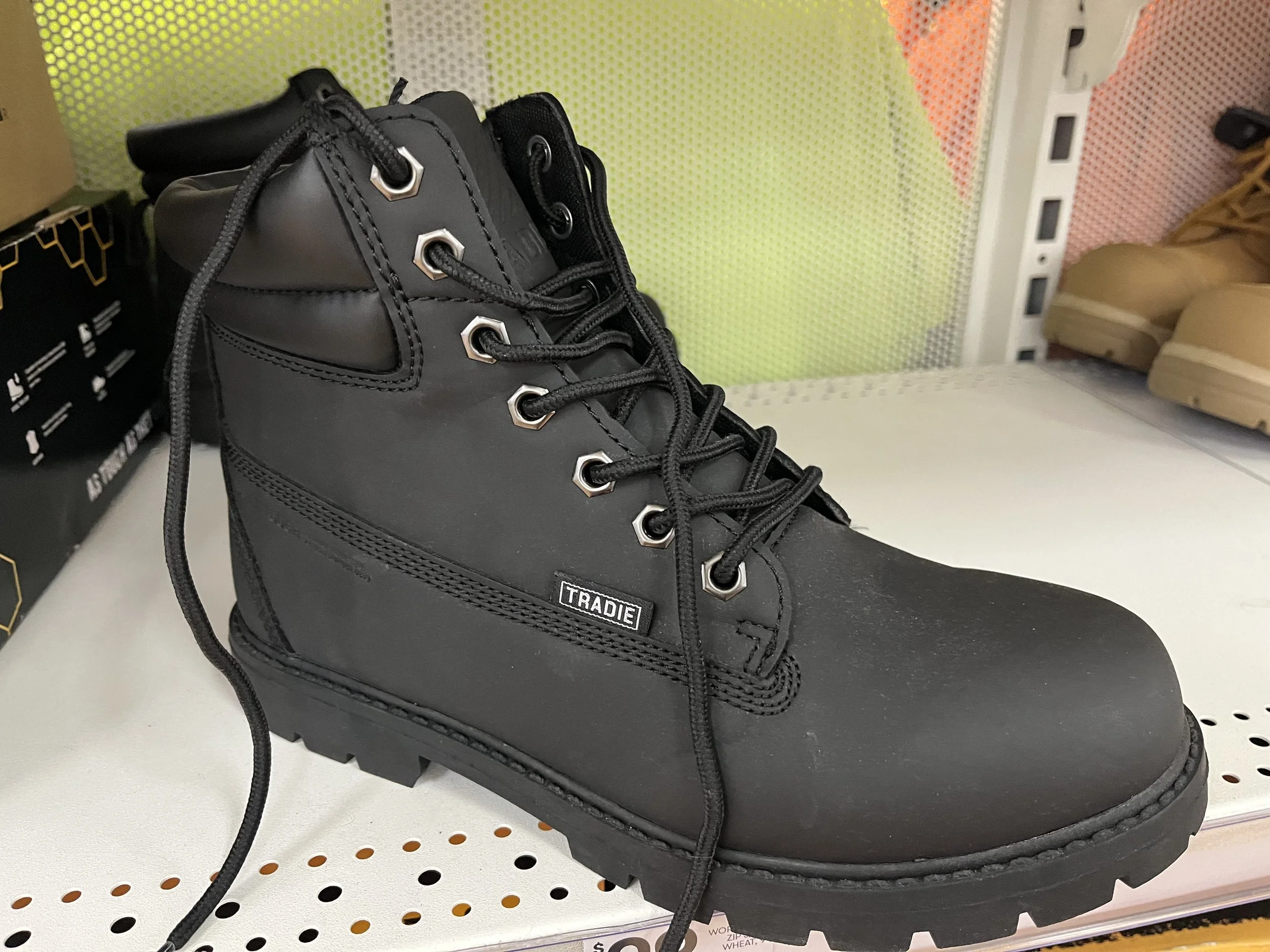
New ‘Tradie’ brand boots on the shelf at Big W. Photo: Emily Brayshaw
Breaking down
Breaking down the boots to make them look well-worn was trickier than expected. The first steps to breaking down footwear is to use sandpaper or a cheese grater to scuff the surface and to remove any identifiable brand tags if not required. This roughens the boots’ surface, but Tradie boots are much tougher than I had anticipated, so I had to use a potato peeler for this step and to “scuff” the toes and wear the boots down at the heel.
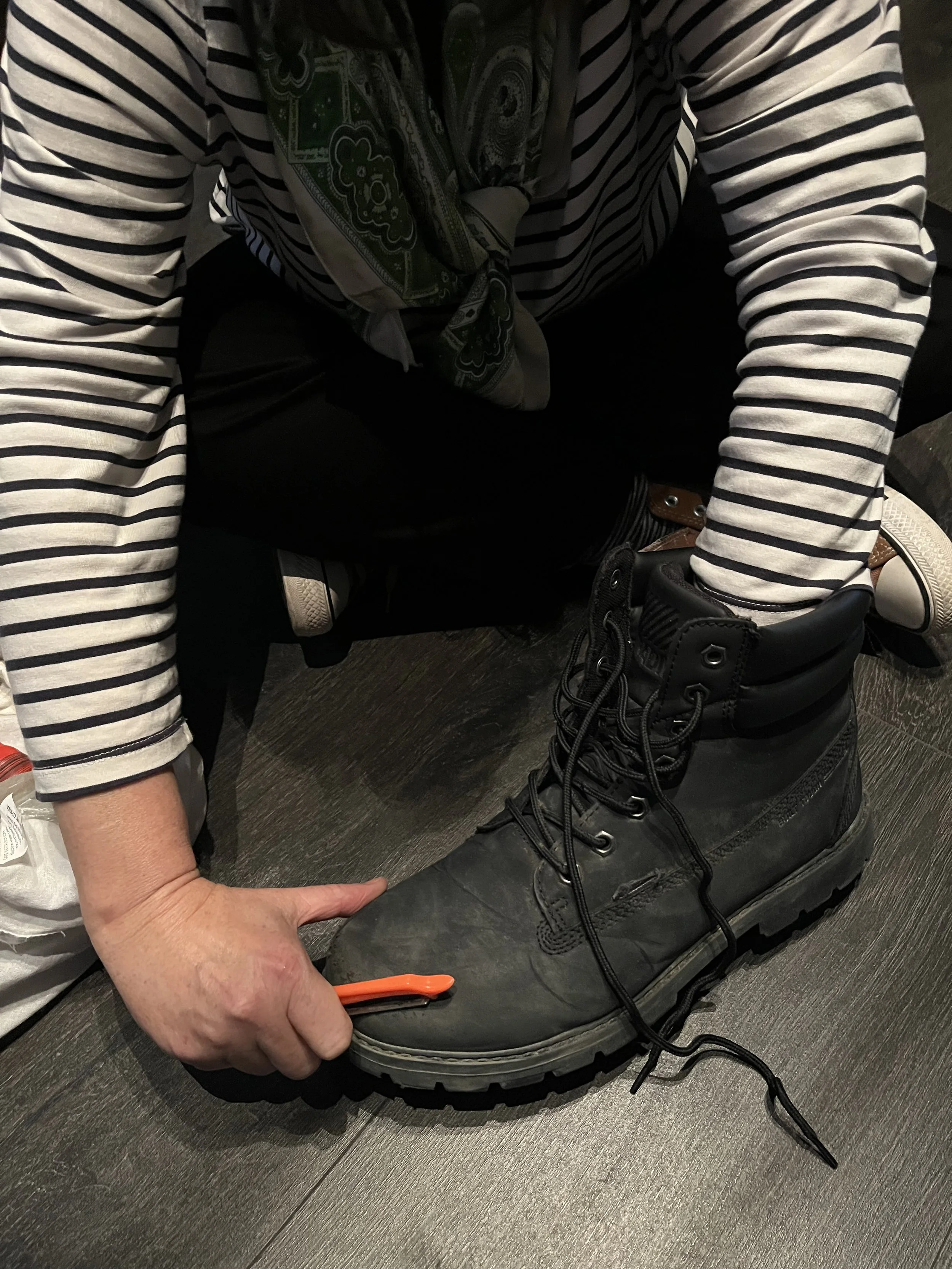
I’ve cut the brand tag off the boot and am using a potato peeler to scuff the toes. Photo: Emily Brayshaw.
The next steps were to lightly spray the boots with cooking oil and rub it in to make them greasy, and then to apply a cosmetic powder that resembles dirt. The dirt was then rubbed into the greasy surface, making it stick to the boot so it looks dusty and old.
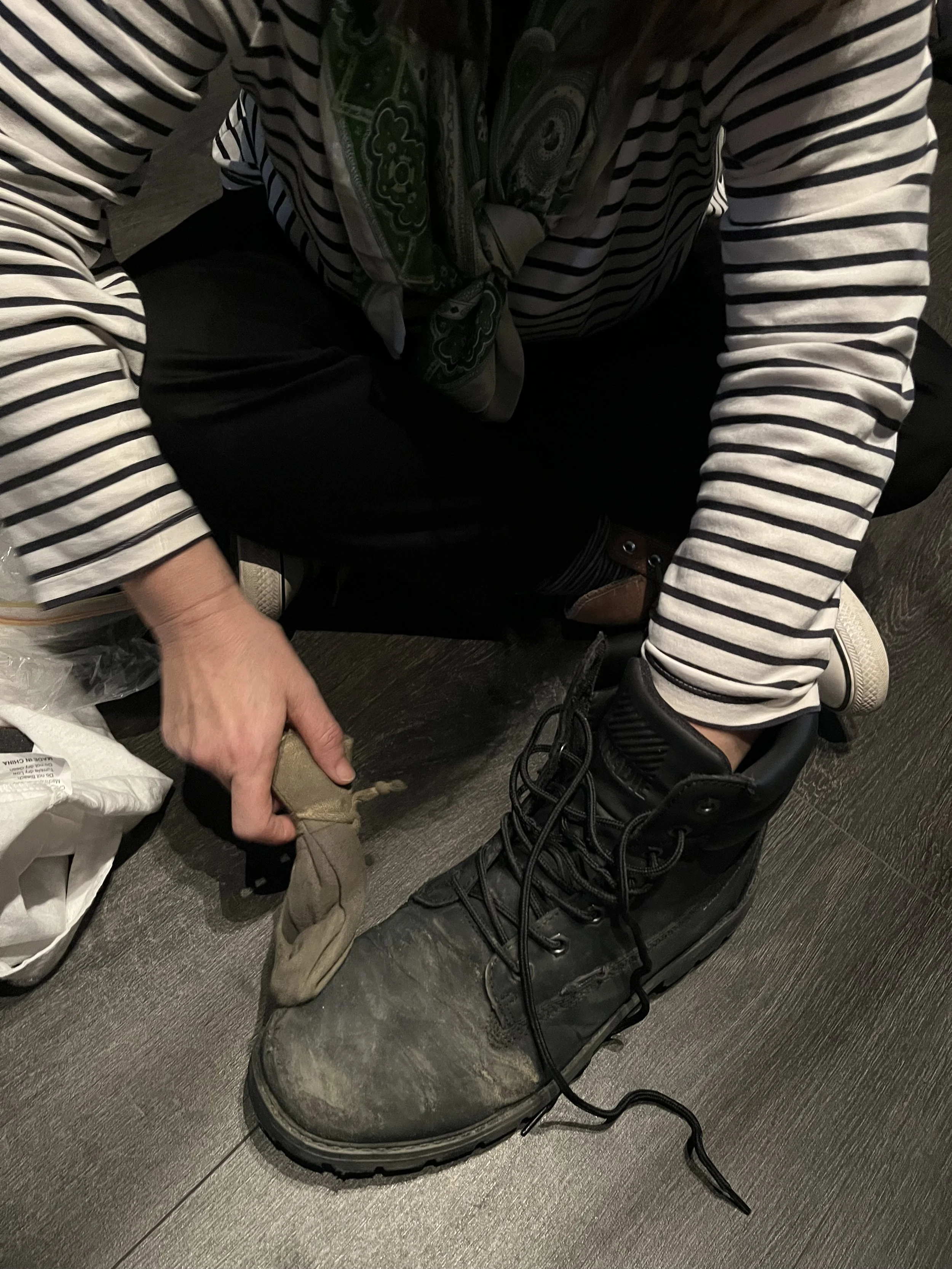
Dusting the scuffed, greasy boot with cosmetic dirt. Photo: Emily Brayshaw.
The boots did not have to look perfectly broken down at the top, as Frank’s jeans would cover them there. The laces didn't have to be broken down in this instance, though they might be in other productions. With that in mind, the boots were ready to help Murray become Frank. And Murray really loved them.
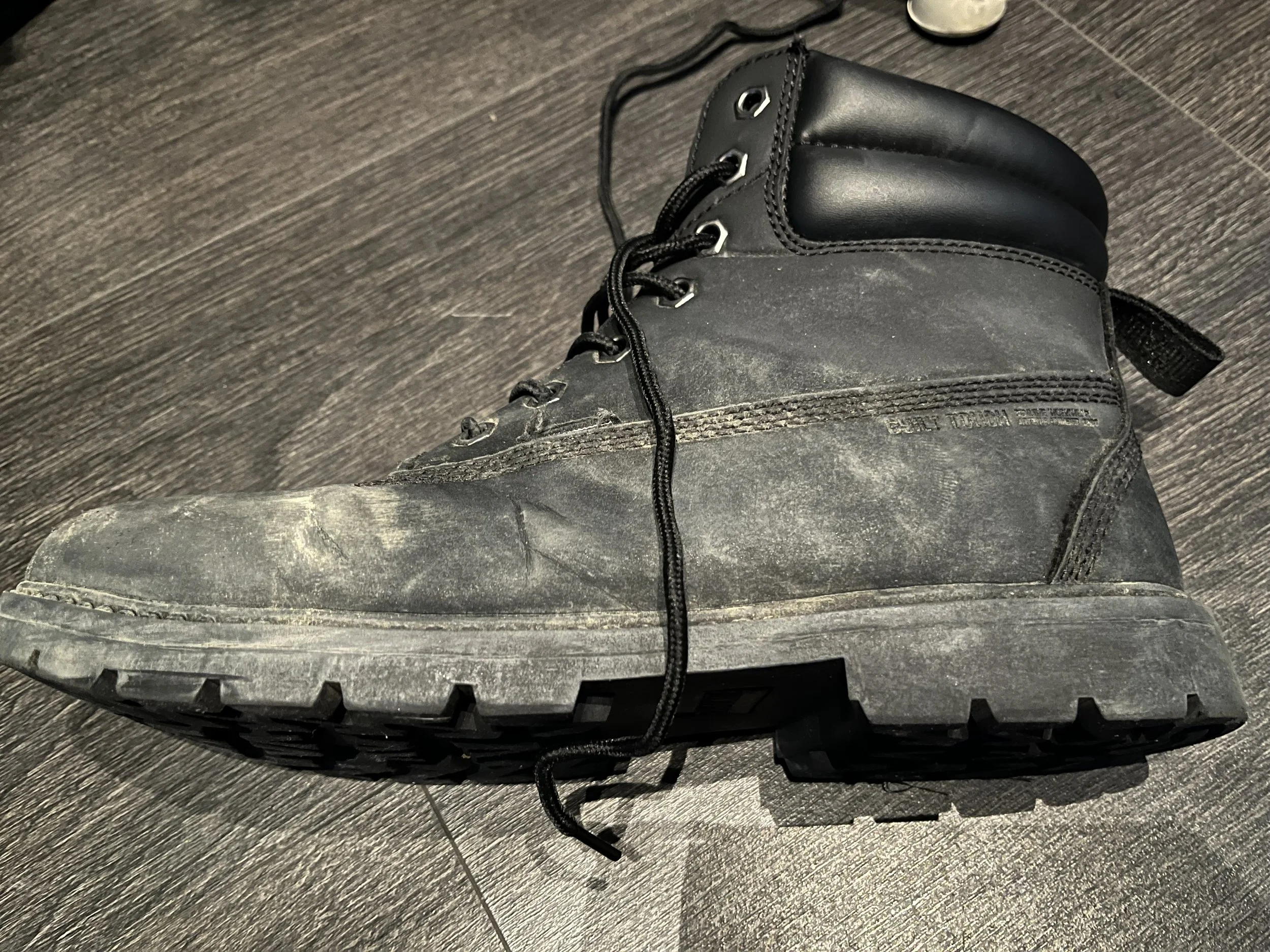
Et voila! Boot customised for the 2026 production of Equus, dir. BROCKMAN at KXT on Broadway. Photo: Emily Brayshaw
So, this is not a shoe — it’s a costume
Clearly, the boots came with their their own story: from design to their manufacture offshore, being shipped to Australia and stocked in a large retail chain. But when I bought them, an unintended story in the life of these boots began. When Murray walked on stage as Frank, the boots, like Murray, had been transformed to support the narrative and to inhabit the world of the play. Scuffs on the toes told stories of the times the boots protected Frank when he stubbed his toes. The worn heels told stories of a boot Frank has worn over time. The dust told stories of Frank’s work environment and the muddy English countryside he travels through to get to and from work.
Thinking about the importance of footwear to actors in telling characters’ stories can help us to think about how we wear and value our own shoes. After all,
All the world’s a stage,
And all the men and women merely players;
They have their exits and their entrances;
And one man in his time plays many parts… (Shakespeare, As You Like It).
What are your favourite shoes, either on stage or screen? Let us know in the comments.
Additional credits
The cast of this production also featured:
Hesther: Linda Nicholls-Gidley; Jill: Cloud Fernandez-Montoya; Dalton/Horseman/Nurse: Stephen Madsen; and Nugget the Horse: Shalamah Tautaiolefue.
Crew
Set and lighting design BROCKMAN; Composition & Sound Design Miles Mclaughlin; Movement Jeremy Lloyd; and Intimacy Director Hayden Tonazzi.
Additional links
Miles Lambert (2021). Check Shirts, Flannel Jackets, Canvas Trousers: The Trade in Slops from Eighteenth-Century Liverpool, Textile History, 52:1-2, 78-100, DOI: 10.1080/00404969.2021.1938794
Aoife Monks (2009). The Actor in Costume. Bloomsbury Publishing https://www.bloomsbury.com/au/actor-in-costume-9780230216990/
Giorgio Riello & Peter McNeil (2006). Shoes: a history from sandals to sneakers (English ed.). Berg. https://www.abebooks.com/9780857850386/Shoes-History-Sandals-Sneakers-Riello-0857850385/plp
Peter Shaffer (2011). Equus. Scribner. https://www.google.com.au/books/edition/Equus/5xit9YQw8hkC?hl=en&gbpv=0
William Shakespeare, All the World’s a Stage, https://www.poetryfoundation.org/poems/56966/speech-all-the-worlds-a-stage
Drake Stutesman, ‘Cooking: Studying Film Costume Design’, in: Sofia Pantouvaki/Peter McNeil (eds.), Performance Costume: New Perspectives and Methods, 2021, 28.
Daniel Miller & Sophie Woodward (2011). Global denim (English ed.). Berg. https://www.bloomsbury.com/au/global-denim-9781847886323/